

Originally published on Progress and Poverty on April 15, 2026. Republished on Progress.org with permission.
Big news today: it’s been many years since a land value tax enabling bill has passed in a state legislature, until this past week, where it’s just happened twice; once in Virginia last week and once in Kentucky yesterday.
We also have a proposed Land Value Return policy in Andalusia, Spain, a win in Cook County, Illinois (that’s where Chicago is), the winners of our fellowship, and more, all in today’s Landscape.

Expanding LVT Enabling Legislation in Virginia
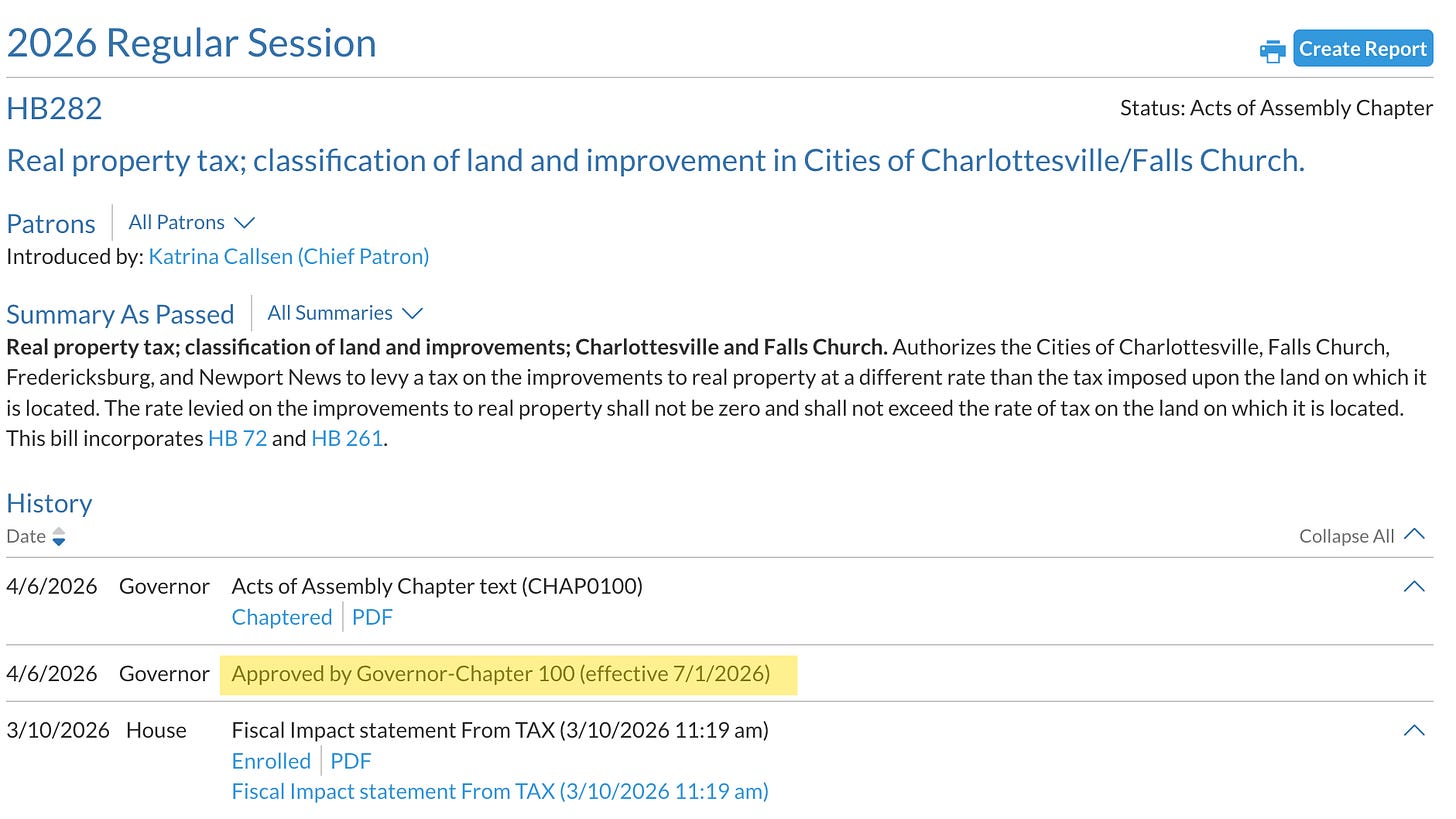
On April 6th, Virginia Governor Abigail Spanberger signed HB 282 into law. The bill passed both chambers with overwhelming majorities, authorizing the cities of Charlottesville, Falls Church, Fredericksburg, and Newport News to voluntarily adopt a split-rate land value tax.
As we covered last month, Virginia has been on a slow march toward LVT for decades, adding cities to the authorized list one bill at a time. HB 282 adds four more, and the unanimous vote signals this is no longer a fringe idea in Richmond.
Now the question is implementation. In Charlottesville, there are local advocates and council members interested in acting on this new authority. In Falls Church, Councilmember Justine Underhill was making the case publicly before the ink was dry, arguing that soaring Northern Virginia land values need to translate into affordable housing, not just windfalls for landowners. Fredericksburg and Newport News each face their own version of the same challenge.
Kentucky: From interest to law in half a year
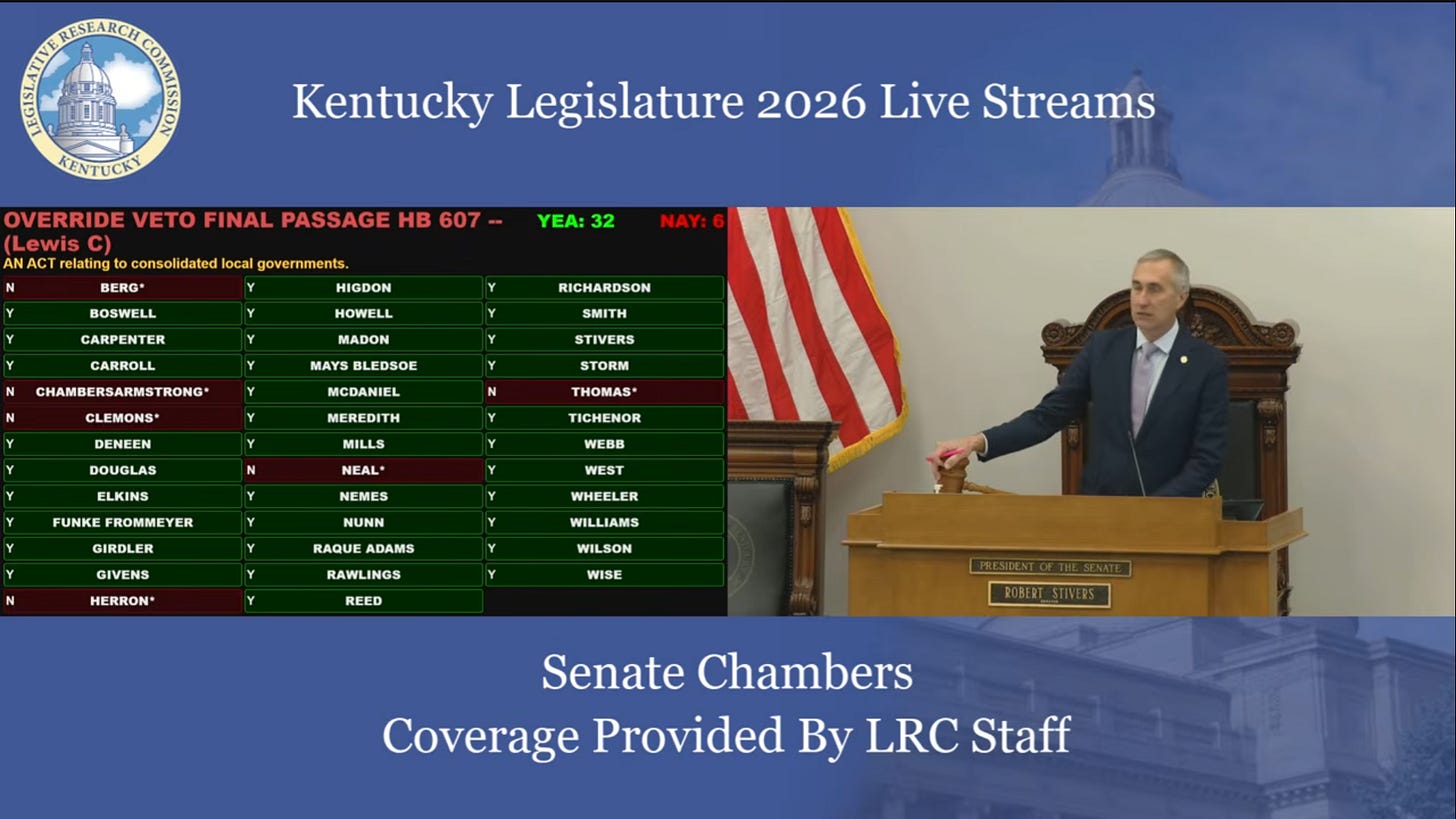
Kentucky’s HB 607 passed the state legislature in late March. The bill, which covers a much broader set of provisions related to local government of Republican priorities, contains a provision enabling metro governments to implement split-rate taxes in their urban service districts. Beshear vetoed the bill on April 13th, but the GOP supermajority overrode that veto on the 14th, and the measure has now become law.
When the bill first passed the House on its way to the Senate, Rolberto Roldan, a reporter at Louisville Public Media, caught hold of the idea. In his article, he spoke to local and national advocates (including myself), and one quote from a local Democrat councilwoman stuck out:
“We’ve gotten to a little bit of a breaking point where the people that live in the suburban areas of the city are saying, ‘We don’t want any more development. We’d like to see more development go downtown,’” Owen said. “So, I think this is one way to do that.”
We’ve previously highlighted folks who have spent decades building coalitions to successfully get land value taxes implemented, such as Josh Vincent in Pennsylvania and Dr. Dirk Löhr in Germany. Now, the next generation of LVT advocates is coming into its own.
Today we offer the story of Jackson Arnold, a local resident of Louisville, who deserves much of the credit for this recent local legislative win.
Jackson discovered LVT around 3 years ago, but was disheartened to learn that local implementation was blocked in most places. He later became, in his own words, “abundance-pilled” and joined an Abundance-focused national network which connected him to other members, including Louisville councilman Ben Reno-Weber.
He also found us, joined our OpenAVMKit Discord and started poking around avenues to implement and model land value taxes in Louisville. He faced two chief challenges:
- Non public property assessment data
He gained access to the data through conversations with the city council who helped facilitate access. - Local LVT not permitted
He found a legal mechanism to enable it for Louisville and found interest among state representatives.
Later, Jackson spoke to state Republicans (Kentucky is a red state) and found a larger bill related to reforming the powers of local metro governments that could serve as a vehicle for LVT enablement.
The LVT provision became part of the bill which had pre-existing momentum to make it all the way through both houses of the state legislature with a large enough majority to overturn the governor’s veto. Now, LVT is enabled for Louisville’s Urban Service District.
Andalusia, Spain
In Andalusia, Spain, the Andalucistas coalition (led by Andalucía Por Sí) is running on a platform that includes what is effectively a land value tax, though they’ve branded it “FRUSA” to work within the constraints of Spanish national tax law, which reserves property tax authority to the national parliament. A Sectoral Coordinator for Discourse and Strategy for the party, Pablo Soria-Rojas, has been developing a housing policy funded by the FRUSA alongside a proposed tourist tax, positioning the package as a practical response to Andalusia’s housing crisis.
The connection runs deep historically: Blas Infante, the father of Andalusian nationalism who was killed during the Spanish Civil War, was heavily influenced by Henry George, and Progress and Poverty held pride of place among his personal library. With Andalusian regional elections now officially called for May 17 (moved up due to a corruption scandal), the Andalucistas are in active campaign mode, and Pablo recently published an opinion piece in a local Almería newspaper advocating for land-value-based housing policy.
We are excited to see these developments in Andalusia and hope to see more from other European countries in the future!
A Win in Cook County
Drake Warren, who appeared on our LVT Landscape Live event late last year, successfully won his seat for Cook County Commissioner of the tenth district. Illinois has been flirting with land value tax for the Chicago region, and this win helps build momentum to turn the interest into reality. (As an aside, the Cook County assessor’s office has been a leader in open source initiatives, and their repository was the direct inspiration for our own OpenAVMKit).
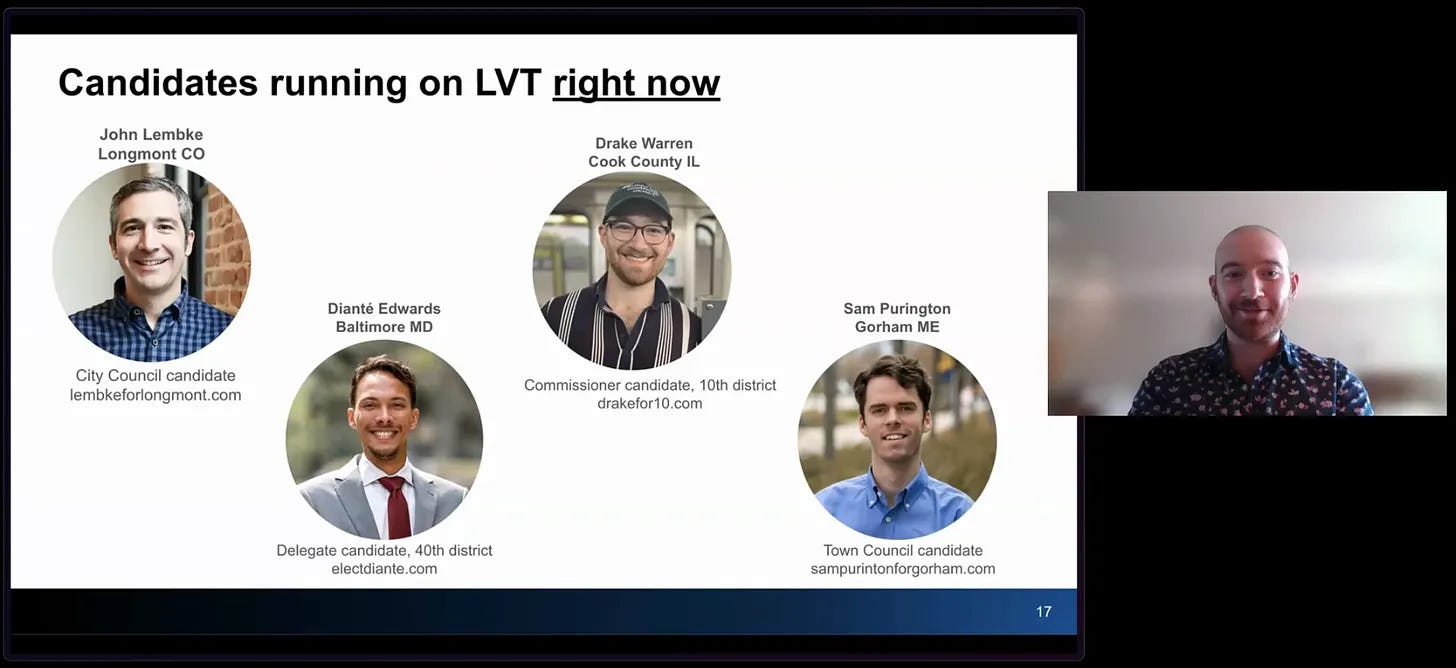
This year, there are other candidates across the country running for elected office with a platform that includes support for land value taxes. We plan to highlight those folks as campaign season progresses. Know any, or are you running for office yourself? Shoot me an email: [email protected].
Updates from the Center for Land Economics
Join Us at StrongTowns National Gathering
Lars and I will be at StrongTowns National Gathering, and we will be hosting a get together on Monday, May 18th at 5PM—right after registration and before the 7PM StrongTowns reception.
There will also be a LVT panel at StrongTowns sponsored by the Center for the Study of Economics featuring Lars Doucet, Josh Vincent, and Joe Minicozzi.
We will be joined by our friends at the Progress and Poverty Institute. If you are around and curious about land value taxation and getting it implemented, or just looking for a good conversation to start the weekend, join us!
RSVP HERE —> https://luma.com/piu2mmj9
Announcing the Land Economics Fellows
When we opened applications for the inaugural CLE Land Economics Fellowship, we were testing the hypothesis that there is a lot of untapped potential for high-impact research on land value return policies. After reviewing the applications, we were surprised by both the number and quality of applicants. Selecting just a handful was no easy task–a validation that our hunch was right.
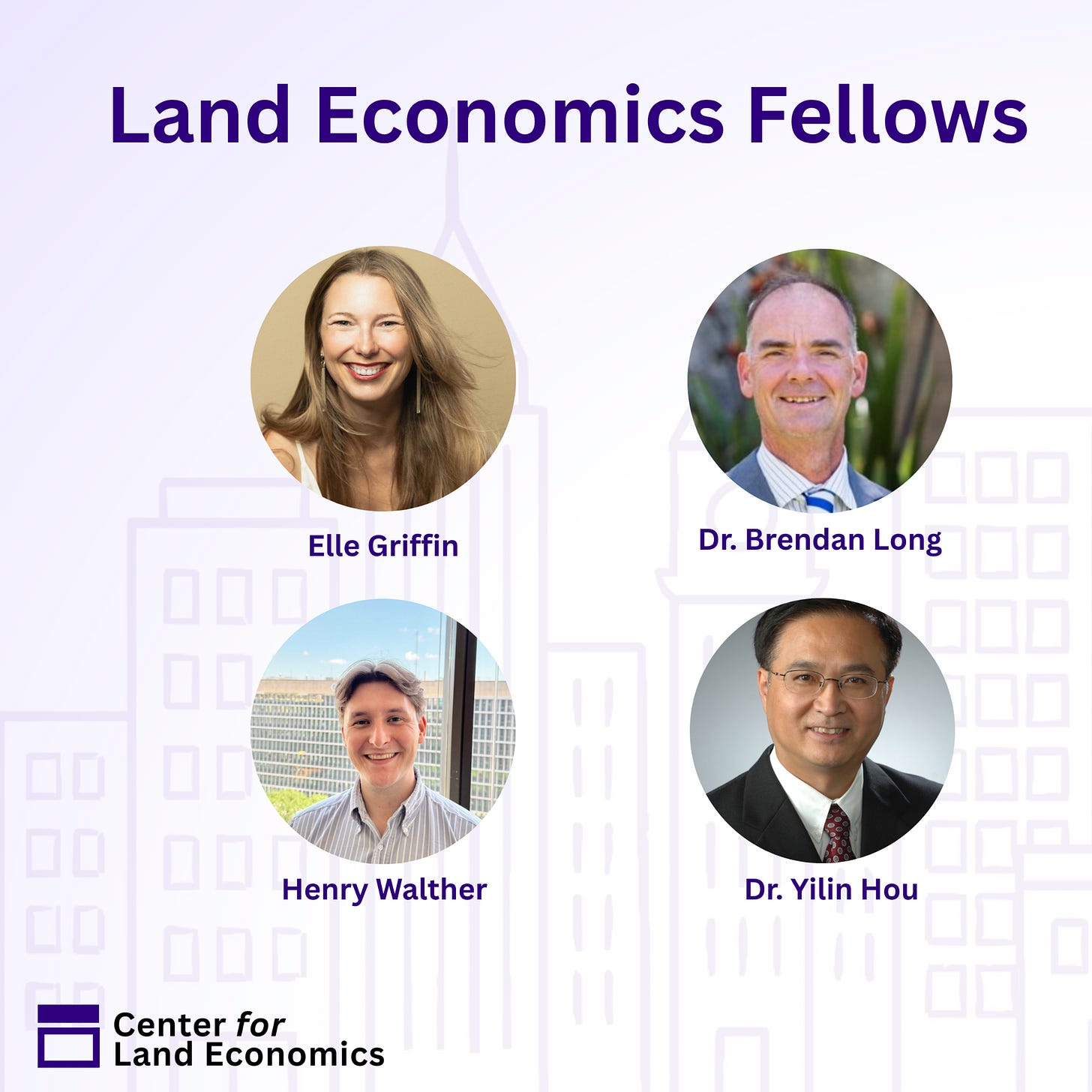
We are thrilled to introduce our four fellows for this year. Each will produce original research investigating the role of land in our economy from a differing perspective.
Elle Griffin is the writer and publisher behind The Elysian and the author of the pamphlet Let Cities Build Utopia. Her fellowship work will examine best practices and cautionary lessons from new cities, community land trusts, and city-owned land initiatives, exploring how communities can successfully consolidate land ownership for the public good.
Dr. Brendan Long is a researcher at the University of Notre Dame Australia. His fellowship will focus on the Australian Capital Territory’s landmark implementation of land value taxation, one of the most significant real-world experiments in LVT policy, which has yet to be properly studied.
Dr. Yilin Hou is a professor at Syracuse University whose research has included building a comprehensive land valuation database for China. His fellowship will draw on that work to analyze land value data across China, offering what promises to be a rare empirical window into land economics at a national scale.
Henry Walther is a master’s candidate at MIT in City Planning and Real Estate Development, and a Housing Fellow at the Center for Public Enterprise. He previously served as Director of Policy and Data in the New Orleans Mayor’s Office. His fellowship research will examine the implicit “improvement penalty” that property taxes create, discouraging owners from protecting and upgrading buildings against disaster, as well as investigating what a shift to land value taxation could mean for New Orleans.
We are excited to see what this group produces this year, and we plan to run the fellowship again in 2027. If you’re interested in applying in the future, stay tuned.
More LVT Coverage
- Josie Faass, Executive Director of the Progress and Poverty Institute, has a fantastic Shelterforce piece arguing that property taxes aren’t the cause of our housing crisis but a solution to it. The piece includes quotes from many folks involved with LVT advocacy across the country, including me.
- Reed Schwartz, a former Niskanen Center intern and current Institute for Progress researcher, as well as a previous contributor to the Substack, did a deep dive published by Niskanen Center into Kauai’s experience with a split-rate tax system, and covering the modern need for land value tax.
- Speaking of think tanks and established support for LVT, Joe Gyourko, a renowned housing economist, makes the case that we should be taxing land much more than buildings in his Brookings Institution 35-page primer on addressing the housing shortage.
- Over in the UK, The UK Collaborative Centre for Housing Evidence published a large 139-page report titled “Who Should Own the Value of the Land?“ which seems quite holistic in its exploration of land value capture. My only regret is that I have not yet had the time to sit down and fully read it.
- Whitney McKnight, founder and publisher of The Edge in Berea, Kentucky, is interested in expanding LVT to other areas of Kentucky beyond just the metro councils. She published a piece which features an interview with me on the potential for land value tax shifts in Kentucky.
- TAPinto Princeton investigates land value tax in Princeton, NJ citing Progress and Poverty Institute’s study of a LVTShift in the city.
- Twin Cities covers land value tax as a method for St Paul, MN to encourage development. Minnesota currently has legislation being considered which would enable land value tax–which we have covered in past LVT Landscape articles on this Substack.
- A commentary piece in Cambodia made the case for using a land value tax to fund a guaranteed income in Cambodia.
- Rod Lockwood, a veteran Michigan real estate developer and Chairman of Lockwood Companies, makes the case for Belle Isle in Detroit to become a Special Opportunity Zone with a full land value tax implemented in order to spur economic growth in the region in a podcast conversation with the Mackinac Center. This proposal is as interesting as it is ambitious.
- Russell Richie, who recently became Director of Strategy and Impact at the Progress and Poverty Institute, wrote a commentary piece in Broad & Liberty pushing for land value tax in Philadelphia.
Greg Miller is the Co-Founder and Executive Director of the Center for Land Economics.