
Originally published on Progress and Poverty on April 23, 2026. Republished on Progress.org with permission.
If you are a Universal Basic Income (UBI) or Land Value Tax (LVT) advocate, you need to be paying more attention to South Korea because that country may just be the biggest opportunity in the whole world for your movement.
For UBI or LVT to succeed anywhere, they must first succeed somewhere.
Politicians are skittish, but they are also sheep—they never want to be the first to try something, but the second something new and trendy seems to already be succeeding, they all get jealous and want to copy it. Therefore, if you want UBI or LVT to succeed, you should scour the world for a place where these two policies are the most:
- Economically feasible
- Technically feasible
- Politically possible
- Socially and politically urgent
That place is South Korea.
South Korea is a Big Deal
South Korea has several features that make it uniquely suited to an aggressive and large-scale UBI pilot funded by LVT, and the political timing has never been better—or more urgent. This blog post is the result of ongoing interviews with various Korean activists—chief among them Vitnarae Kang and Jinsu Lee—working to bring those policies to life in their country; my mission is to spread their message to potential supporters internationally. Jinsu in particular works for the Land & Liberty Institute1. Quotes are by Jinsu unless otherwise indicated, for which Vitnarae provided the English translations. Jinsu’s interview did not originally include links, I added some citations for the convenience of readers, but otherwise did not alter the text except to arrange sections for editorial flow.
Let’s go down the list of why South Korea matters so much right now.
Economically feasible:
Incredibly high Land to GDP ratio
Two of the most common objections to UBI are “how will you ever pay for it?” and “won’t the UBI just lead to inflation when landlords jack up the rents?” Both objections are solved in one stroke with a simple retort: pay for the UBI with a Land Value Tax (LVT).
For this to work, however, there must be sufficiently high land values available that aren’t already being tapped. This is indeed the case in South Korea. South Korea’s land value to GDP ratio is in excess of 500%.
That is an astoundingly high figure, the highest in the OECD. To put that number in perspective, my own research puts the United States’ total land value to GDP ratio in the ballpark of a mere 200%. If you were at all excited by the figures I produced in my article series and book, then you should be more than twice as excited about South Korea’s.
Of course, the immediate reaction to hearing about Korea’s anomalously high ratio is that it sounds too crazy to be true. This must be some kind of temporary bubble, purely artificially elevated land value driven by insane mania or speculative froth that can never actually be captured. However, it turns out that long-run (last 50+ years) land value-to-GDP ratios are ~400%, and that the current ratios aren’t even at peak levels—the all time record tops out around 600%. Plain and simple, desirable land is just that valuable in South Korea—and that scarce.
The upshot? Taxing South Korean land values could generate an enormous amount of revenue, and a modest LVT could easily raise enough for a meaningful UBI with no risk of evaporating the tax base. This would directly drive affordability in two ways: provide direct financial support to struggling Korean citizens, while taxing the speculative extraction that makes housing unaffordable in the first place.
Technically feasible:
The land is already valued
The next objection to a UBI+LVT proposal is griping about how hard it is to value land. As we covered this in our last article, How to Value Land: Korean Style!, Korea has long since solved this problem.
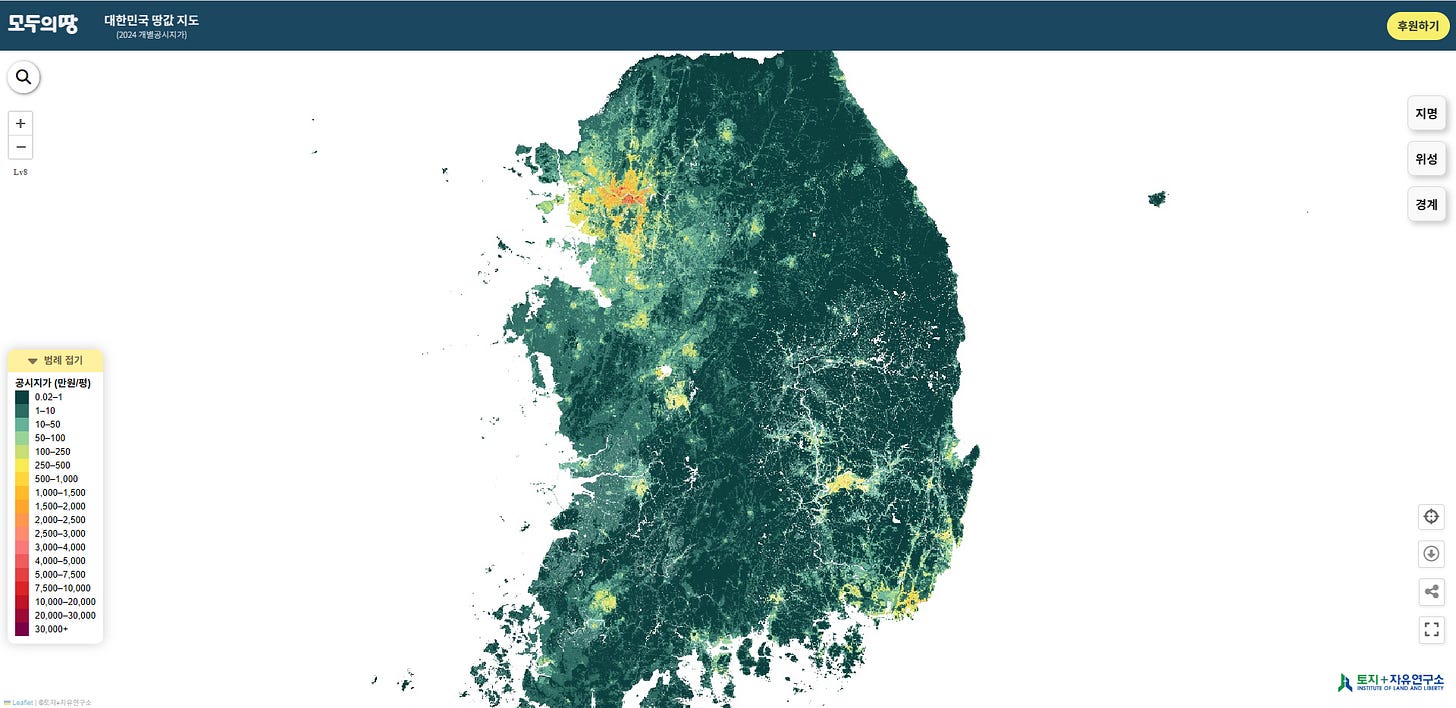
All the land in the country is regularly valued by a central agency, down to the parcel, and this public data is sufficiently easy to obtain that Jinsu Lee has put together an interactive map that shows all the national values down to the individual parcel (https://landforall.kr):
Additionally, all the legal infrastructure for a land-based property tax is already in place, because there is already a nominal property tax. Of course, the current effective tax rate for holding property is quite low (the current political status quo favors high transaction taxes instead), but the existence of a non-zero nominal holding tax still provides the necessary scaffolding for instituting an LVT.
Politically possible:
President Lee Jae Myung

New president Lee Jae Myung has historically been a strong supporter of both UBI and LVT, although he has moderated his stance in public in order to get elected. Sources tell me that he remains a firm true believer and is simply waiting to marshal sufficient political capital, which may already be underway as he is achieving high approval ratings. Meanwhile, the former leader of the opposition, Yoon Suk Yeol, just got jailed for life for attempting insurrection.
This is not to say that there are not political headwinds and stiff opposition to overcome in Korea. However, having a national leader who has even heard of one’s favored policies, let alone personally advocated for both of them in the past, is a far cry from what UBI and LVT advocates are used to here in the West.
Socially and politically urgent:
Housing + Affordability + Fertility crisis
South Korea is widely recognized to be facing an existential crisis, exemplified by their rock-bottom fertility rate far below 1.0, the lowest in the OECD. Youtube explainer channel Kurzgesagt famously declared “South Korea is Over“ in a particularly doomy video with no side order of nuance or irony:
All the Koreans I speak to agree the situation is bad, and that if everyone just follows the status quo, the country is basically done in 50 years. The appetite for reform is high. My Korean friends disagree with the western received wisdom in one regard: they believe their country can still be saved. Here’s Jinsu:
Citizens have self-pride and hope in the fact that they drove out a bizarre government non-violently and established a new government. For this reason, the citizens of the Republic of Korea were nominated for the Nobel Peace Prize early this year. Also, I have hope in the fact that President Lee Jae-myung is a very capable administrator while being public-oriented, although he is not a perfect person. While Korean citizens have been steeped in rent-seeking for a long time, on the other hand, they are diligent and have a strong heart for the community. I think we can become a country that is an example of democracy and other countries, not just in terms of productivity but in terms of guaranteeing fundamental rights and distribution, and I want to work toward that. I hope we become a righteous country rather than just a wealthy country.
One of the chief causes of local hardships is incredibly high cost of living burdens on young working families, which LVT + UBI directly addresses. LVT attacks land speculation and boosts housing supply to address the housing shortage, while UBI directly addresses financial hardship. Formulating the UBI as a per person bonus rather than per adult (so that there is an explicit bonus for families with children) tilts the scale even further in the desired direction.
In short, there’s a ton of potential, the institutional ground has already been paved, the current president seems close to ideal and at the apex of his power, and everyone seems to agree that if South Korea does nothing, disaster is certain.
So where do we go from here?
South Korea’s Challenges
First, let’s take an honest look at the challenges South Korea is really up against, not only to properly grasp the urgency, but also so that nobody goes in halfcocked thinking this will be a cakewalk.
Upside-down property tax system
The effective holding tax on real estate South Korea is quite low—around 0.15%—which is lower than just about any city in the United States:
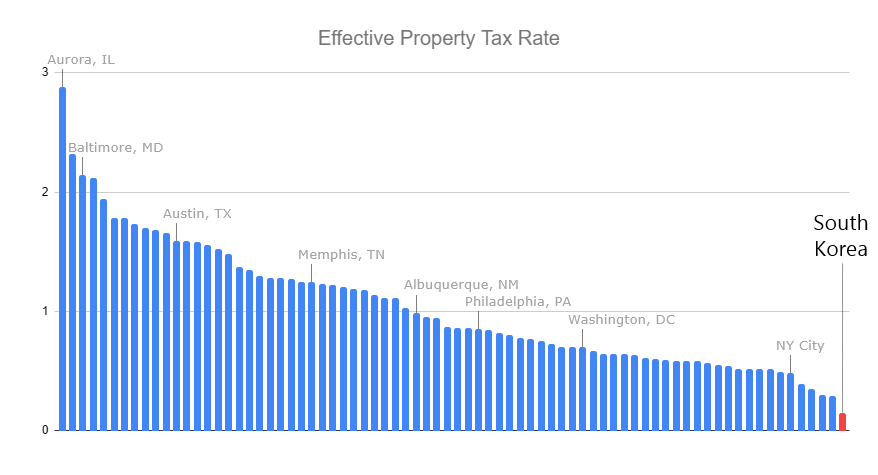
On the other hand, the real estate transfer tax (called “stamp duty” in some countries) is quite high, ranging between 1 and 4%. This is almost completely backwards and the opposite of what economists recommend. Whereas holding taxes on real estate are generally beneficial—and land value tax is the best—transfer taxes are about the worst kind of real estate tax, because they create perverse lock-in effects.
Life for the Average Korean
I asked my Korean researcher friends about daily life, material conditions, and working hours in South Korea right now. Here’s what Jinsu had to say:
40 hours a week (8*5) is the standard, but depending on the occupation, there are cases where people work a lot of overtime. Before the 90s, the ratio of dual-income couples was about 20%, but it has gradually increased to over 50%, and for the younger generation, it is over 60%. On average, they save about 8% of household income.
The wage gap is very large. With median income, life is tight [for a single-earner family]. Because the wage gap is so large, young people compete fiercely to go to good universities and get jobs at large corporations somehow, rather than developing their own aptitudes. Considerable rent-seeking and resulting social waste occur in jobs as well.
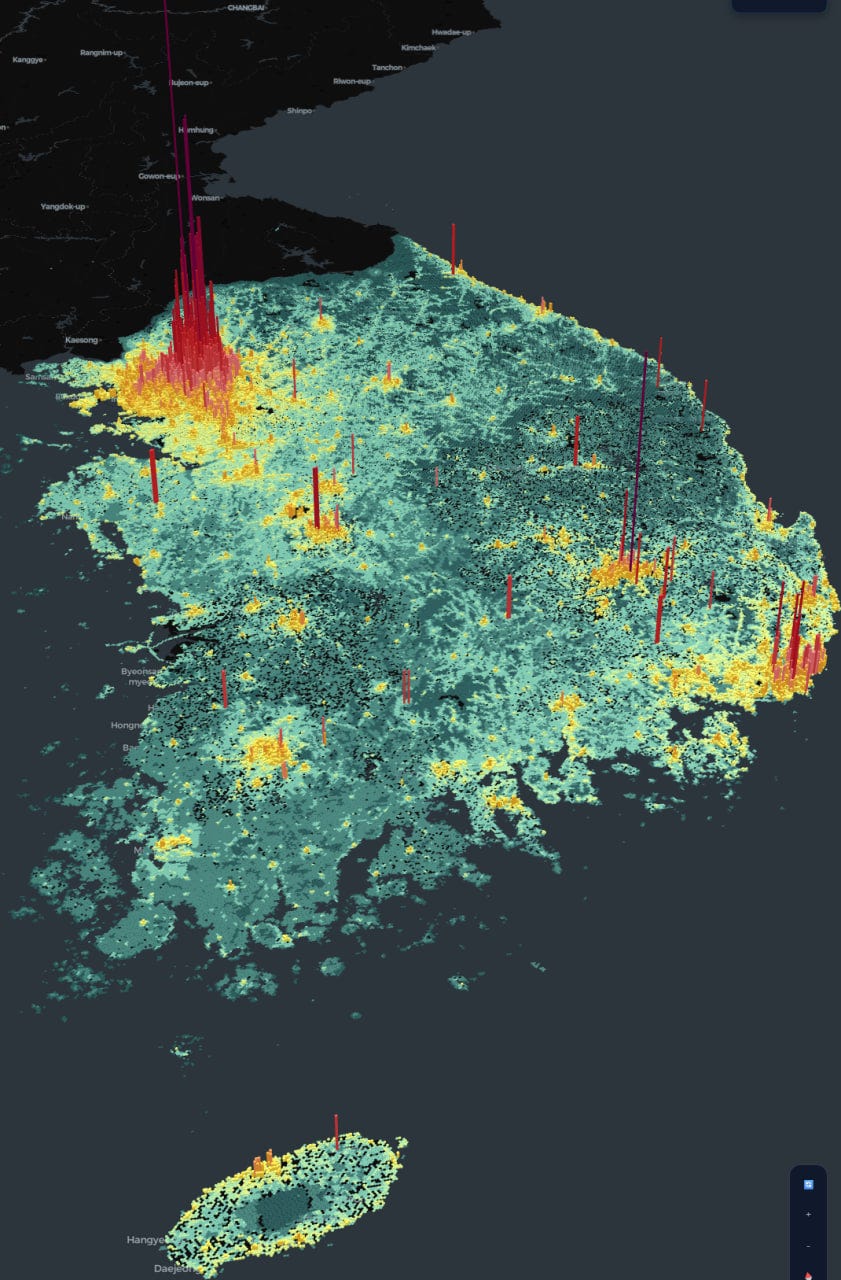
Many workplaces are concentrated near the capital, Seoul. To get good jobs, the population flocks to Seoul, where land prices are high. This creates a negative interaction that raises real estate prices again, and the concentration of jobs in the metropolitan area tends to become more severe. This is a problem, and currently, the Lee Jae-myung government is implementing strong local decentralization policies in response (e.g., Rural Basic Income, differentiating subsidies the further a region is from Seoul, etc.). All citizens and the government recognize that concentration in the metropolitan area is a problem.
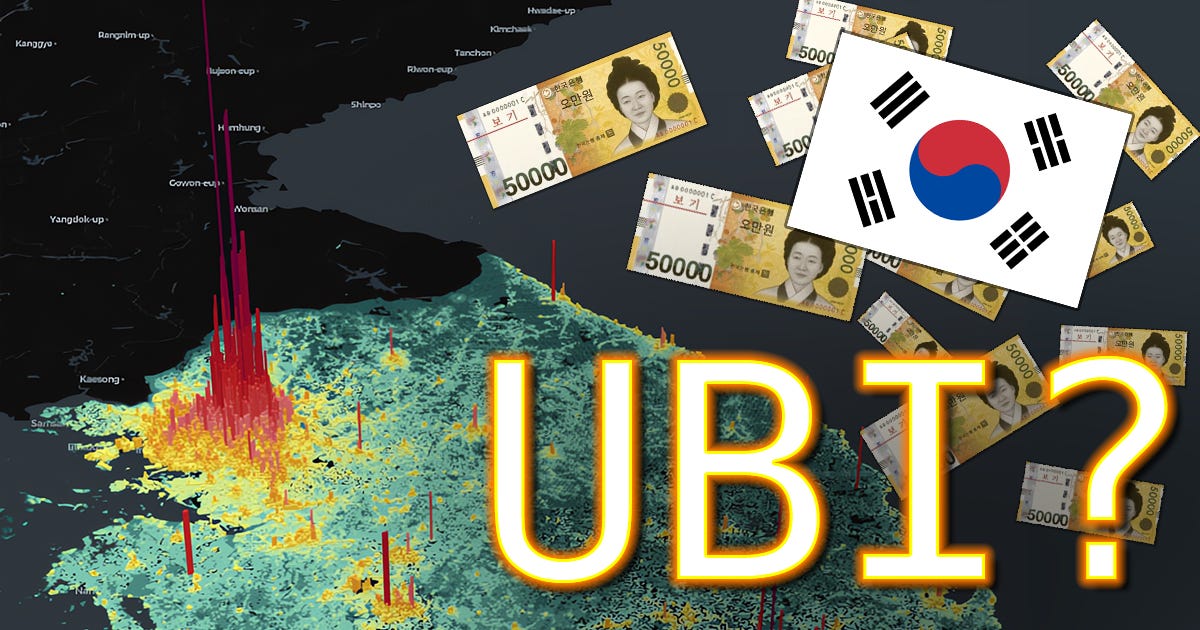
He’s really not kidding about land prices in Seoul. See that giant red tower on the upper left? That’s Seoul. Notice how part of it goes off the top of the image.
If we go to another map Jinsu produced, landforall.kr, we can look at per parcel values:
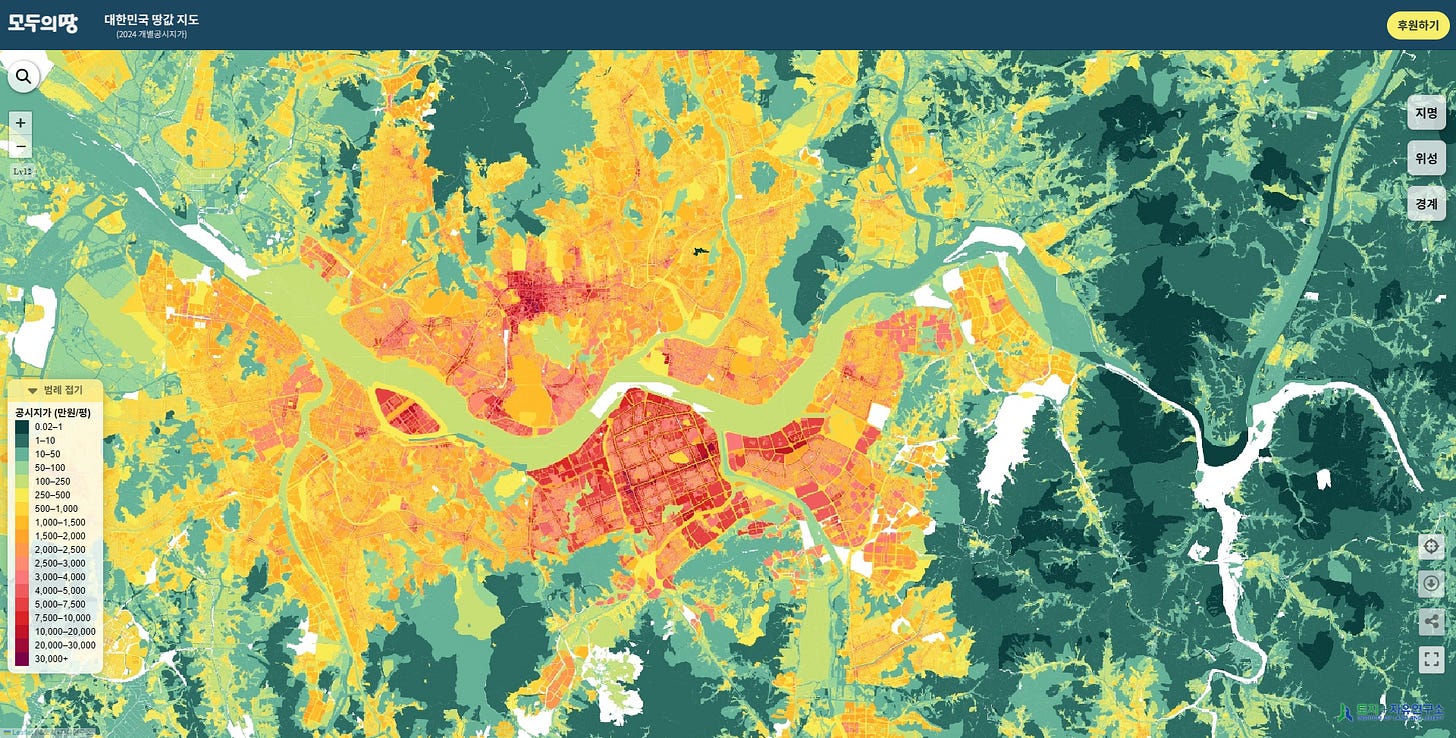
(I don’t read Korean, but Google does, so forgive me for any mistakes I’m about to make here)
Gangnam Value
The text on the legend to the left says “Officially assessed land value (10,000 won/pyeong)”. Won is the Korean currency, and a pyeong is a unit of measure that Wikipedia tells me is equivalent to 3.3058 square meters. The parcels that line the streets of the Gangnam District are in the 100-200 million Won/pyeong range; that works out to $1,894-$3,789 USD/sqft, and that’s not even the top of the range. And that’s just land value.
If any of you are old enough to remember this massively popular music video and were wondering what the “Gangnam” in “Gangnam style” meant, just replace “Gangnam” in your mind with “Beverly Hills”:
For context, let’s compare that to this $8.35 million dollar empty lot in San Francisco I found on Redfin, which is listed for a measly $782 USD/sqft:
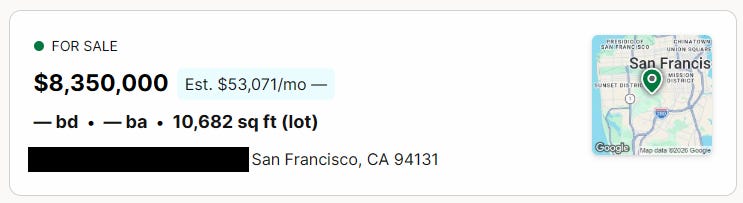
If you go further out in Seoul to the orange/yellow areas, the land prices are more like $95-$189/sqft, which sounds more reasonable at first (a 2,000 sqft empty lot would go for $190K-379K at those ranges), until you consider two things:
- South Korea’s average salary is only 61% that of the USA
- Official land prices lag; currently they are ~69% of market value
To properly guide your intuition, those two figures taken together mean that any figures I put in dollar terms should be further multiplied in your head by about 2.37X to get a rough sense of how expensive things actually are to the average Korean. How does the average Korean experience these sky-high prices?
House prices in Seoul are too expensive (they have risen steeply with some fluctuations over the last 10 years; while prices rose 20-30% over the past 10 years, Seoul house prices more than doubled). For a median-income household in Seoul to buy a median-priced house, they must save for 14 years without spending anything (as of 2024). Therefore, the perception that investing in real estate is the most reliable has spread among all ages. Newlywed couples often buy houses by taking out the maximum possible loans even if it is a stretch, instead of looking for monthly or ‘Jeonse’ (deposit-only) rental houses.
What’s Jeonse? Time to learn some fun Korean vocabulary words!
Jeonse and Yeong-kkeul
Jeonse is a system where instead of paying traditional lease rent as in most countries, you pay a large up front lump sum which can be as much as 80% of the total purchase price of the entire house, as a sort of deposit. Then, when you move out, you receive that entire value back. For those who can actually afford such an up-front payment this creates the illusion that the rental is sort of “free” in the long run—whereas what’s actually happening is that you are losing the time value of that money and surrendering it to your landlord, who invests the deposit and makes money off of the interest for the entire duration of your stay. When you leave and receive your deposit back, not only have you lost money due to inflation, you have also gone without all the interest that large amount of money could have earned you, which went to your landlord instead. As for those who can’t afford jeonse, they would be entirely locked out of those properties, unless they go to extreme lengths to borrow the necessary capital. Vitnarae Kang tells me that due to widespread scams related to Jeonse, more people are favoring conventional monthly contract rent, or simply attempting to buy their own house outright, if they can afford it. Here’s Jinsu again:
Consumption is also significantly shrinking due to repaying the principal and interest of loans. Most people agree that high house prices in the Seoul metropolitan area are a major factor in Korea’s extremely low birth rate. In the case of men, there is a large difference in marriage rates according to income levels. (The marriage rate of low-income men is significantly low).
The next term is Yeong-kkeul, literally, “to scrape together even one’s soul”, is a phenomenon in which you mobilize every single last resource you possibly have: emptying your savings account, taking out every loan you can, borrowing from your family, levering yourself to the complete hilt—in order to make a big purchase (typically real estate).
Vitnarae:
In particular, homeowners and those who own multiple properties utilize online real estate communities, such as Naver Cafes, to influence market analysis and public sentiment. Their aim is to promote excessive leveraging and the practice of “yeong-kkeul” (stretching one’s financial resources to the absolute limit to purchase real estate).
Jinsu:
The new word ‘Yeong-kkeul’—meaning pulling together even one’s soul—was created to mean gathering all available loans from family and banks to buy a house.
To the Moon
Another thing I noticed immediately from the map was just how concentrated land values were in the capital city relative to literally everywhere else. Jinsu explains:
The difference in house prices between Seoul and the provinces is large. The price-to-income ratio is over 10 for Seoul and under 5 for areas outside Seoul. In Korea, housing prices were at a low around 2012. After that, they rose very slowly, then rose very sharply from 2017, and rose particularly much during the COVID period. There was a significant adjustment at the end of 2022 as COVID was ending, but prices continued to rise centered on the metropolitan area due to the real estate stimulus policies of the conservative government in 2023.
(That’s the same government whose last president just got jailed for life for insurrection)
The expression “crazy” would be appropriate for real estate prices in the metropolitan area. Compared to 2012, real estate prices in the metropolitan area have tripled, while income has only increased 1.5 times. While most people think current real estate prices are not normal, they also have a psychology of FOMO and a psychology that real estate is the investment asset with the highest value and safety. The behavior of the past few years was that even the younger generation bought houses in Seoul by taking out massive debt (even taking the risk of reducing spending to pay back principal and interest) out of a psychology that they could never buy if they didn’t buy now.
Banks lend a lot of money through real estate mortgage loans. Although they regulate LTV and DTI, they are not very strong and change a lot according to the tastes of the administration. Since the inauguration of the Lee Jae-myung government in June 2025, there has been some strengthening of real estate policy regulations, but prices have continued to rise moderately. Recently, as the President has been speaking out strongly about strengthening real estate regulations for the past month, real estate prices in the most expensive areas of Seoul have begun to turn downward for the first time in a while. However, prices have not dropped much yet. Personally, I think it is a normal price if Seoul’s house prices drop by more than 30% from the current level.
President Lee — Georgist or not?
So the current president has made a lot of noise in the past about both UBI and LVT. Where did this guy come from, what does he stand for, and what is he saying now?
Jinsu (clearly a fan) says this:
Basically, Lee Jae-myung has and pursues values that resist privilege and consider the weak. While serving as the Mayor of Seongnam, he came out with a really strong Land Basic Income policy when he ran for the presidential primary in 2017. At this time, our Institute and related people had a lot of influence on the drafting of this policy, and Georgist activists, including myself, were quite excited. In the process of the Democratic Party primary, competing with candidate Moon Jae-in who was more popular, he proposed a policy to establish a National Land Holding Tax and distribute it as Basic Income (initially about 300,000 KRW per person per year) and once stated that everyone has an equal right to land. Unfortunately, he lost to Moon Jae-in in the primary. After that, he served as the Governor of Gyeonggi Province, the metropolitan local government surrounding Seoul. After President Moon, Lee Jae-myung went out as the candidate for the Democratic Party but narrowly lost to the conservative party candidate, Yoon Suk-yeol. Since President Yoon Suk-yeol resigned after serving only 3 years of his 5-year term due to impeachment for declaring illegal emergency martial law, Lee has been the President since June 2025.
Here’s where we’re at now:
Regarding real estate, President Lee is speaking in a less radical voice than during his days as a candidate 10 years ago. Recently, regarding real estate policy, he did make a statement that holding tax is the last resort, but he is making it clear that high real estate prices are a problem and earning money through real estate is not desirable. Recently, he showed his strong will to stabilize house prices by selling the house he had owned and lived in for 30 years. Also, he recently gave an instruction to exclude public officials who own multiple houses from drafting real estate-related policies.
President Lee Jae-myung gradually weakened his stance after proposing the strongest LVT policy (combined with Basic Income) in the 2017 presidential primary. However, Lee Jae-myung appears to be a very practical and strategic person rather than an idealist, and in some ways a “populist” (in a neutral sense). He is certainly a politician who pursues idealistic values. He clearly maintains the position that income generated as unearned income from real estate is not desirable and it is necessary to minimize it. However, his idea that holding taxes should be strengthened universally seems weak. As a politician, he seems to have a strong motivation to minimize the groups that lose out due to policy. On the other hand, regardless of political interests, he has stated several times that he will stabilize real estate prices (in the metropolitan area).
So how popular is this guy?
President Lee Jae-myung began to gain popularity with the public by being the first politician to raise his voice saying the President should be impeached during the large-scale mass protests against President Park Geun-hye’s corruption case in 2016. However, he was not popular enough to become the presidential candidate for the Democratic Party at that time. It has now been about 9 months since he started his presidential term, and his approval rating is rising as his term progresses. It is currently over 60%, and the reason people like him is that he is practical and capable.
I double-checked that figure, and as of today his approval rating is actually at 69%, a record high. Let’s see if he can keep it up.
He enjoys substantial debate and broadcasts most cabinet meetings live (for the first time in the history of the Republic of Korea). Although he did not do it intentionally, his mobile phone number is public, so he reads all the text messages people send and tries to continue communicating with people through X (Twitter). On the other hand, Korean media has a strong conservative tendency, so he actively uses his own social media as his own media. He is very skilled in diplomacy and his appearance of taking good care of his country’s interests is gaining significant support from the existing moderate and conservative classes. I think the factor of his popularity is that he conducts practical policies without being biased toward ideology. He shows a very strong side in persuading and debating opposing forces when he tries to implement policies for improvement. (In the past, he had an image like a fighter, but recently he has become a bit more of a soft image.)
So where do we go now?
The impeachment of President Yoon has given the current ruling Democratic Party very strong support and momentum. I think this is a good opportunity for the current President. Meanwhile, it is an important task to restore the order and the people (public office) planted by President Yoon Suk-yeol, and it seems to be going well. Many people want President Lee Jae-myung to serve as President for more than 5 years even by amending the Constitution, while on the other hand, there seems to be internal conflict for leadership within the ruling Democratic Party because the approval rating is high. Since there is a local election in June this year, I thought he wouldn’t bring up the holding tax before that, but it was a bit surprising that President Lee Jae-myung recently said that holding taxes can also be used. May 9 was the deadline for the end of the suspension of heavy taxation on capital gains tax. The suspension had been extended several times until now, but the President has been sending a strong message since the beginning of the year that he will absolutely not suspend it this time and will start the heavy taxation on capital gains for multi-home owners as planned. Therefore, Seoul house prices have stopped their long-term upward trend and begun to turn into a downward trend.
Ultimately we can only put so much faith in politicians, but I’m willing to be cautiously optimistic here. I think this is one of the best opportunities we’re going to see for a while, so anyone who cares about UBI and LVT and can help this initiative along in any possible way should seriously consider reaching out to allies in Korea.
What’s the Plan?
When we wrote our previous article on President Lee, it included this:
In [2022], one analysis found that an effective LVT of 1.1% would generate revenues of 80 trillion won (USD$58.5 billion), enough to fund an annual UBI of 3.6 million won ($2,600) per household (5% of current incomes). They found it would lower house prices, raise the net income of 85% of all households, and reduce every measure of income inequality2.

Jinsu proposes that same UBI, but per person, not per household:
I expect that a Basic Income of about 300,000 KRW per person per month can be paid in Korea. (This is an amount of about 30 hours at Korea's hourly minimum wage). Tax improvements that are tax-neutral, such as lowering taxes on buildings and raising taxes on land (or reducing acquisition tax and raising holding tax), will also be necessary.
How likely is this to go through? Obviously a lot depends on how bold the president’s feeling, but from the looks of it he’s more than happy to keep pursuing UBI publicly, and that makes me optimistic for LVT, because there’s realistically few other ways to actually fund it.
But maybe we can help give him a nudge. I asked Jinsu what he hoped to achieve in the next year:
I want to create visualizations to show exactly who is reaping the most unearned income from land, where they are located, and how much people in specific areas are actually paying in property holding taxes (effective tax rates). Through this, I want to visually convey the unfair reality that a small minority is monopolizing land value.
Just put it on a map! That’s the spirit.
In 2024, we created a 2D bitmap land value map of South Korea for specific years (utilizing vectors at high zoom levels). [LARS: I believe this is landforall.kr] This year, I want to develop a 3D vector land value map that incorporates the past 30 years of officially assessed individual parcel prices provided by the government, enabling time-lapse animations. [LARS: the 3D maps of Korea in this blog post were produced by Jinsu]
Seizing the opportunities presented by a progressive presidency, I aim to propose a land tax combined with a universal basic income. This would ensure that everyone can practically share at least a portion of the land’s value, while also securing the stability of real estate prices.
At the institute level, I want to expand our communication channels and actively scale up the collection and curation of domestic and international trends in related research and activities, leveraging automation technologies.
Furthermore, as an institute, I want to continue building a repository of research reports on the real estate tax systems of various countries. I also want to contribute to academic journals.
I asked Jinsu what resources and help he needs to achieve his goals:
The operating finances of the Institute are not abundant, so becoming a supporting member of the Institute, even with a small amount, would be a great help to our stable activities. (This is the overseas sponsorship channel: https://ko-fi.com/landlibertykorea).
I wish there was a global newsletter that delivers research on land value and shared wealth from each country and news of activities (it might already exist and I just don’t know).
I’m not sure if this exists already either, but hopefully Progress & Poverty substack is quickly becoming just such a resource.
Here are some other things you can do to support this initiative:
- Share this article with any of your friends obsessed with UBI
- If you attend UBI events, tell everyone involved about South Korea’s UBI push
- If you attend mass appraisal events, tell everyone involved about South Korea’s land valuation system
- Download the South Korean land value datasets and build your own models. I think these are the sites:
- https://www.data.go.kr
- https://rt.molit.go.kr
- Reach out to folks like Jinsu and Vitnarae and ask them how you can help. I can connect you directly if you like, just email me at [email protected]
And last but not least:
I ask for your prayers that Korea may become an exemplary country of distributive justice.
You’ve got it, brother 🙏. Godspeed!
The Land & Liberty Institute is one of several Georgist institutions in Korea that have a fascinating history in which Korean protestant Christians in particular became an early vector for Land Value Tax advocacy. Much of this has to do with Henry George’s famous speech, “Moses,” which tied Georgist ideas directly to the Old Testament concept of Jubilee laws. (For context, president Lee Jae Myung is a protestant Christian). There’s a lot of interesting stuff to get into here that goes back over a hundred years, but this article is already too long so we’ll have to save it for later. Korean Georgism is hardly exclusively Christian—there are prominent secular and non-Christian Georgist advocates in Korea as well—but I wonder if the historical connection to Korean Christianity helps to rebut the common slur by opponents that Korean Georgists are Communists.