
Originally published on Progress and Poverty on May 6, 2026. Republished on Progress.org with permission.
First, a couple points of housekeeping
- Tomorrow (Thursday May 7th), Jeff Fong, YIMBY Action Board Member and Urban Proxima writer, will be live on Substack with Ron Davis at 7PM. Ron is based in Washington State and has played a large role in passing state legislation promoting housing abundance. He was also one of the first folks I spoke with in Washington State when kicking off work on land value taxes there. Alongside Spokane city officials, namely Councilwoman Klitzke, he helped turn the idea into true political momentum. He is now running for Washington State House.
- Will you be at StrongTowns National Gathering in two weeks? If so, there will both be an LVT hangout and meetup right before the reception kickoff (register here), and there will also be a panel on LVT at the conference itself sponsored by Josh Vincent and the Center for the Study of Economics.
Loudoun County, Virginia is collecting record tax revenue while charging homeowners less every single year. The county’s residential property tax rate has dropped 30% over the past decade, even as the county budget has grown. The reason: data centers now generate most of Loudoun’s tax revenue, funding everything from body cameras for police to expanded parkland.
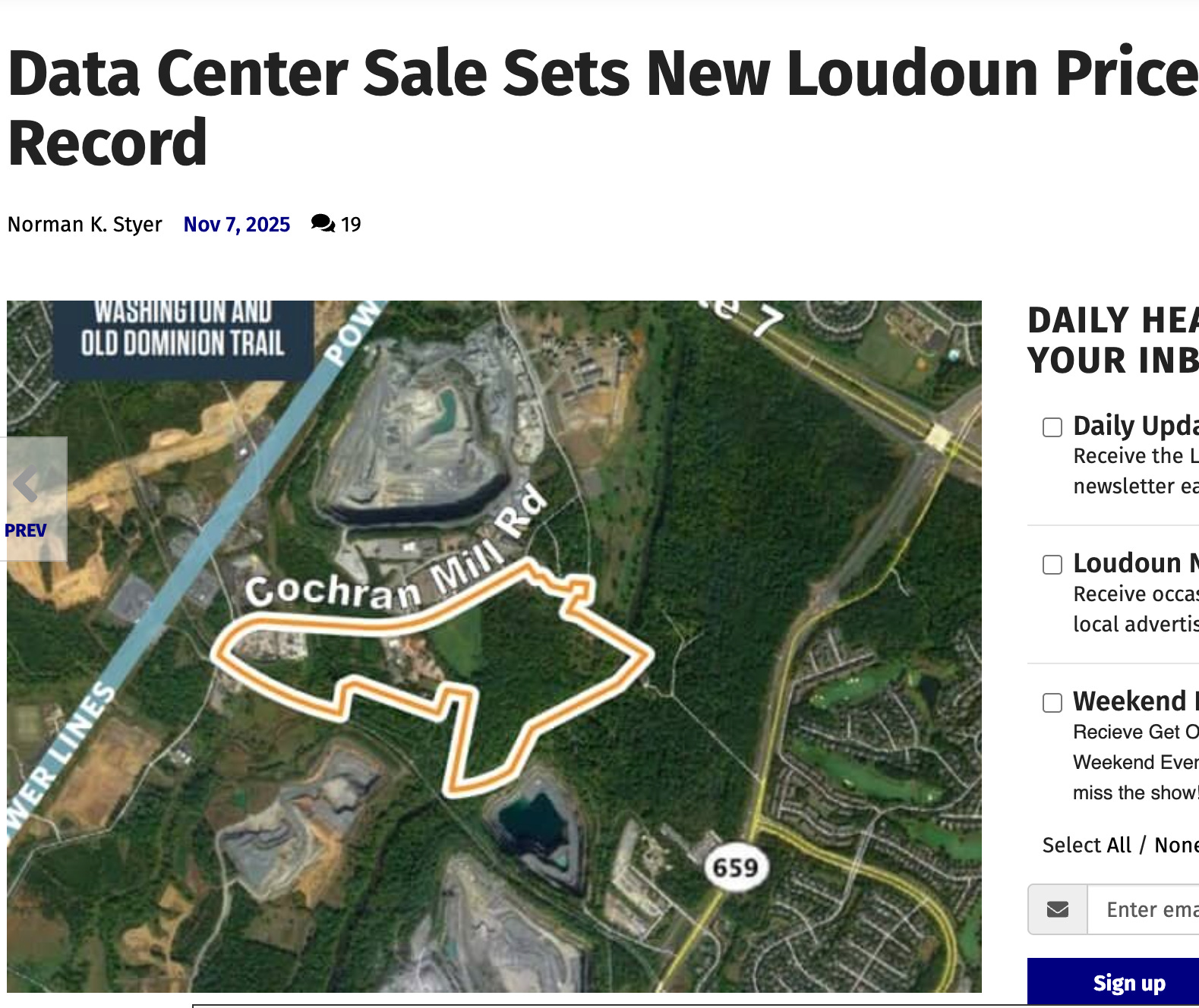
The data center industry in Loudoun County is so strong that one plot of land recently sold for $6 million per acre. This is not Manhattan. It’s exurban Virginia.
Over the past few weeks, I’ve been at four conferences, and at each one, someone has asked me the same question: what do you think about data centers? It’s a fair question for this Substack to take on. Data centers are the most expensive land use in America right now, and they’re reshaping the politics of every community where they touch down.
My answer has three parts:
- Data centers should be developed.
- Communities should welcome them.
- Local governments should negotiate much harder to make sure residents benefit.
Data centers are coming, the revenue they generate is real, and the question worth asking isn’t whether to allow them but on what terms.
Build Them
I don’t want to dwell on this point too much. AI is a real, usable tool that has already fundamentally changed humanity. We can stop all model progress today, and we are still at the very beginnings of the way that AI has reshaped our economy.
Compute is a major bottleneck, and future systems will rely on the data centers that provide it. Of course, we will build more efficiencies into existing systems (as DeepSeek did in 2025), but compute and data storage will still be needed. If we stop that progress in the United States, we risk falling behind China at a critical moment for technology and safety.
If you hold that AI is a bubble or actively harmful, you may have reasons to disagree with the premise of this article. But I’m starting from the standpoint that AI is important, U.S. dominance in AI is important, and the data centers that enable both will get built somewhere. The question is on what terms, and localities shouldn’t be afraid to negotiate.
A few facts worth establishing up front. Concerns about data center resource use are largely overblown. Data centers don’t threaten national or regional water supply, and they’re far less damaging to the environment and local water tables than, say, growing corn for ethanol fuel. (Though local impacts can be real, which is exactly why negotiation matters.) But data centers also don’t deliver the upside people often assume. Unlike factories or office campuses, they aren’t large jobmakers. They also do not supply amenity value, such as restaurants, hotels, or even entertainment. Instead they are large, nondescript buildings that generate significant revenue per employee.
Put together: data centers are neither as bad for a local economy as resource critics may claim, nor as good as job and amenity boosters may claim. That changes what good policy looks like.
Welcome Them
In December of last year, residents in Chandler, Arizona cheered as the city council rejected a $2.5b data center development. I am from Chandler, and this made me disappointed.
The data center proposed by Active Infrastructure would have contributed significant property tax revenue to the city: $10.2m annually. Indeed, to help incentivize the deal, the developers were ready to sign commitments for every concern of the local government:
- Not enough jobs? A commitment of 750 jobs paying at least $75,000 annually
- Too much water consumption? A commitment to a closed-loop water system
- Too much electricity consumption? A commitment to their own power supply
- Too much noise? A commitment to monitor decibels to ensure noise levels were unchanged
With all these concessions, the council rejected the data center unanimously due to public pushback on environmental and anti-AI concerns. In doing so, they rejected tax revenue that could’ve helped expand fiscal capacity. Having grown up there, I watched the city become what it is today through Intel, Microchip, and the broader Price Corridor tech build-out. Investments like these data centers are the ones that transformed Chandler into a dynamic and growing economy.
Chandler’s rejection of Active Infrastructure’s development sent a signal to the market: don’t build data centers here.
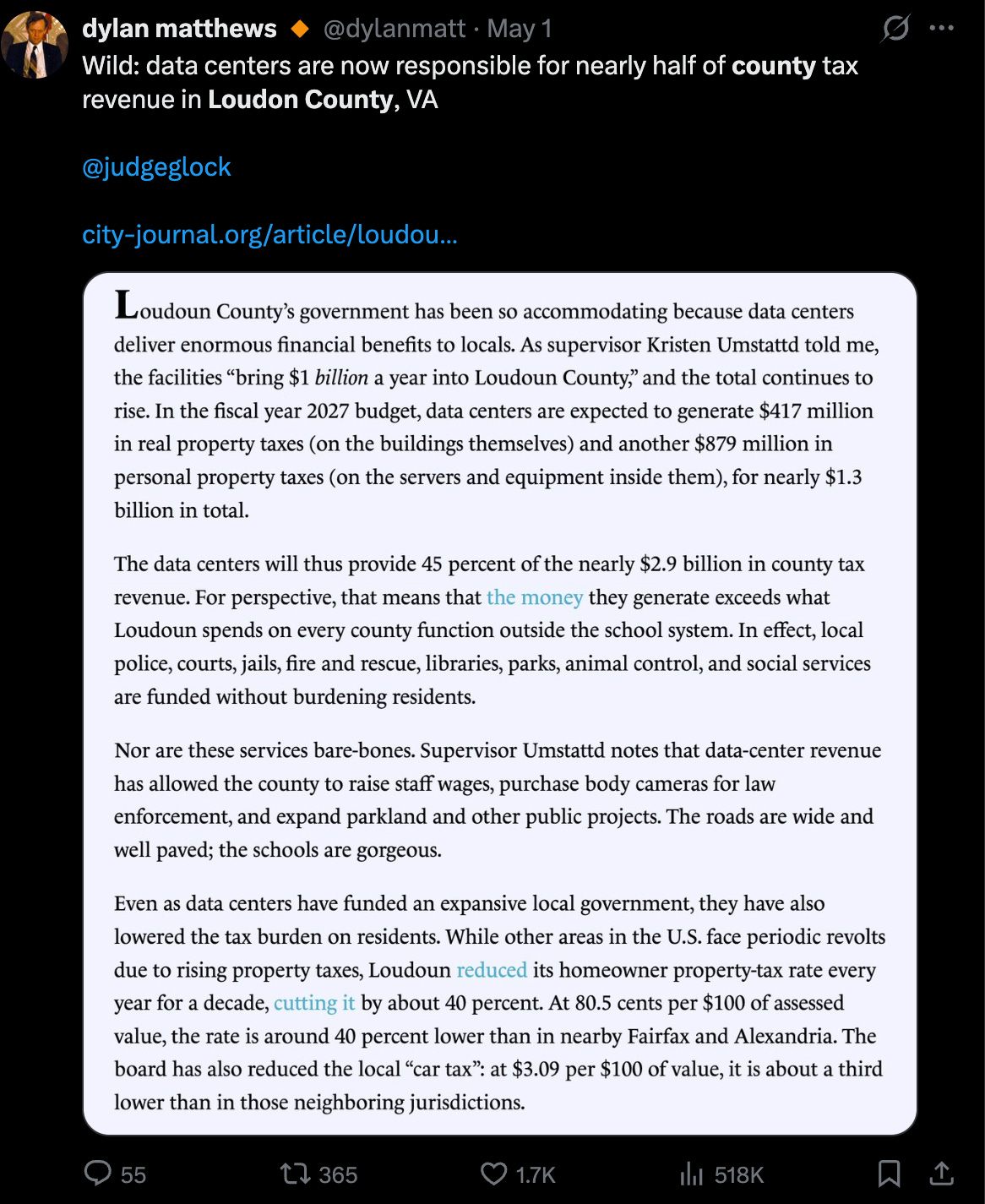
The flipside is Loudoun County, where data centers dominate. For the FY2027 budget, City Journal reports data centers will generate roughly $1.3 billion, about 45% of the total county tax revenue funding everything from body cameras for police to expanded parkland, all without raising taxes on homeowners. Because of data center revenue, Loudoun has lowered its real property tax rate every year for a decade, from $1.145 per $100 in 2016 to $0.805 in 2025
Stop Subsidizing Them
In some places, local governments have actively subsidized data center development. This is a multi-trillion dollar industry exploding in value — they do not need our help.
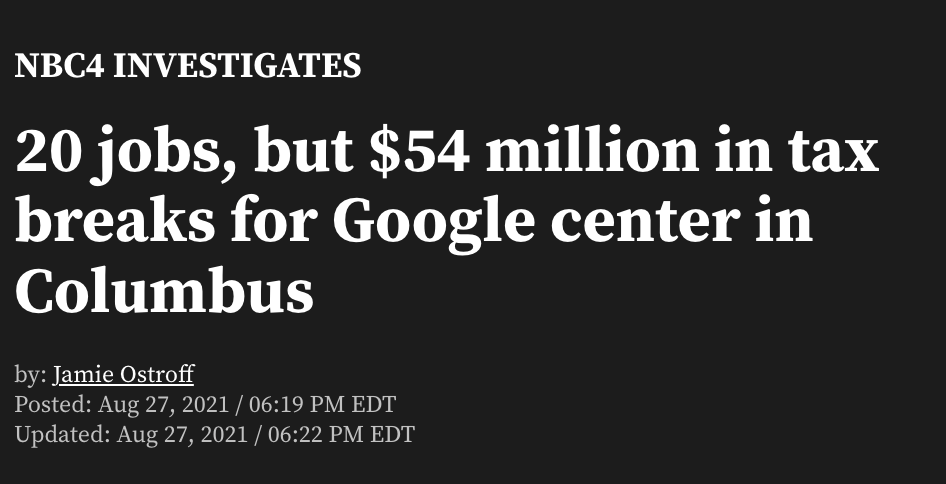
In Columbus, Google built a $300 million data center through a shell company called Magellan Enterprises LLC. The Columbus City Council approved a 100%, 15-year property tax abatement worth roughly $54 million in exchange for only 20 permanent jobs. Months later, the city learned Magellan was actually Google. The city, of course, was on the hook for the water and electricity infrastructure that made the project viable.
State-level subsidies are even more aggressive. At least 37 states now offer some form of sales and use tax exemption or related incentive to attract data centers. These exemptions waive state sales tax on the computer equipment, servers, software, and (in some states) electricity that data centers buy typically in exchange for hitting a minimum capital investment threshold and creating a small number of jobs.
States have created a race to the bottom where without these incentives, data centers are less likely to develop in the state. In states like Virginia with a burgeoning data center industry, the financial interests are now too entrenched to overturn such a policy.
The numbers have spiraled. When Virginia created its exemption in 2008, the Department of Taxation projected an annual cost of $1.54 million. In FY2025, the actual cost was $1.6 billion. In FY2024 alone, the exemption cost Virginia $1.02 billion, and over the decade from 2015 to 2024, the state forgave $2.7 billion more than half of all economic incentive spending in the commonwealth. Texas is on a similar trajectory, revising its FY2025 cost projection from $130 million to $1 billion in the span of 23 months.
Negotiate With Them
All of which is to say: states have already given the store away. The leverage that’s left lives at the local level which is why how local governments negotiate matters more than ever.
Imagine if local governments partnered with data centers and negotiated with them. These negotiations should start with the obvious: data centers should not negatively harm residents.
Therefore, local governments should ensure that data centers supply the grid with electricity and utilize closed-loop water systems, or ensure through some other means that water usage does not impact residents.
But, local governments can and should go a step further. These data centers are large moneymakers, and the data centers are willing to negotiate to be allowed to develop. Local governments can actively ensure that local residents are positively impacted by their development. This could look like partnering with data centers to create a fund through a Payment in Lieu of Taxes (PILOTs) where the payment is near or beyond the typical property tax the center would pay. PILOTs are often done by local governments as subsidies, but they do not need to be.
The fund could be split-use between paying down residents’ electricity bills and funding capital projects. It appears that Cedar Rapids has already done something similar through a Community Benefit Agreement, though likely the math breaks out to still be a significant subsidy.
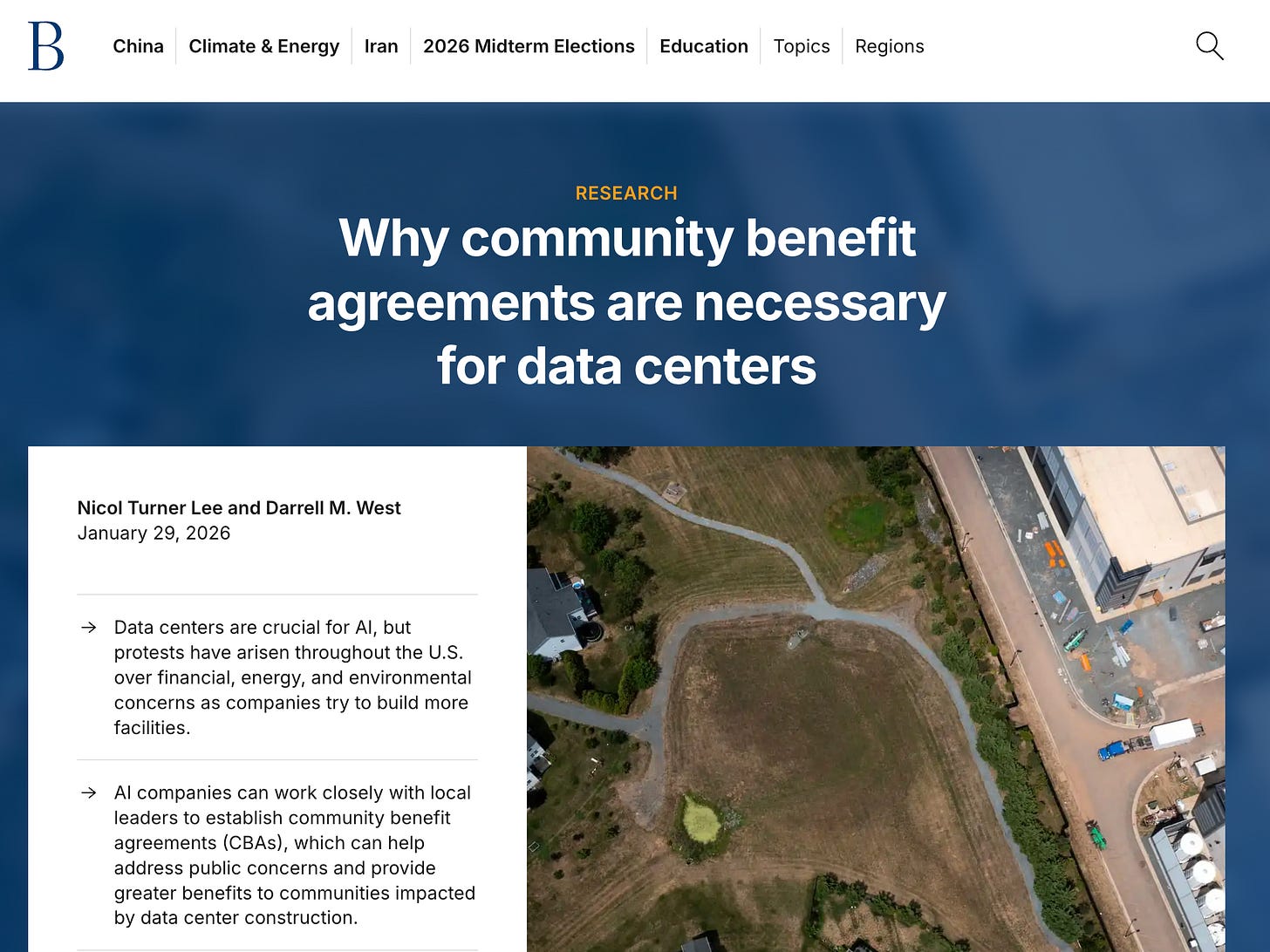
If cities proactively built these systems of negotiation, data centers which already spend significant time on land acquisition would actively compete to locate where the city had already handled permits and approvals through a pre-set framework. Done right, this could be a win-win: data centers face less community pushback because their investment directly lowers costs for residents, and cities get reliable operating funds.
We can have data center progress without electricity poverty. We just have to bargain for it.
Greg Miller is Co-Founder and Executive Director of the Center for Land Economics.