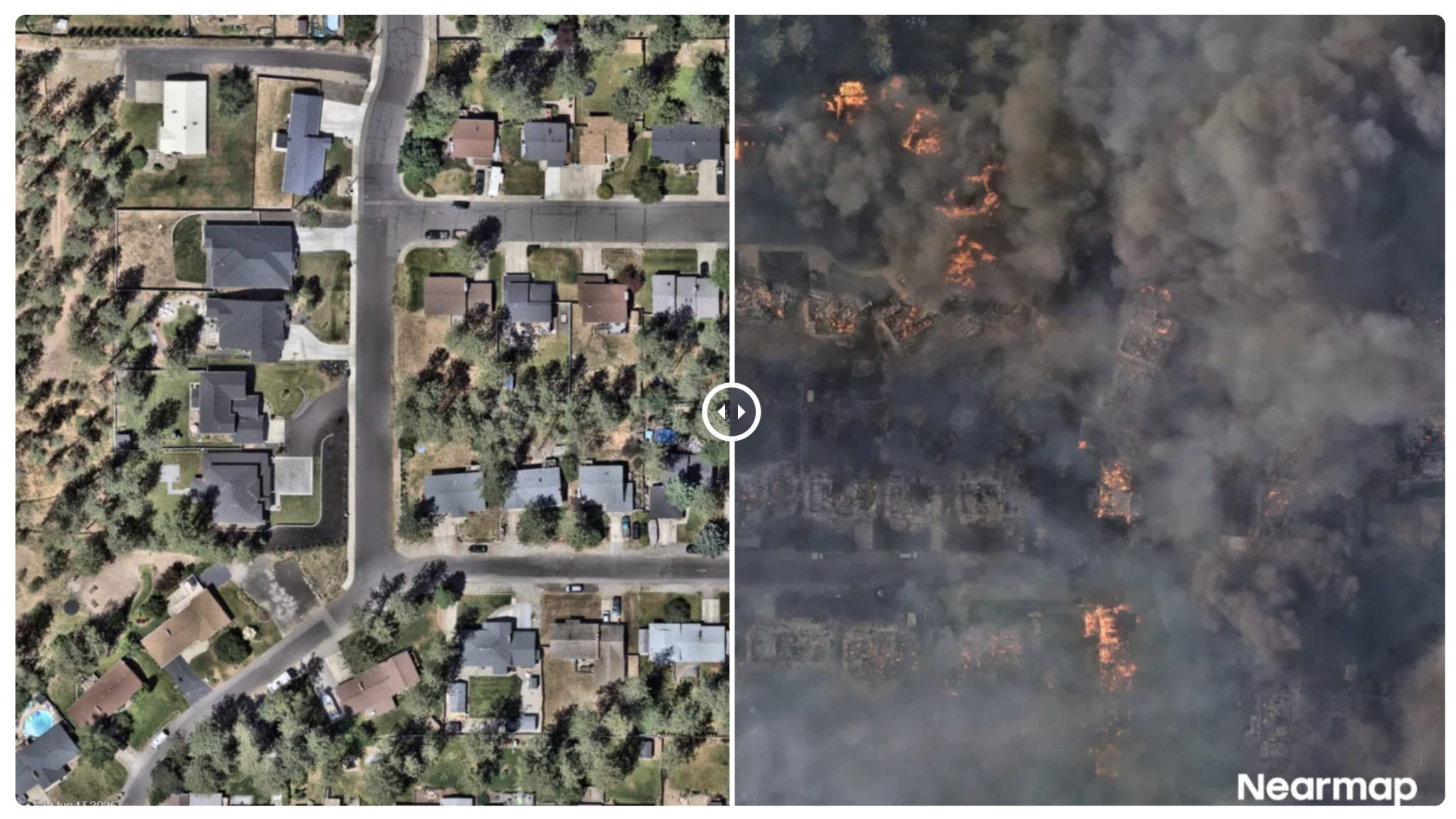
The government should not completely freeze transactions from occurring; residents should be able to freely sell their land if they want. Instead, during this window all property sales in the affected area should be freely initiated by a landowner intentionally putting their land on the open market. This would also let the landowner receive competing offers that raise the selling price to something closer to the land’s true worth.
This leaves us with the next question – what do we mean by “true worth”, and how can anyone know if they’re getting a good deal or being ripped off? The land’s “true market value” is whatever people are willing to pay, but only in an open market when all participants have equal information and no one is subject to undue haste or pressure. To discover the market value of land post-disaster, we need to push investors’ offers out of backroom dealing and into the pure light of day. Which brings us to the next policy proposal:
Broadcast new transactions in real time
Every day, the government should update a website showing all transactions made in the affected area on the prior day, overriding any state sales non-disclosure laws. This policy may extend to include all listings and offers in the area, as well. In the volatility of a post-disaster land market, a daily ledger everyone can see sharply cuts down the information asymmetry between private buyers and local residents. It also makes the overall market more efficient and aids in price discovery. There should be immediate reporting requirements for these transactions, so neighbors can see what nearby land is selling for, especially while things are still volatile.
Publish pre-disaster land values
It is important for disaster victims to remember what their land was worth before the disaster and to be able to compare current transactions to previous values. Of course, because the area has been badly hit, they should expect land values will have dropped, but a website showing the previous year’s assessed land value for each property could help residents gut-check what their land might be worth now. This could be supplemented with data concerning how prices evolved in other areas in the years immediately following a disaster.
Provide public information about resources
Finally, the federal or state government should publish general resources and information for people trying to understand their options. This should include which government programs are available to residents, and what federal programs have historically provided to other disaster-prone areas, while noting that some of this help may not be guaranteed.
All of the above could be done via one web portal that contains all the information, and is broadly advertised in local media and official communications in the immediate wake of a disaster.
Maintaining a strong recovery
After the dust has settled, the government needs to ease back into business as usual, but along the way it should make that transition smoothly while also looking for ways to improve.
Continue mandating daily reporting of transactions
In the years following the disaster, the market will still have uncertainty about how much the area may recover, and land values will be more volatile, and perhaps more speculative, because of these uncertainties. Residents will still be working through insurance payouts, the city will still be sorting through rebuilding permits, and new buyers will still be entering the market. There should continue to be up-to-date information on transactions being made in the market, and this should keep running for several years past the disaster. It is a low-cost, high-leverage tool for the government to provide crucial market information to all participants, including the government itself.
Remove regulatory barriers
Government red tape can slow down a recovery, which means removing it can speed it up.
To start, the government can ensure that what was there before can be legally rebuilt without minimal questions asked. After the LA fires, California suspended environmental reviews for any rebuild that stayed within 110% of the original footprint and height.
But, the government could go even further to—stealing a once-popular political phrase—build back better. While some owners will rebuild what they previously had, the government could remove zoning barriers such that other owners could build with more units and more flexibility to bring more housing options onto the market.
At the same time, local governments may consider streamlining parcel combinations. Due to increased land transactions during this period, an owner may acquire adjacent lots, and by combining these parcels, it may be easier for them to build larger developments, including mixed-use housing.
Establish a government land leasing program and fund
Post-disaster, cities may gain new land through foreclosure and property left behind, and they may also have the opportunity to acquire new land. The city should steward this land appropriately, perhaps through a municipal land trust. The city could allow private actors to develop on land through land leasing programs, and to further boost the impact, the city could create a fund to acquire more land for its municipal land trust. A policy like this ensures that a century on, the city—and thereby, its residents—still share in the prosperity and value they create. City-owned land trusts and land leasing programs are a proven method to ensure growth paired with community benefit.
That’s the purpose of a land trust or a public leasing fund; as the neighborhood recovers and land values climb, the gains flow back to the people who lived through the disaster, instead of leaking out to whoever got there first with cash.
But, should the city even rebuild to begin with?
All of this discussion so far presumes that we should actually be rebuilding in areas affected by disasters in the first place. Not all places should. Some disasters are random unpredictable events, others are the product of an increasingly unstable climate, and yet others are caused by humans building in areas where disasters are inevitable and rebuilt homes will only be subjected to fire and flood again and again. Determining which area is which is an important discussion worth having, but is a topic beyond the scope of this particular article. For now, assume we’re only discussing policy prescriptions for areas where it makes sense to rebuild in the first place.
A flexible toolkit
After a disaster, residents face an information asymmetry while still recovering from loss. Meanwhile, outside investors are positioned to exploit this situation. State and local governments can close the emotional gap through a pause on solicitations. They can then help bring price information directly into the open through publishing a daily update on transactions. Long term, the government can find room to rebuild better, through removing regulatory barriers and establishing a robust municipal land program.
There still isn’t one fixed playbook for what governments should do when disaster strikes, but as more disasters come, that policy package will keep getting built, not as a fixed formula, but as a flexible toolkit, with room for variation in how each city or state gets there.
Nevertheless the choice in the wake of a disaster is the same: use it as an opportunity to heal and regrow, or let the land vultures pick the bones clean.
Greg Miller is the Executive Director of the Center for Land Economics
Progress and Poverty is a reader-supported publication. Subscribing really helps.