

Originally published on Progress and Poverty on January 21, 2026. Republished on Progress.org with permission.
This is the first Landscape article of the New Year—and if you’re new here, welcome. Over the past year, the Progress and Poverty Substack has gained a significant number of new readers.
For those just joining, the Landscape series is a recurring roundup where I track momentum, legislation, and news related to land value taxes. You can find the previous installment here.
If you enjoy this article and don’t want to miss future updates, consider subscribing:
Announcing the Center for Land Economics Board
Before jumping into the latest LVT legislation, I’m excited to announce the formation of the Board of Governors and Advisory Board for the Center for Land Economics. This board brings together nationally recognized leaders in housing economics, parking reform, pro-housing policy, civic entrepreneurship, and local fiscal resilience to accelerate our mission and scale our year-one impact.
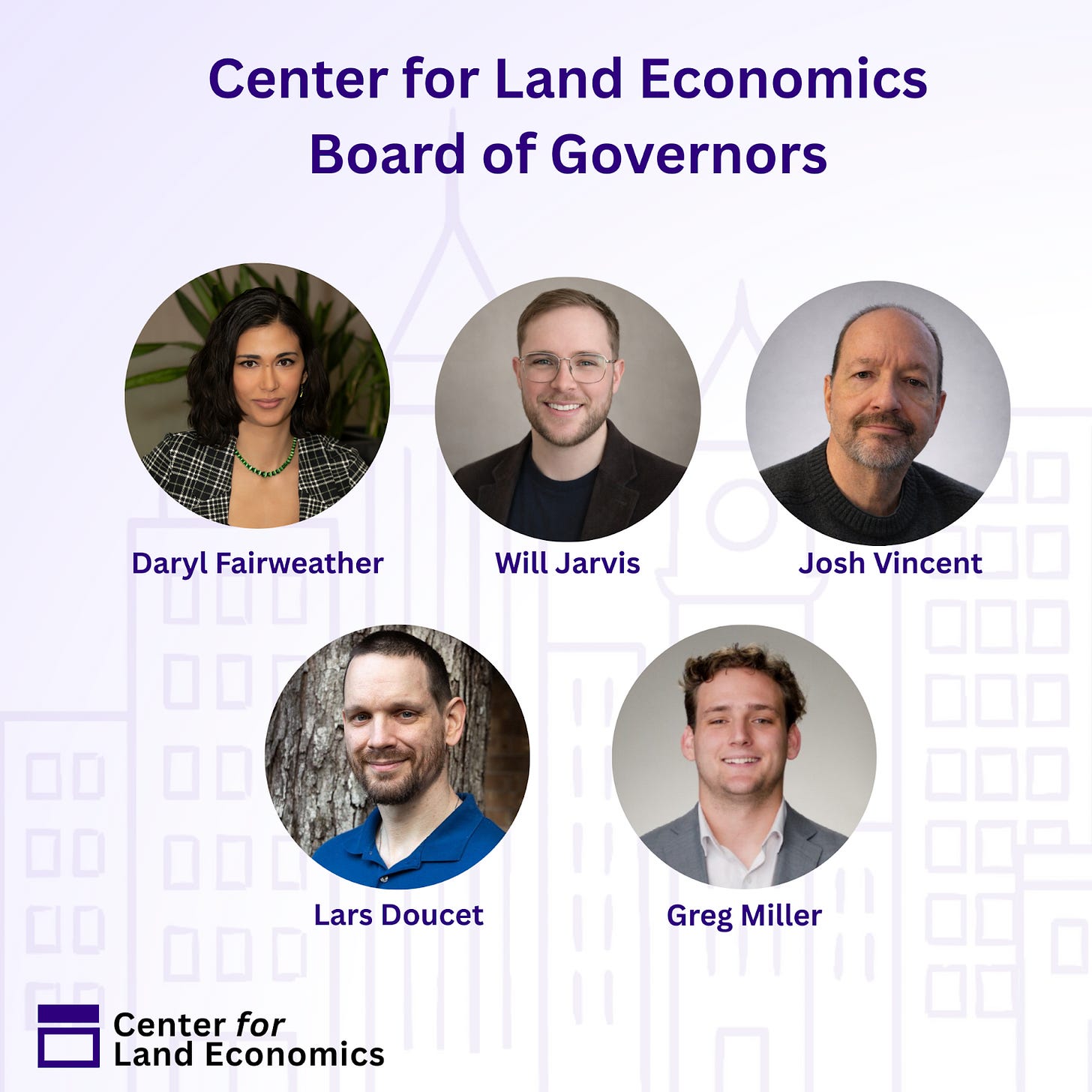
Our Board of Governors consists of Daryl Fairweather (Redfin Chief Economist and author of Hate the Game), Will Jarvis (CEO of ValueBase), and Josh Vincent (President of the Center for the Study of Economics), along with founding partners Lars Doucet and myself, who both work full-time on CLE.

Our Advisory Board includes Andrew Burleson (Strong Towns co-founder), Laura Fingal-Surma (Urbanist Ventures founder and YIMBY Action founding board member), Kevin Fishner (Successful tech executive and Radius Grocery Founder), Tony Jordan (Parking Reform Network founder), Kevin Purvis (insurance executive and United Way Broward County Board), and Rory Sutherland (Vice-Chair of Ogilvy and regular contributor to The Spectator).
This is an exceptionally strong group, reflecting how quickly land value tax is becoming a mainstream policy idea—first within urbanist circles, and increasingly beyond them. Lars and I are deeply grateful for the opportunity to build CLE with the support of this team.
This is the perfect moment for this launch, with land value tax legislation being actively considered across the country.
Starting with Legislation
As the New Year begins, so do new legislative sessions across the country. Already, two states have introduced new legislation in the past few weeks, while others are carrying over bills from the previous session, and still more states are considering what legislation they will introduce.
Maryland: Split-Rate Tax Authority
In Maryland, Delegate Vaughn Stewart has reintroduced legislation that would allow Baltimore and other counties to adopt split-rate property taxes, separating the tax rate on land from the tax rate on buildings. The bill was introduced last week as HB0078.
Cities in Maryland—other than Baltimore—already have this authority. Delegate Stewart’s legislation is intended to provide parity by extending the same taxing powers to Baltimore and additional counties.
Over the past few months, I’ve had multiple opportunities to speak with Maryland-based groups about the importance of land value taxation.
In December, I presented at an event hosted by Baltimore Thrive, a local organization focused on land value capture. Last week, I was joined by Josie Faass, Executive Director of the Progress and Poverty Institute presenting at Hood College for residents of Frederick, Maryland.

Momentum around land value tax is also building in the region more broadly. Greater Greater Washington recently published its staff pick for favorite post of 2025, awarding the honor to a land value tax piece by Matt Girardi of the Amalgamated Transit Union (ATU).
In 2025, ATU collaborated with Nick Allen, an MIT PhD student and a key architect of Detroit’s land value tax efforts, to publish a report exploring the use of land value taxation to fund WMATA operations.
New Hampshire: A Republican-Led “Tax Shift” Bill (HB 1417)
New Hampshire has a newly introduced land value tax bill: HB1417. It’s sponsored by Rep. Joe Sweeney, a Republican representing the 25th District and is scheduled for a public hearing on January 23rd.
At a high level, HB 1417 would authorize municipalities to adopt a land value tax system to shift their taxes to land. This is a Republican-sponsored bill sponsored by a candidate whose campaign promised lower taxes and smaller government. The bill’s own statement of purpose emphasizes “efficient land use, expanding housing supply, reducing blight/vacancy, and shifting the tax burden away from building investment.”
One of the underappreciated features of a land value tax is that residents feel its benefits directly. Because the revenue is raised and spent locally, it is more closely tied to tangible services—streets, schools, public safety, and infrastructure—than most other taxes, whose benefits are often diffuse or difficult to trace. That same locality also makes the tax unusually accountable. When a land value tax rate rises, residents can clearly see where the money is going and who decided to raise it. If they disagree, they know exactly which local officials are responsible and can vote against future increases through town meetings, council elections, or referenda. By contrast, increases in income, sales, or statewide taxes are typically spread across layers of government, bundled into larger fiscal packages, and far harder for voters to identify, challenge, or reverse. In that sense, land value taxation is not just economically efficient—it is one of the most democratically legible forms of taxation available.
This is why fiscal conservatives are adopting the land value tax as a forward thinking conservative principle.
New York: Carryover LVT Legislation
Some states operate on biennial legislative sessions, meaning lawmakers are returning this year with bills introduced in the previous session still active. Several of those carryover bills involve land value taxation.
In New York, legislators are returning with active land value tax legislation. The Senate bill is S1131.
The companion Assembly bill is sponsored by Alex Bores, who previously sponsored and led a major artificial intelligence regulation bill. Bores is currently running in a crowded primary in New York’s 12th congressional district, where AI-focused Super PACs are spending heavily against him in response to his work on AI regulation, a dynamic covered in detail by Wired. The correlation between Bores AI regulations and support of land value tax should not be a surprise: forward-thinking politicos will endorse forward-thinking policy ideas.
Minnesota: State Legislation and Local Institutional Support
Minnesota lawmakers are also returning with land value tax legislation already introduced. The Senate bill, SF 1422, comes with public support from Minneapolis Mayor Jacob Frey, signaling serious executive interest.
Momentum is also building at the local level. Minneapolis’ Board of Estimates and Taxation (BET), an often overlooked body that sets the city’s maximum tax levies, now includes an elected member openly supportive of exploring land value taxation.
As MinnPost reported in its article on how Minneapolis’ tax board is exploring new approaches to property taxation, BET member Eric Harris Bernstein has expressed interest in a land value tax as a way to encourage more productive land use while reducing pressure on residential property taxes. This support builds the cross-government institutional support that is needed for a policy like this to be passed within a city government.
This positions Minnesota as one of the most promising states for near-term progress.
Washington: Spokane’s Sprint in a Short Session
In Washington State, Spokane continues to pursue a universal building exemption as a mechanism to shift property taxes toward land. I was interviewed by the Spokesman-Review, which covered the legislative push and highlighted how the proposal could realign incentives, particularly for valuable downtown parcels.
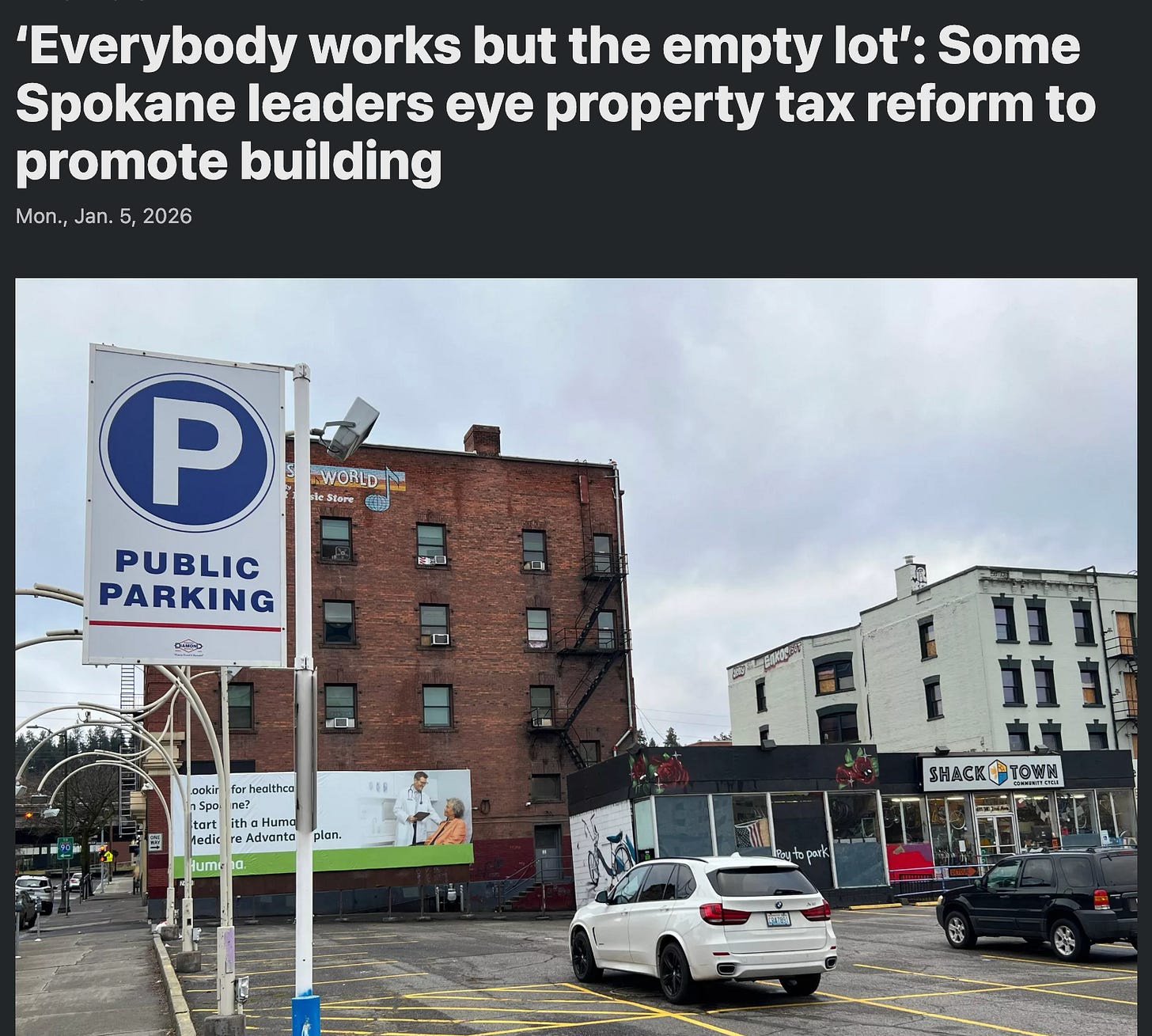
The Washington State legislative session has already begun, but it is short—just two months—which may imperil a new bill of this kind. Even so, there are reasons to remain optimistic. There is a real push behind the proposal, and even if it does not advance this session, momentum is likely to carry into the next.
This effort aligns with broader political trends in the state. Seattle’s new mayor, Democrat Katie Wilson, has officially taken office after winning her election on a platform that endorsed land value taxation. In addition, Nilu Jenks, a progressive candidate for Seattle City Council District 5, has also publicly endorsed land value tax in her campaign announcement with The Urbanist.
Michigan: Duggan Vows to Renew LVT Effort
In Michigan, former Detroit Mayor Mike Duggan has officially left office and is now running for governor as an independent.

In a recent interview with Rocket Mortgage co-founder Dan Gilbert, Duggan vowed to renew his push for land value tax if elected governor, explaining that his experience trying, and failing, to secure state authorization in Detroit directly shaped his decision to seek statewide office.
While serving as mayor, Duggan had secured legislative buy-in but lacked the authority needed from the state legislature. The bill ultimately stalled due to interpersonal and interpolitical conflict and was never brought to a vote. That experience also helped motivate his decision to run as an independent rather than as a Democrat, with the goal of advancing land value tax at the state level.
Ohio: LVTs Blessing from Blessing
Ohio Republican State Senator Bill Blessing continues in his press to put a constitutional amendment on the ballot which would allow cities to enact land value taxes. He has issued a statement which responds to frequently asked questions and rebuttals and continues to spread the word via local media. For Blessing, the land value tax offers an alternative to the ongoing discourse in Ohio about lowering and eliminating property taxes.
A Step Back in Scranton
Scranton, PA has long held a split-rate taxation system and Mayor Paige Cognetti has undone the system.
Lackawanna County has completed its first revaluation since 1968. Numerous times over the past couple of years, counties have completed revaluations for the first time in decades, leading to property tax backlash (just ask Delaware or Syracuse which voted to undo its reassessment efforts). Reassessments should be a continual process, but unfortunately some counties do not treat them as such.
The results of the revaluation come out this year. It is telling then that before the results were even out the city decided to undo the split-rate system. Why undo the system without first releasing the reassessments? The citizens deserve to understand what the change back to property tax entails and why it is being done in line with the reassessments. It also is sadly another case where assessment controversy has impeded land value tax—the most notable being Pittsburgh.
In peak irony, the budget states:
“The incentive behind a split real estate tax millage rate is that a higher millage rate for land would encourage development of vacant properties and spur economic growth. Over the past 100 years, the City has developed most of the vacant, developable property in the City.”
If anything, that’s the clearest endorsement possible. The policy aimed to encourage development and productive use of land, and Scranton’s own budget claims the city is largely built out. Yet the proposed change risks reversing those incentives by taxing buildings more heavily, discouraging improvement and new construction at the exact moment the city needs housing and reinvestment.
Mayor Cognetti is a well-educated Oregon transplant with bigger ambitions, now running for Congress. She may go far. But as housing costs become an increasingly potent political issue, and as over 58% of Scranton renters face rent burden, rolling back a system that rewards building and penalizes vacancy should result in questions being asked of her priorities later.
A Roundup
Beyond formal legislation, land value taxation continues to surface across media, research, and political discourse—often in places where you wouldn’t have seen it even a year ago.
- Land value tax made its way into Congress, with Representative Bill Foster (D-IL) raising its merits during a congressional hearing. Foster focused in particular on ways the federal government could encourage state and local adoption. You can watch the exchange here.
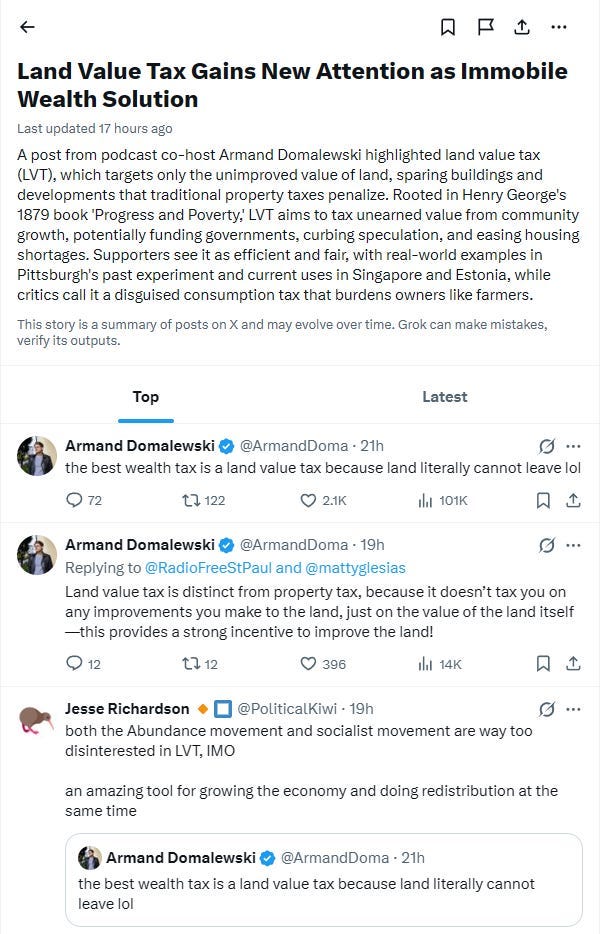
- As California debates a controversial wealth tax, land value tax briefly trended on X (formerly Twitter) after Armand Domalweski tweeted: “the best wealth tax is a land value tax because land literally cannot leave lol.” The viral moment reflects a growing intuition that immobile assets are easier and fairer to tax.
- The Pittsburgh Post-Gazette editorial board issued a full endorsement of land value tax in their piece, “Pittsburgh should return to its roots in land value taxation.” Pittsburgh remains a touchstone for LVT advocates, having implemented a land value tax with notable success before abandoning it in 2000 amid political and assessment turmoil. The editorial sparked several supportive letters to the editor, including this one.
- The Lincoln Institute of Land Policy released an updated edition of its “Who Owns America?” analysis in November, mapping corporate ownership of residential land. Their findings are stark: across nearly 500 urban counties with sufficient data, 8.9% of residential parcels are now owned by corporations. The full report is available here.
- A parallel report—“Who Owns Kenya?”—was published and quickly spurred debate about land inequality and taxation. According to the findings, 0.1% of large-scale landholders control 39% of agricultural land in Kenya, renewing interest in land value taxation as a corrective tool.
- Daryl Fairweather, Redfin’s Chief Economist, wrote in Forbes about land speculation in the aftermath of climate disasters, one year after the Palisades fires. She argues that land value tax could discourage speculative “buy and hold” behavior in disaster-stricken cities. Her piece can be read here.
- The Center on Budget and Policy Priorities published a report at the beginning of the year examining new revenue options to expand housing subsidy programs, explicitly including land value taxes among the tools states should consider. The report is available here. Even a revenue-neutral shift toward land value taxation—by lowering taxes on buildings—would meaningfully expand housing supply for low- and middle-income renters.
- In Florida, Matt Caldwell, the Lee County Appraiser and former state representative, argues that land value tax offers an innovative solution to property tax reform. His argument is laid out here.
- Similarly, in the Sun Sentinel, Reed Schwartz makes the case that land value tax is “the most conservative tax,” positioning it as a serious alternative amid calls from Governor DeSantis to eliminate property taxes altogether. That column can be read here.
That wraps up the first Landscape of the year. If you are seeing movement on LVT in your area, reach out: [email protected].