
Originally published on Progress and Poverty on August 20, 2025. Republished on Progress.org with permission.
Hello,
Welcome to The Landscape #4. I left out the “LVT” to shorten the title, but do not be fooled, this is still very much focused on movement in land value taxes across the US and world.
Every week something new seems to happen in my world as LVT continues to gain interest from local areas. While legislative sessions have largely ended, the momentum continues to build to the point where I am now asking myself not if land value taxes will be passed in the next few years but when and by which jurisdiction first. The policy would not be implemented over night, but within the next few years, we may see jurisdictions shifting taxes to land.
LVT Landscape Live
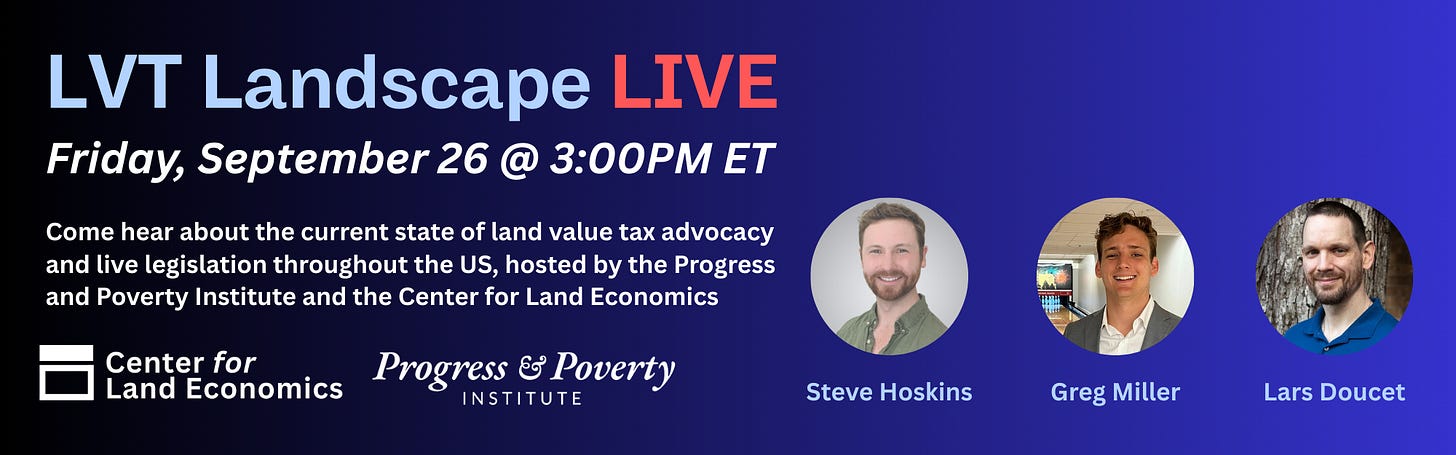
Mark your calendars: September 26th at 3PM ET / 12PM PT. The Center for Land Economics is teaming up with the Progress and Poverty Institute to host our first LVT Landscape Live, a can’t-miss one-hour event that we promise will be lively, engaging, and packed with insights.
We want this to be an opportunity to share insights from our work, explain how lvt legislation comes to be, and provide a framework via which others can engage their local areas. Here’s our plan.
- Stephen Hoskins and Greg Miller will dive into:
- Where momentum for LVT is building
- The different shapes that momentum takes (local enablement, split-rate taxes, building abatements)
- How YOU can replicate what we’re doing and make movement happen in your community
- Lars Doucet will speak on modern assessment practices and how we can value land within existing systems. Lars has been doing great work to reclaim the narrative on the ability to value land.
- Special guests running for office in their local jurisdiction will discuss the need for lvt in their area.
- Followed by an open Q&A.
This is our chance to bring together activists, researchers, and curious newcomers who want to shape the future of land value taxation. Don’t just read the Landscape… join us live.
Big Win in Baltimore
Two weeks ago, the Center for Land Economics put out a report authored by Lars Doucet and myself on vacant land undervaluation. Tl;dr: Baltimore assessments undervalued residential vacant land by up to half a billion dollars. It’s like an inverse LVT. By fixing their valuations, the assessment agency can advance land value return. So, what was the agency’s response?
They agreed to begin fixing the problem! Our report attracted attention from the Baltimore Banner and Realtor.com, and other outlets are tracking the story.
- Baltimore Banner: State chronically undervalues vacant land in Baltimore, report finds
- Realtor.com: Homeowners Are Covering a Massive $484 Million Property Tax Mistake in This U.S. City
Shining a light on flawed assessments led to a city with higher land value taxes all without legislative change. This may seem dull and boring. But the impact cannot be overstated. If SDAT carries through with the fixes, then vacant lot holding in Baltimore will be disincentivized and development will occur.
Maryland
You may recall that a few months ago, the Maryland Senate passed a bill allowing Baltimore and other counties to set a higher land tax rate for land within one mile of rail lines. Now, the Maryland House is considering both that bill and HB 1178, which would grant Baltimore full tax parity to set different rates on buildings and land. Both pieces of legislation are under review as part of a summer study.
The Center for Land Economics has been actively engaged in that study, making the case for reform. We are hopeful that the House will see the benefits of allowing Baltimore to shift taxes from buildings to land. This shift is particularly important for Baltimore, where reinvestment in its housing stock is desperately needed, and discouraging land speculation can free up more space for productive development.
Minnesota
Minneapolis is in the midst of a mayoral election, and every candidate has expressed support for shifting property taxes toward land value.
More on the candidates’ responses here: More Neighbors Minneapolis Mayoral Questionnaire
St. Paul also hosted a special election for a vacated City Council seat and all the candidates endorsed LVT in that race, including the winner Molly Coleman.
Local support matters, because Minnesota is considering statewide legislation (HF 161) to authorize jurisdictions to enact LVT. Mayoral backing in Minneapolis strengthens the case for passing that authority and sets the stage for real implementation.
Colorado
Colorado has quietly become one of the most promising states for LVT momentum. The state previously ordered a study on land value tax, Governor Jared Polis has expressed support, and State Senate Majority Whip Nick Hinrichsen is a champion of the cause.
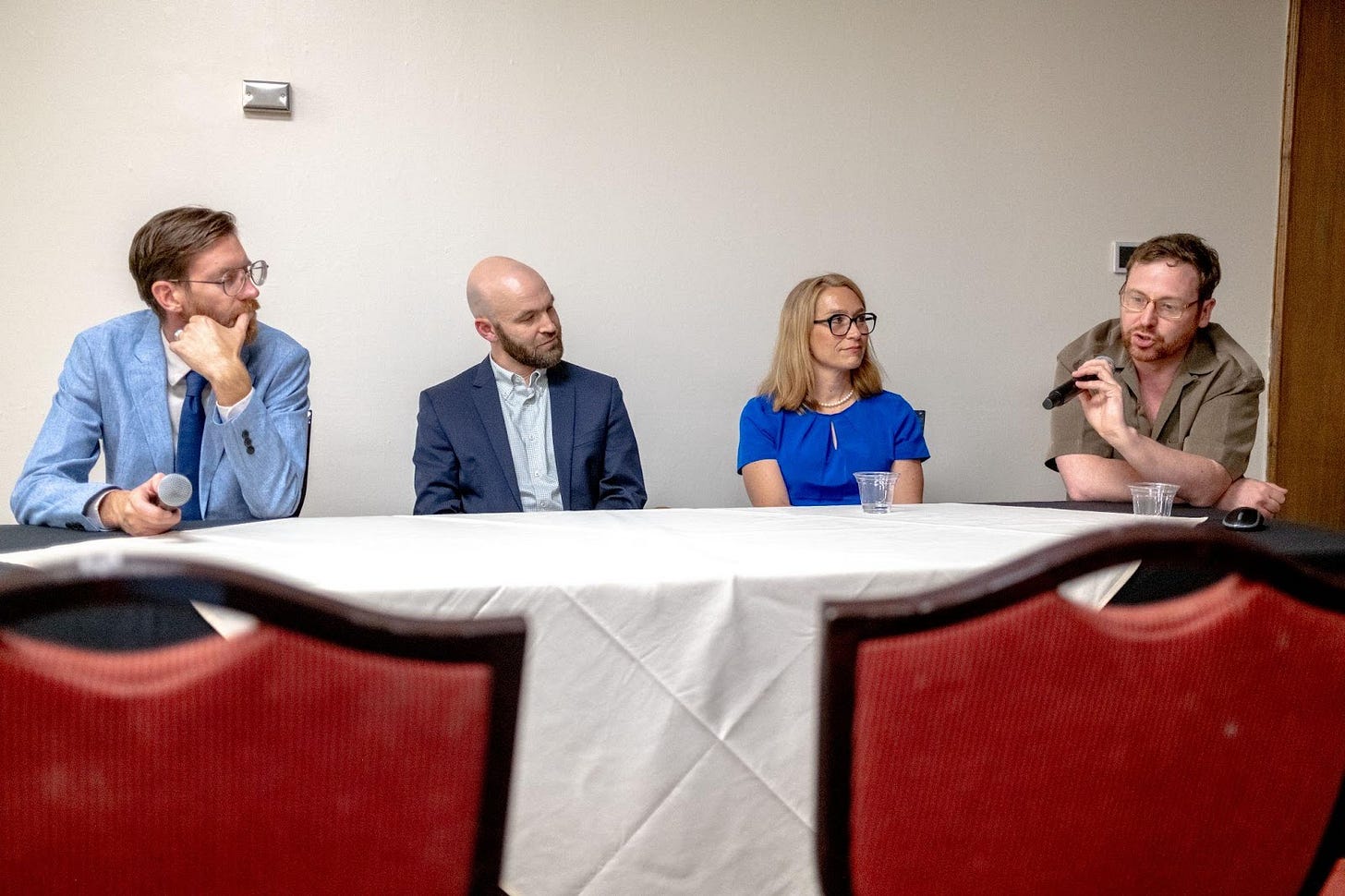
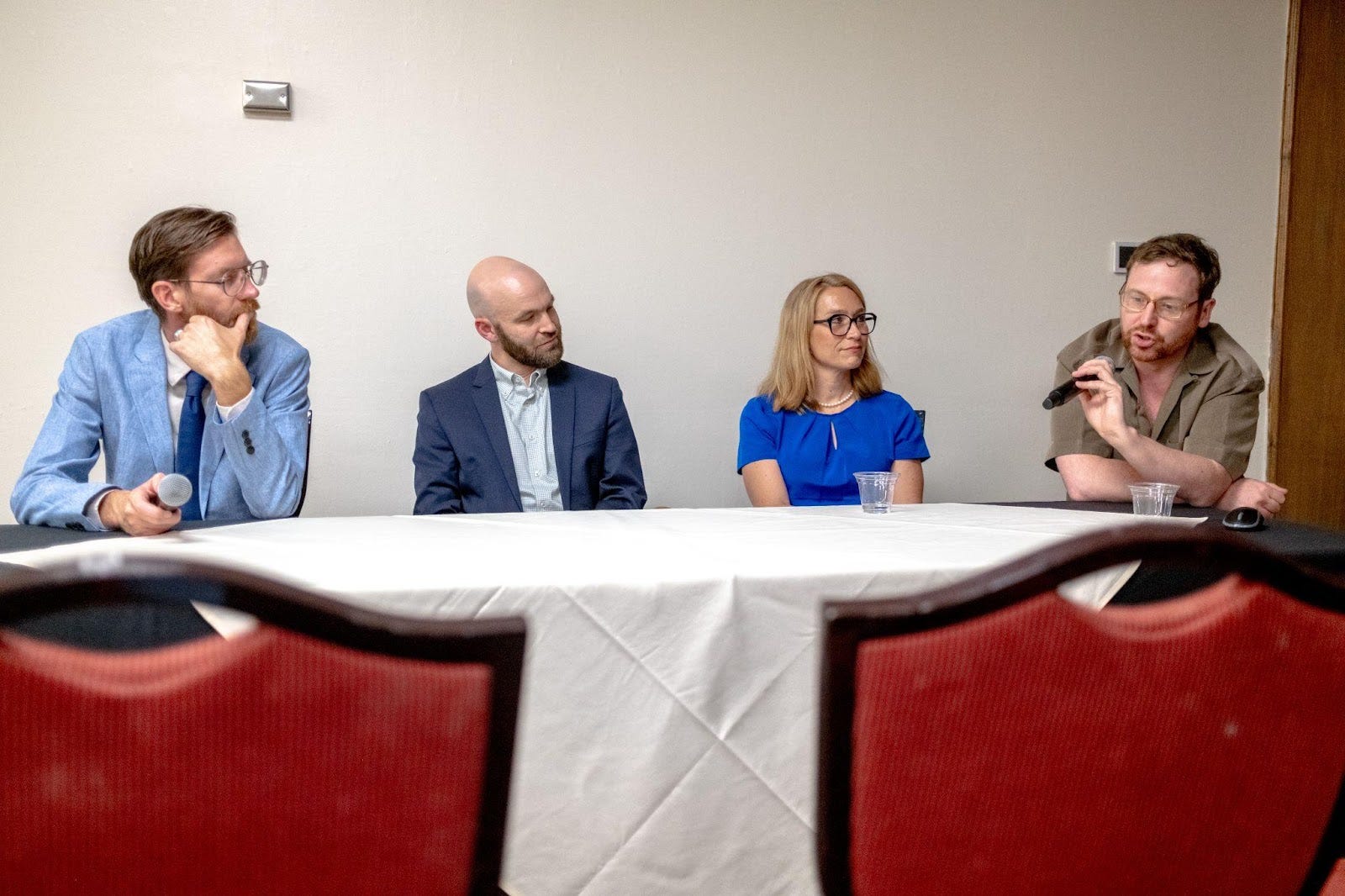
Recently, the Progress and Poverty Institute were hosted by YIMBY Denver for an event on LVT in Denver. Their panel included Josie Faass, Stephen Hoskins, and Sen. Hinrichsen, and showed how an LVT would cut taxes for most homeowners and renters, shift the burden onto vacant land and parking lots, and support equitable growth. Enabling legislation is needed, but the political and grassroots energy is growing. Hinrichsen pledged to reintroduce his LVT bill next session.
UK
The land tax conversation isn’t just American. In the past month, the National Institute of Economic and Social Research (NIESR) suggested that the UK seriously consider LVT as part of reform. Why? Because council taxes are outdated, regressive, and poorly aligned with today’s land values.
Public frustration with council taxes has grown, and recent commentary (see links below) highlights the urgency of replacing them with a system that more fairly captures land value. Will they implement a land value tax? Unlikely as of yet, but the narrative is more than dormant.
As an aside, In the Guardian Commentary, the opinion quotes Tom Johnston, a Scottish thinker who would go on to be Secretary of State in WW2. Johnston should not be confused with Tom Johnson, the Georgist Cleveland Mayor who secured big wins for the city. However, I did some digging, and perhaps the comparison is closer than just the name.
Johnston wrote an entire book, Our Scots Noble Families, exposing the nobles of his time and their ties to land values by which they did not have legitimate claim. In the introduction, he writes:
Today, In Scotland, our artisans and peasants appear to believe that these ancient noble families hold their privileges and lands at the earnest behest of Divine Providence; that their wealth has been justly earned; and that their titles are but rewards for honest service to the State.
The first step in Reform, either of the Land Laws or of the House of Lords, is to destroy these superstitions. Show the people that our Old Nobility is not noble; that its lands are stolen lands – stolen either by force or fraud…
Johnston’s most lasting legacy was the creation of the North of Scotland Hydro Electric Board, which he set up to provide power to the Highlands despite landlords' objections. To historians out there, Johnston may be a figure worth studying.
LVT Candidates
On top of the mayoral races, there are supporters running for offices across the country. If you like what they stand for, consider volunteering or donating:
- John Lembke — Longmont, CO City Council
- Diante Edwards — Maryland Delegate
- Katie Wilson — Seattle, WA Mayor
- Keith Linhares — Worcester, MA City Council
Know of others? Send them my way.
Other Readings
- Asterisk: The Georgist Roots of American Liberalism
- Guest Opinion: It’s time for Ogden to shrink government and grow the free market
That’s the latest from the front lines of the land value tax movement. See you on September 26th at LVT Landscape Live!
Greg Miller is the Co-Director of the Center for Land Economics. Reach out: [email protected].