Capital in the Twenty-First Century
Piketty's bestselling data-driven inequality book documents rising wealth-income ratios and capital's share of income — the empirical starting point that Rognlie, Bonnet et al., and La Cava later re-decompose as substantially a land/housing phenomenon.
Summary
Capital in the Twenty-First Century is a 2013 book by French economist Thomas Piketty (Paris School of Economics, EHESS), published in French as Le Capital au XXIe siècle and in English translation by Arthur Goldhammer in 2014 by the Belknap Press of Harvard University Press. Built on more than a decade of historical data work by Piketty and collaborators (including Emmanuel Saez, Gabriel Zucman, and Anthony Atkinson) assembled in the World Wealth and Income Database, the book documents long-run trends in wealth and income concentration across France, the UK, the US, and other advanced economies, in some series stretching back to the 18th century. It became an unexpected global bestseller and one of the most widely discussed economics books of the 2010s, credited with returning wealth and capital concentration — as opposed to income inequality alone — to the center of both academic and popular economic debate.
Piketty is not a Georgist and the book does not discuss land value taxation or Henry George. Its relevance to this wiki is almost entirely as an empirical starting point that other researchers re-decomposed: the book's headline data on rising wealth-income ratios and a rising capital share of income is the very dataset that Matthew Rognlie's 2014–2015 critique worked from and reinterpreted as substantially a story about housing, and therefore land, rather than about the broad category "capital" (machines, equipment, financial assets) that Piketty's framing emphasizes. Because of this, the book is best read on this wiki not as a piece of pro-land-tax or land-decomposition research in its own right, but as the widely credentialed data source and thesis that the land-decomposition literature (Rognlie, Bonnet et al., La Cava, Knoll-Schularick-Steger) subsequently refines and partially redirects.
The Core Argument
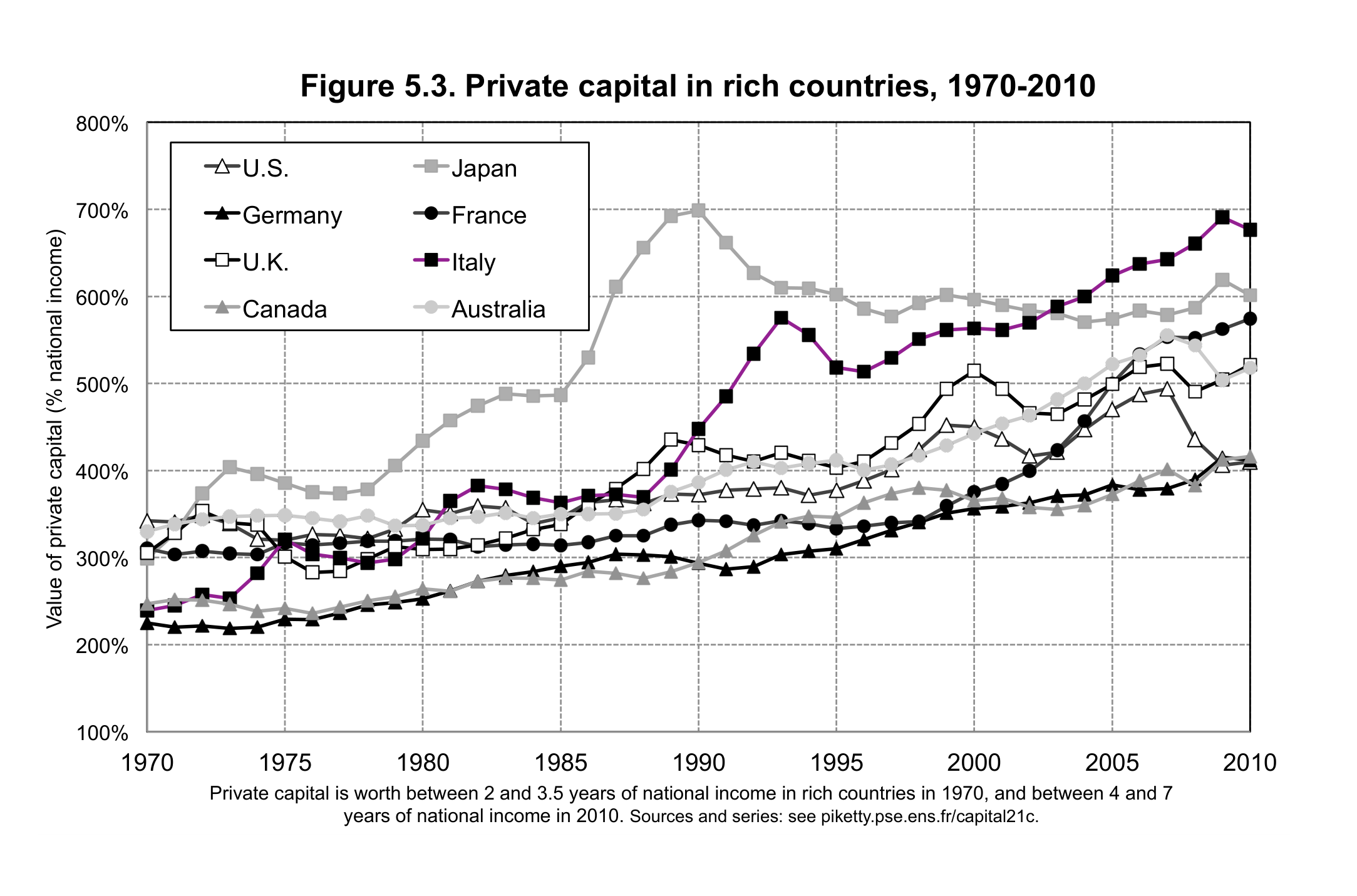
- Wealth-income ratios have risen back toward historically high, pre-WWI levels. Using national accounts and historical wealth estimates, Piketty (with Zucman, in the companion paper "Capital is Back," Quarterly Journal of Economics, 2014) shows that private wealth-to-national-income ratios in the US, UK, France, Germany, Japan, and other rich countries fell sharply across the World Wars and mid-20th century, then rose steadily since 1970 back toward historically high, pre-WWI levels. Piketty's own open-access figures state this precisely: "Private capital is worth between 2 and 3.5 years of national income in rich countries in 1970, and between 4 and 7 years of national income in 2010" (Figure 5.3), and for Europe specifically, "Aggregate private wealth was worth about 6-7 years of national income in Europe in 1910, between 2 and 3 years in 1950, and between 4 and 6 years in 2010" (Figure 3.2). [Verified against Piketty's open-access figure captions at piketty.pse.ens.fr/capital21c; the companion Piketty & Zucman (2014) QJE paper carries the same series.]
- The central r > g mechanism. Piketty's headline theoretical claim (interpretive/ argumentative, built on the empirical r and g series) is that whenever the rate of return on capital (r) persistently exceeds the economy's growth rate (g), wealth accumulated in the past grows faster than output and income, so inherited wealth tends to dominate wealth created through current work and enterprise, and wealth concentration rises over time absent countervailing shocks (wars, depressions) or policy (progressive taxation). Piketty reports that historically r − g has typically been on the order of several percentage points, narrowing sharply only during the mid-20th-century era of wars, high growth, and progressive taxation, and argues this gap is likely to widen again as growth slows in the 21st century. His open-access Figure 10.9 states the empirical pattern directly: "The rate of return to capital (pre-tax) has always been higher than the world growth rate, but the gap was reduced during the 20th century, and might widen again in the 21st century," with the pure pre-tax rate of return "roughly stable around 4%-5% in the long run" against a world growth rate historically well below 2% until the 20th century. [Verified against Piketty's open-access figures at piketty.pse.ens.fr/capital21c, Figures 6.4 and 10.9.]
- Rising capital's share of national income. Piketty presents the rise in wealth-income ratios alongside a rise in the share of national income accruing to capital (as opposed to labour) in several advanced economies since the 1970s–1980s, treating this as a related and mutually reinforcing trend with the wealth-ratio rise.
- Proposed remedy: a global progressive wealth tax. Piketty's main policy proposal is a coordinated, progressive annual tax on individual net wealth (capital in Piketty's broad sense, spanning financial assets, business equity, and real estate), which he argues is better suited than income taxation alone to arresting rising wealth concentration, alongside highly progressive income and inheritance taxation. The book does not propose or discuss a land value tax, and it does not treat land or housing as a category requiring separate tax treatment from other forms of capital.
Relation to the Georgist Case
Piketty's book supplies the widely credentialed raw material and framing question — is capital's share of income and the stock of accumulated wealth rising, and if so why — that the land-decomposition literature treated elsewhere as central evidence answers with a specific, narrower claim: that the rise Piketty documents is concentrated in housing, and within housing substantially in the land component rather than in reproducible structures or productive equipment.
- Matthew Rognlie's 2014 note and 2015 Brookings Papers article directly re-analyze Piketty's own data (and the underlying national accounts) and report that once depreciation is properly netted out, the long-run rise in the net capital share across seven major advanced economies is concentrated in housing; ex-housing, the net capital share shows little long-run trend. Rognlie states the conclusion sharply in his abstract: "Overall, the net capital share has increased since 1948, but once disaggregated this increase turns out to come entirely from the housing sector: the contribution to net capital income from all other sectors has been zero or slightly negative." He adds that "housing's average portion of the aggregate net capital share rose from roughly 3 percent to 9 percent over the sample period, even as the private sector fell from 23 to 20 percent." [Verified verbatim against the Brookings PDF, abstract and p. 3. Note: the widely-circulated paraphrase "vanishes once we remove housing" is a secondary gloss (Marginal Revolution), not Rognlie's own wording, and has been replaced here with his verbatim statement.]
- Bonnet, Chapelle, Trannoy & Wasmer (2021) independently confirm, using French and other European data, that the long-run rise in wealth-income ratios Piketty documents is overwhelmingly a rise in land values, not produced capital.
- La Cava (2016) and Knoll, Schularick & Steger (2017) further refine why housing's income and price contribution rose (falling mortgage rates interacting with inelastic land supply; land, not construction cost, driving the postwar house-price boom), reinforcing the same land-centred reading of the Piketty-era data.
Piketty did not accept this reframing without qualification. In the broader debate over Rognlie's critique, Piketty and Zucman acknowledge that housing capital's income share has risen, consistent with Rognlie, but — according to secondary accounts of the exchange (see the note below) — maintain that a meaningful rise in the non-housing capital share remains in some of their preferred specifications. The characterization of the residual non-housing rise as driven by market power / markups rather than by a rising "pure" return to reproducible capital is Rognlie's own: in his primary text he decomposes non-housing capital into equipment, structures, and land plus a residual "that can be interpreted as representing firm markups over cost," and finds that "Markups are responsible for most of the change in shares, in both directions; in particular, accumulation of equipment or structures cannot explain the recent rise" [verified against the Brookings PDF, p. 3]. A note on provenance for the Piketty–Zucman attribution above: the underlying primary paper, Piketty & Zucman, "Capital is Back: Wealth–Income Ratios in Rich Countries 1700–2010," QJE 129(3), 2014, has been consulted in full (piketty.pse.ens.fr / gabriel-zucman.eu). It predates Rognlie's critique and contains no US-specific "non-housing capital share rises" rejoinder. What it does state is (a) that excluding housing from wealth is "inappropriate," because housing "typically represents about half of the capital stock" and the housing/business frontier is porous (n. 17), and (b) the theoretical claim that with a capital–labour elasticity of substitution moderately above 1, rising capital–output ratios raise the aggregate capital share — with housing included in the capital concept. A targeted search for a standalone Piketty–Zucman document making the specific non-housing-US claim returned only Rognlie's own notes and Brookings paper, not a Piketty–Zucman rejoinder. The sentence above should therefore be read as characterizing the broad Piketty–Zucman position (housing belongs in capital; the aggregate share rose) documented in the CEPR/VoxEU and Equitable Growth discussions — not a located primary claim that a non-housing rise survives in a preferred US specification, which remains attributable only to those secondary/tertiary accounts. The scholarly consensus that has since formed — reflected in this wiki's capital-share-rise-is-land outcome page, which rates the evidence "Strong (independently replicated across US and European data)" — favours the Rognlie/Bonnet-et-al./La Cava land-centred reading over Piketty's original broad-capital framing, but the point remains contested in its particulars (see Autor et al. (2020) on superstar firms for the leading non-land rival account of a related trend, the falling labour share).
Because the finding this wiki relies on for the capital-share-rise-is-land outcome is Rognlie's and the later literature's re-decomposition of Piketty's data — not a claim Piketty's book itself makes or endorses — readers should understand Piketty's own role here as supplying the credentialed empirical starting point and the thesis being refined, not as itself providing land-specific evidence. The book is indispensable context for that literature; it is not, on its own terms, a source for the land-specific claim.
Nuances and Limits
- Piketty's "capital" is a broad accounting category, not land or housing specifically. It aggregates housing, other real estate, financial assets, and business capital into a single wealth stock; the book's own analysis does not decompose this stock into land versus structures versus financial/productive capital, which is precisely the decomposition Rognlie and the subsequent literature perform.
- Methodological critiques beyond the housing/land question. The book drew substantial academic scrutiny on other grounds too — for example, a widely reported Financial Times investigation (Chris Giles, Financial Times, May 23 2014) raised questions about data transcription and adjustments in the underlying wealth-inequality series for the UK and Europe; Piketty published a detailed rebuttal (dated May 28 2014) disputing the FT's methodology and conclusions, noting that the criticisms "only refer to the series reported in chapter 10 of my book" and that he had put all the underlying Excel files online "precisely because I want to promote an open and transparent debate about these important and sensitive measurement issues." [Verified against Piketty's open-access Response to FT (Technical Appendix to Chapter 10, May 28 2014).]
- The r > g mechanism is a stylized long-run generalization, not a structural growth model. Economists including Rognlie and others have questioned whether the elasticity of substitution between capital and labour that Piketty's projection implicitly assumes is empirically plausible; if capital and labour substitute less easily than Piketty's framing requires, accumulating capital drives down its own rate of return, capping rather than amplifying capital's income share — a point Rognlie's 2014 note makes explicitly as a second, separate critique from the housing-decomposition finding.
- The book's own policy proposal (a global wealth tax) is not a land value tax, and Piketty does not treat land as warranting distinct tax treatment from other capital; readers looking for Piketty's own view on land taxation will not find one in this book.
- Scope. The book's core historical wealth-inequality series concentrate on France, the UK, the US, Germany, and a handful of other rich countries; its global inequality claims beyond these economies rely on thinner data, a limitation Piketty himself acknowledges.
Bears On
- Outcome: Most of the modern rise in the capital share is land, not capital — Piketty's documented rise in wealth-income ratios and capital's income share is the dataset and thesis that Rognlie, Bonnet et al., and La Cava subsequently re-decompose and substantially attribute to land/housing; Piketty's book itself does not establish the land-specific finding, so this page's support for the outcome is indirect — as essential context and the thesis being refined, not as independent land-specific evidence. (T1 ruling 2026-07-11: context-only wiring confirmed —
supports_outcomesstays empty, because the land-specific claim is Rognlie's contribution, not Piketty's; the capital-share claim pages correctly cite Rognlie directly with Piketty as the dataset being decomposed.) - Research: Rognlie (2014), "A Note on Piketty and Diminishing Returns to Capital" — the first and most direct critique/re-decomposition of this book's data.
- Research: Rognlie (2015), "Deciphering the Fall and Rise in the Net Capital Share" — the peer-reviewed development of the housing/land finding.
- Research: Bonnet, Chapelle, Trannoy & Wasmer (2021) — independent European confirmation that the wealth-income ratio rise Piketty documents is a land-price phenomenon.
- Research: La Cava (2016) — supplies a causal mechanism (falling mortgage rates, inelastic land supply) for the housing-income-share rise within Piketty-era capital-share data.
- Research: Autor, Dorn, Katz, Patterson & Van Reenen (2020) — the leading rival, non-land explanation for a related trend (the falling labour share), relevant to assessing how much of "capital's rise" beyond housing is genuinely a land story.
- Concept: Economic Rent — the underlying theoretical category (land rent as a return distinct from capital's return) that the Georgist reframing of Piketty's data depends on.
See Also
- Thomas Piketty
- Deciphering the Fall and Rise in the Net Capital Share (Rognlie 2015)
- A Note on Piketty and Diminishing Returns to Capital (Rognlie 2014)
- Land is Back, It Should Be Taxed, It Can Be Taxed (Bonnet et al. 2021)
- Housing Prices, Mortgage Interest Rates and the Rising Share of Capital Income (La Cava 2016)
- Most of the modern rise in the capital share is land, not capital
- Economic Rent
Sources
- Thomas Piketty (2014), Capital in the Twenty-First Century, trans. Arthur Goldhammer, Belknap Press of Harvard University Press. Harvard University Press — used for publisher, translator, and publication details. Piketty's open-access supporting materials (figures, data, technical appendix) are posted at piketty.pse.ens.fr/capital21c: the Figures & Tables PDF supplied the verified wealth/income-ratio captions (Figs 3.2, 5.3) and the r-vs-g captions (Figs 6.4, 10.9); the Technical Appendix Response to FT (May 28 2014) supplied the verified Piketty rebuttal to the Chris Giles / Financial Times critique.
- Thomas Piketty & Gabriel Zucman (2014), "Capital is Back: Wealth-Income Ratios in Rich Countries, 1700–2010," Quarterly Journal of Economics 129(3), pp. 1255–1310. QJE/Oxford Academic · author copy — used for the wealth-income ratio figures and the companion dataset underlying the book's core empirical claims.
- Matthew Rognlie (2014), "A Note on Piketty and Diminishing Returns to Capital." PDF — wiki summary — used for the diminishing-returns critique and the first statement of the housing/land re-decomposition.
- Matthew Rognlie (2015), "Deciphering the Fall and Rise in the Net Capital Share," Brookings Papers on Economic Activity. PDF · Brookings summary — wiki summary — used for the peer-reviewed housing-decomposition finding and the "vanishes once we remove housing" characterization of Piketty's data.
- Odran Bonnet, Guillaume Chapelle, Alain Trannoy & Etienne Wasmer (2021), "Land is Back, It Should Be Taxed, It Can Be Taxed," European Economic Review 134. PDF — wiki summary — used for the European confirmation of the land-centred reading.
- Gianni La Cava (2016), "Housing Prices, Mortgage Interest Rates and the Rising Share of Capital Income in the United States," BIS Working Papers No. 572. PDF — wiki summary — used for the mechanism linking falling interest rates and inelastic land supply to the housing-income-share rise.
- Marginal Revolution (Tyler Cowen), "Matt Rognlie on Piketty, net capital returns, and housing" (2015). Marginal Revolution — used as a secondary source corroborating Rognlie's headline conclusion and its wording, since direct access to the primary PDF's exact page text was unavailable.
As of 2026-07, the wealth/income-ratio figures, the r > g pattern, the Rognlie "housing" decomposition quotation, and the Piketty response to the Financial Times have been verified verbatim against open-access primary sources — Piketty's capital21c figures & technical appendix and Rognlie's Brookings PDF — and the marked reconstructed quotations were replaced with verbatim source text. One item remains open: the Piketty–Zucman side of the exchange with Rognlie (their claim that a non-housing capital-share rise survives in their preferred specification) is documented only in secondary/tertiary accounts, not a single standalone primary rejoinder; a future editor should cite the specific Piketty–Zucman specification directly if located. The book's own paywalled prose (exact page numbers within the HUP edition) was not quoted here; the load-bearing empirical claims are instead sourced to Piketty's own open-access figures and data, which carry the same series.