Housing Prices, Mortgage Interest Rates and the Rising Share of Capital Income in the United States
BIS/RBA paper showing the postwar rise in US housing's income share is overwhelmingly imputed rent to owner-occupiers, driven by falling mortgage rates and concentrated in supply-constrained states — a land-scarcity story.
Summary
"Housing Prices, Mortgage Interest Rates and the Rising Share of Capital Income in the United States" is a 2016 paper by Gianni La Cava, an economist then at the Reserve Bank of Australia (RBA). It was published simultaneously in two peer institution working-paper series: as Bank for International Settlements (BIS) Working Paper No. 572 (July 2016) and as RBA Research Discussion Paper 2016-04, with identical title, abstract, and content, as both institutions' publication pages confirm. The paper sits squarely in the post-Piketty literature on the rising income share of capital, alongside Rognlie (2015) and Bonnet, Chapelle, Trannoy & Wasmer (2021), but contributes a distinct empirical strategy: rather than a purely national-accounts decomposition, La Cava exploits US state-level panel variation (1978–2012) in mortgage rates, inflation, and housing-supply elasticity to identify why housing's share of income rose, not just that it did. Publication by two central-bank research departments — institutions with no Georgist affiliation — gives the paper the same "mainstream, not fringe" evidentiary weight this wiki attaches to comparably-sourced results.
The Core Argument and Findings
- Housing's share of US national income roughly doubled over six decades. La Cava documents that gross housing output rose from about 7.8 percent of GDP in 1950 to about 12.3 percent in 2014, and that housing capital income (net operating surplus, i.e., after depreciation) rose from roughly 3 percent of GDP in 1950 to about 7 percent by 2014. Within that total, the owner-occupier share of income rose from just under 2 percent (1950) to close to 5 percent (2014) — the paper's central object of interest, since owner-occupied housing (unlike rental housing) generates no market transaction and is measured in the national accounts via imputed rent.
- The rise is concentrated in imputed rent to owner-occupiers, not landlord profit on rental housing. This is the paper's headline distinction: decomposing the housing capital-income share shows the long-run increase is "mainly due to higher imputed rental income going to owner-occupiers," not to a rising share of market rent captured by landlords of rental property.
- Net housing profit income (after subtracting mortgage interest) rose even faster than capital income. Between 1980 and 2014, net housing capital income rose from about 3.1 percent to about 4.9 percent of GDP, while net housing profit income (capital income minus mortgage-interest payments) rose more sharply, from about 0.2 percent to about 2.9 percent. La Cava attributes this wider rise in profit income specifically to the decline in mortgage interest rates over the period: falling debt-servicing costs let owner-occupiers retain a growing share of imputed rental income as profit rather than paying it out as interest.
- Quantitatively, La Cava estimates falling interest rates explain roughly half the long-run rise. Using the state-panel regressions, a 100-basis-point decline in nominal mortgage rates is associated with an increase in the housing capital-income share of roughly 8–22 basis points (specification-dependent), and a larger effect on the owner-occupier profit share specifically. Given that mortgage rates fell by an average of about 17 basis points a year over the sample while the housing capital-income share rose by about 7.4 basis points a year, the paper concludes that "the long-term decline in interest rates can explain more than half the increase" in the relevant housing-income share since the early 1980s.
- Housing-supply elasticity is the key source of cross-sectional heterogeneity. La Cava merges his state panel with Saiz's (2010) metropolitan-level housing-supply-elasticity index (aggregated to the state level) and finds the interest-rate effect on housing's income share is significantly larger in supply-inelastic states than in supply-elastic ones — for example, a 100-basis-point rate decline is associated with roughly 32 basis points of increase in housing capital-income share in the most inelastic states versus roughly 22 basis points in the most elastic ones, a statistically significant difference. Supply-inelastic states' contribution to aggregate housing capital income rose over the sample while elastic states' contribution stayed roughly flat, and the paper reports a negative correlation (around −0.5) between a state's housing-supply elasticity and its housing-income growth from 1980–2014: the more constrained the supply, the faster the housing-income share grew.
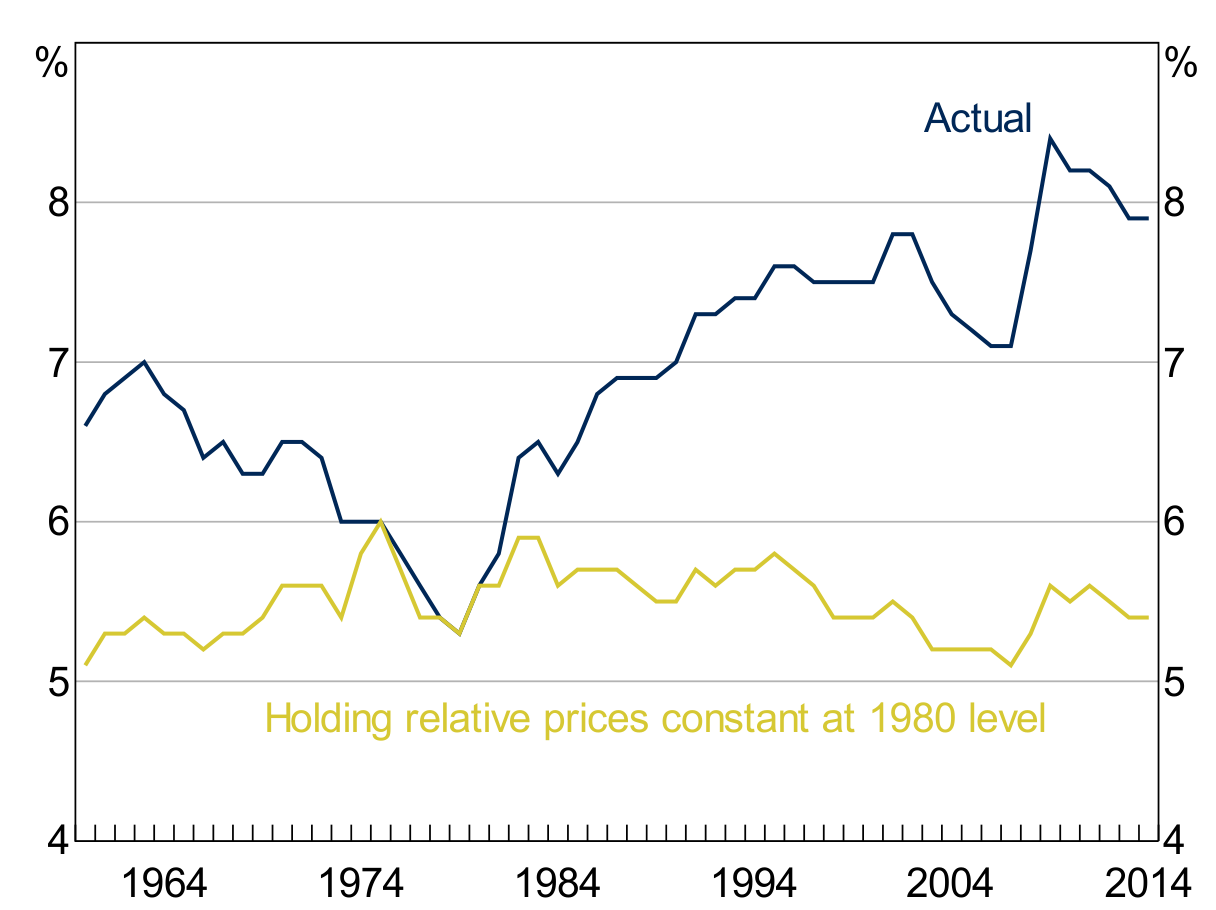
- The entire rise is a relative-price phenomenon, not a rise in the real quantity of housing services. La Cava reports that the rise in the relative price of housing services (rent relative to other consumer prices) "explains more than 100 per cent of the rise in the housing share of the economy" over the last quarter-century in his sample — i.e., in real, volume-adjusted terms, housing's share of output has been flat or falling since the 1960s. This is the paper's clearest link to a land-scarcity story: since the quantity of housing services was not rising, the increase in nominal housing income had to come from rising prices for a relatively fixed factor, which the paper's supply-elasticity results identify as concentrated where land is scarce.
- A supplementary identification strategy links credit deregulation to relative house-price gains in inelastic markets. In an appendix, La Cava uses the staggered interstate bank-branching deregulation of the 1980s–1990s as a difference-in-differences design and finds that relative housing prices rose more (on the order of a few percentage points) in supply-constrained metro areas after deregulation than in supply-elastic ones, consistent with an easier-credit-to-land-scarce-market transmission channel rather than a pure demographic or income story.
Relation to the Georgist Case
La Cava's paper is best read as a mechanism-level complement to the Rognlie/Bonnet-et-al./Knoll-Schularick-Steger cluster of findings this wiki already documents under Most of the modern rise in the capital share is land, not capital: where those papers show that the postwar capital-share rise is concentrated in housing (Rognlie; Bonnet et al.) and that long-run house-price appreciation is overwhelmingly a land-price, not construction-cost, phenomenon (Knoll, Schularick & Steger 2017), La Cava supplies a specific, tested causal mechanism for the US case: falling mortgage rates raised the imputed-rent value households derive from owner-occupied housing, and that effect was quantitatively concentrated in states where housing supply is inelastic — i.e., where the marginal response to rising demand is a higher price for the fixed factor (land) rather than more construction. That the effect all but disappears in supply-elastic states, and that the rise is entirely a relative-price rather than a real-quantity phenomenon, is consistent with the Georgist reading that the "rising capital share" is substantially a rising land-rent share rather than a return to reproducible housing capital.
The paper does not itself use Georgist framing or discuss land value taxation, and it does not attempt to separate land value from structure value directly (unlike Knoll, Schularick & Steger, which computes an explicit land/structure price decomposition). Its evidentiary contribution to the Georgist case is therefore indirect but pointed: it identifies the mechanism (interest-rate-driven demand hitting an inelastic land supply) that would produce a land-rent-driven rise in the capital share, and shows that mechanism is empirically present and geographically concentrated exactly where Georgist theory would predict — in supply-constrained markets.
Nuances and Limits
- The paper measures housing capital/profit income, not a land/structure price decomposition. Unlike Knoll, Schularick & Steger (2017), La Cava does not directly separate the land component of house value from the structure component; his inference that the rise is a land-scarcity phenomenon rests on the supply-elasticity heterogeneity result and the "more than 100 percent explained by relative price" finding, not on a direct land-value measure. The wiki should present this as strong circumstantial/mechanism evidence for a land story, not as a direct land-value decomposition.
- Aggregate (time-series) coefficients on interest rates and inflation lose statistical significance once year fixed effects are included, because most of the variation in national mortgage rates and inflation over the sample is time-series (common across states) rather than cross-sectional. La Cava's causal claims about the magnitude of the interest-rate effect on the aggregate housing share therefore rely more heavily on cross-sectional heterogeneity (the supply-elasticity interaction) than on a fully identified aggregate time-series estimate, which he acknowledges limits how cleanly the aggregate "explains more than half" claim can be interpreted as strictly causal.
- State-level data combine housing with other real estate, and lack state-specific depreciation rates, which La Cava flags as a data limitation; he argues the effect of the missing depreciation adjustment is likely small and roughly time-invariant, but this is an assumption rather than a directly tested robustness check.
- The bank-deregulation difference-in-differences design assumes deregulation timing was not driven by local housing-market conditions. La Cava defends this using external evidence (Kroszner & Strahan 1999) that deregulation timing tracked state-level small-bank political lobbying power rather than local housing conditions, but this remains an identifying assumption rather than a randomized or fully exogenous shock.
- US-only scope. The paper analyzes only the United States; La Cava suggests similar dynamics likely hold in other advanced economies with comparable mortgage-finance systems and supply constraints, but does not test this, so the finding should not be read as already-established cross-country evidence in the way the Knoll-Schularick-Steger 14-country panel is.
- No land value tax policy discussion. As with Saiz (2010) and Knoll-Schularick-Steger, this is a positive/empirical paper, not a policy paper; it does not evaluate LVT or any other land-tax instrument, and this wiki's inference that the mechanism supports the Georgist case is the wiki's own framing, not the author's.
Bears On
- Outcome: Most of the modern rise in the capital share is land, not capital — supplies a tested US mechanism (falling mortgage rates raising owner-occupier imputed rent, concentrated in supply-inelastic states) for why the capital-share rise documented by Rognlie and Bonnet et al. behaves like a land-rent phenomenon rather than a return to reproducible capital.
- Research: Rognlie (2015) — La Cava's finding that essentially all of the rise is imputed rent to owner-occupiers, not landlord profit on rental housing, refines where within housing Rognlie's capital-share result is concentrated.
- Research: Knoll, Schularick & Steger (2017) — provides the long-run land/structure price decomposition that La Cava's mechanism (inelastic-supply-driven price appreciation) would be expected to produce, though the two papers use different data and methods and neither directly tests the other's claim.
- Research: Saiz (2010), The Geographic Determinants of Housing Supply — La Cava's central identification device is Saiz's supply-elasticity index; the interest-rate effect on housing income is significantly stronger where Saiz's index indicates land is scarce.
- Concept: Economic Rent — La Cava's finding that the entire rise is a relative-price phenomenon (not a rise in real housing quantity) in supply-constrained markets is an applied instance of rent accruing to a fixed factor as demand rises.
See Also
- Imputed Rent
- Deciphering the Fall and Rise in the Net Capital Share (Rognlie 2015)
- Land is Back, It Should Be Taxed, It Can Be Taxed (Bonnet et al. 2021)
- No Price Like Home: Global House Prices, 1870–2012 (Knoll, Schularick & Steger 2017)
- The Geographic Determinants of Housing Supply (Saiz 2010)
- Economic Rent
- Most of the modern rise in the capital share is land, not capital
Sources
- Gianni La Cava (2016), "Housing Prices, Mortgage Interest Rates and the Rising Share of Capital Income in the United States," BIS Working Papers No. 572, Bank for International Settlements. PDF — used for the paper's title, authorship, venue, and abstract; primary version cited in frontmatter
source_url. - Gianni La Cava (2016), "Housing Prices, Mortgage Interest Rates and the Rising Share of Capital Income in the United States," Research Discussion Paper 2016-04, Reserve Bank of Australia. RBA full text — used for the detailed methodology, all reported magnitudes (housing-share time series, interest-rate coefficients, supply-elasticity interaction results, the "more than 100 per cent" relative-price finding, and the appendix deregulation results), and the author's own stated limitations; confirmed as an identically-titled companion publication of the same study.
- IDEAS/RePEc listing for BIS Working Paper 572. IDEAS/RePEc — used to independently confirm the abstract wording (including the direct quotes "the long-run increase in the aggregate share of housing capital income is mainly due to higher imputed rental" and "the long-term decline in interest rates can explain more than half the increase") and to confirm the BIS/RBA dual-publication relationship.
- IDEAS/RePEc listing for RBA RDP 2016-04. IDEAS/RePEc — used as a secondary independent confirmation of the RBA companion version's existence and identical scope.
- Albert Saiz (2010), "The Geographic Determinants of Housing Supply," Quarterly Journal of Economics 125(3) — wiki summary — used for context on the supply-elasticity index La Cava employs as his cross-sectional identification device.
Both renderings of the study were read at last review (2026-07-03), so the methodological detail is not single-sourced: the BIS Working Paper 572 PDF and an archived copy of the RBA full text agree verbatim on the key figures — both state that "the rise in the price of rent (relative to non-housing prices) explains more than 100 per cent of the rise in the housing share of the economy over the past quarter of a century" (near Figure 4) — and together corroborate the state-fixed-effects specification and the interest-rate/supply-elasticity results. The RBA RDP 2016-04 and BIS WP 572 are the same study issued through both series; exact BIS table and page numbers are not yet recorded.