No Price Like Home: Global House Prices, 1870–2012
New annual house-price indices for 14 advanced economies, 1870–2012, showing real prices were flat for eight decades then rose sharply after 1950 — a boom the authors attribute mostly to rising land prices, not construction costs.
Summary
"No Price Like Home: Global House Prices, 1870–2012" is a research article by Katharina Knoll (Deutsche Bundesbank/University of Bonn), Moritz Schularick (University of Bonn, later Sciences Po/Kiel Institute), and Thomas Steger (University of Leipzig), published in the American Economic Review, volume 107, issue 2 (February 2017), pp. 331–353 (DOI: 10.1257/aer.20150501). It circulated earlier as a CEPR Discussion Paper, a Federal Reserve Bank of Dallas Globalization Institute working paper, and a CESifo working paper (all 2014) before appearing in the AER. The paper's contribution is empirical rather than theoretical: it assembles, largely from scratch, the first long-run, internationally comparable annual house-price dataset covering 14 advanced economies over roughly 140 years (from 1870, or from the 1890s–1900s for a few countries where earlier data do not exist, through 2012). Publication in one of the discipline's five top general-interest journals gives the dataset and its headline finding — that the post-1950 house-price boom is overwhelmingly a land-price phenomenon — considerable weight as a mainstream empirical reference point, independent of any Georgist framing. The AEA abstract states: "Rising land prices explain about 80 percent of the global house price boom that has taken place since World War II."
The Core Argument and Findings
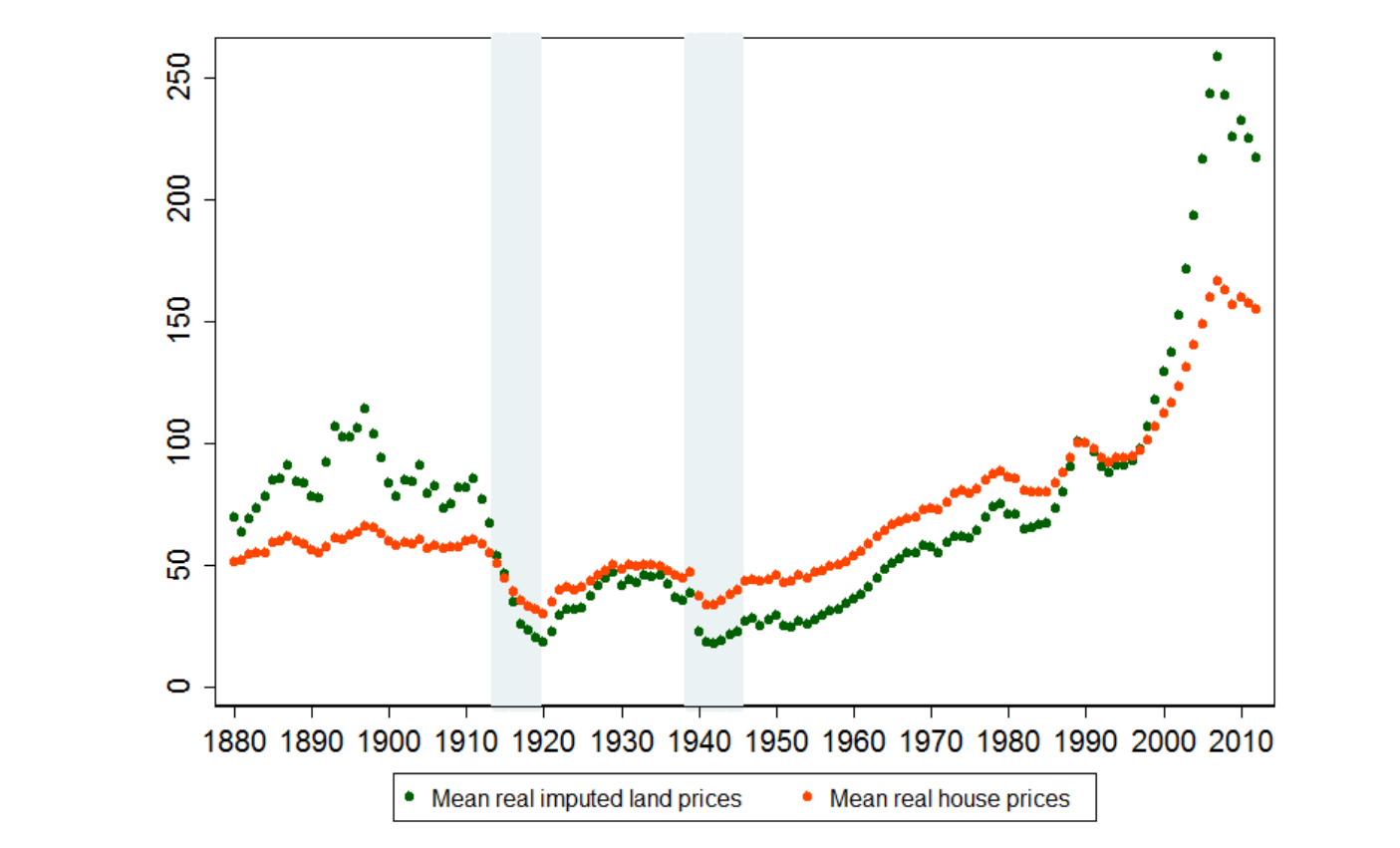
- Real house prices were essentially flat for 80 years, then rose sharply. Across the 14-country panel, real (inflation-adjusted) house prices show no clear trend from the late nineteenth century to roughly the mid-twentieth century, but rise strongly — with substantial variation across countries — over the second half of the twentieth century and into the 2000s. This is a purely empirical, descriptive finding drawn directly from the constructed price series, not a theoretical prediction.
- The post-1950 boom is a land-price story, not a construction-cost story. The paper's central and most-cited claim is that decomposing house prices into land and structure components shows rising land prices — not rising replacement/construction costs — explain about 80 percent of the global house-price increase since World War II. The abstract states: "Land prices, not replacement costs, are the key to understanding the trajectory of house prices. Rising land prices explain about 80 percent of the global house price boom that has taken place since World War II." Construction costs, by contrast, track the price of produced goods and show comparatively little long-run increase relative to land.
- A transport-cost explanation for why land prices were flat before 1950. The authors argue that large, sustained reductions in transport costs before World War II (railways, then early motorization) continuously expanded the effective supply of usable land around cities, which suppressed land-price growth even as populations and incomes grew. Since the mid-twentieth century, comparably large land-augmenting reductions in transport costs have not recurred, so further income and population growth has increasingly bid up the price of a much less elastic land supply. This is presented as the authors' explanatory hypothesis for the flat-then-rising pattern, not as a separately identified causal estimate.
- Rising urbanization frames the demand side. The paper notes the dramatic rise in urban population share over its sample period (for example, roughly 30 percent of Americans lived in cities in 1900 versus roughly 80 percent by 2010) as part of the context for why land in and around cities has become increasingly scarce relative to demand.
- Implications the authors draw out. The paper connects its land-price findings to three broader debates: the long-run evolution of wealth-to-income ratios (a land-driven rise in housing wealth, complementing the Piketty-era capital-share debate), the growth effects of urban agglomeration, and the price elasticity of housing supply (land scarcity, not construction-cost inflation, is the binding constraint on that elasticity in the long run).
Relation to the Georgist Case
This paper functions as the historical backbone for the broader "it's the land" argument this wiki documents elsewhere. Where Rognlie (2015) decomposes the postwar rise in capital's income share and finds it is concentrated in housing, and Bonnet, Chapelle, Trannoy & Wasmer (2021) independently confirm on European wealth data that rising wealth-to-income ratios are a land-price phenomenon, Knoll, Schularick & Steger supply the long-run price series underlying both stories — 140 years of data showing that the land component, not the reproducible-structure component, is what has actually appreciated. The three papers use different data (house-price levels vs. income shares vs. wealth-to-income ratios), different time windows, and different methods, but reach a compatible conclusion: modern advanced-economy asset appreciation is substantially a story about land, the classical Ricardian/Georgist factor that is fixed in supply, rather than about produced capital in the sense George's classical contemporaries and modern growth theory usually mean. Because Knoll et al. are mainstream international macroeconomists publishing in the AER with no Georgist framing, the finding carries the same "not a fringe claim" weight that this wiki attaches to similarly-sourced results (compare Rognlie and the Mirrlees Review).
That said, the paper itself makes no policy argument about land value taxation — it is a pure data/decomposition paper, and any Georgist inference (that untaxed land appreciation is an efficiency and equity problem addressable by LVT) is drawn by this wiki and by other researchers building on the dataset, not asserted by Knoll, Schularick & Steger. The wiki should not overstate the paper as itself a pro-LVT argument.
Nuances and Limits
- It measures house-price composition, not the income share of capital. Unlike Rognlie (2015), this paper does not compute national-accounts capital shares; its claim is about the land/structure decomposition of house prices, and its relevance to the capital-share-rise-is-land outcome is as complementary long-run corroboration of the same underlying land-appreciation phenomenon, not as a direct replication of Rognlie's income-share methodology. The wiki should present it as historical/price-level evidence that reinforces, rather than directly replicates, the capital-share finding.
- The land/structure decomposition depends on the underlying national data sources, which vary substantially in quality and construction across the 14 countries and over 140 years; the authors themselves had to build much of this dataset from disparate national statistical offices, central banks, tax authorities, and real-estate associations, and drew on existing long-run series for a subset of countries (e.g., the Netherlands and Norway) built by earlier economic historians. Cross-country and cross-era comparability of the land/structure split is inherently harder to verify than a single-country, single-methodology series.
- The transport-cost mechanism for the pre-1950 flat period is the authors' explanatory hypothesis, not a separately identified causal test in the sense of an instrumental-variables or natural-experiment design; it is offered as the most plausible account of the pattern, consistent with economic-geography reasoning about effective land supply, but readers should not treat it as definitively proven mechanism.
- The paper is about levels and long-run trend, not a specific cyclical-timing claim. Its 140-year annual series is the kind of long-run land/house-price data that periodicity theories such as the 18-Year Land Cycle — developed by the land economist Homer Hoyt and the economist Fred Foldvary, and popularised by practitioner-authors such as Fred Harrison — rely on for testing recurring booms and busts, but Knoll, Schularick & Steger do not test or endorse a fixed ~18-year (or any other specific) periodicity themselves — their contribution is the trend break around 1950 and its land-price composition, not a cycle-length claim. The paper is therefore not evidence for the 18-year cycle specifically.
- No direct treatment of land value taxation, land assessment, or LVT design questions. The paper is silent on tax policy; its relevance to Georgist arguments is inferential (this wiki's and other researchers' framing), not the authors' own stated purpose.
Bears On
- Outcome: Most of the modern rise in the capital share is land, not capital — provides 140 years of land/structure price-decomposition evidence that the postwar rise in housing-linked wealth is a land phenomenon, complementing Rognlie's and Bonnet et al.'s income- and wealth-share decompositions with a longer-run price series and an explanatory (transport-cost) account of why the land-price trend broke around 1950.
- Concept: 18-Year Land Cycle — supplies exactly the kind of long-run annual land/house-price data that cycle theorists use, though the paper itself neither tests nor claims a fixed periodicity; cited here as background data, not as periodicity evidence.
- Concept: Economic Rent — the paper's land/structure decomposition is an empirical operationalization of the classical distinction between land rent and returns to produced capital.
See Also
- Moritz Schularick
- Deciphering the Fall and Rise in the Net Capital Share (Rognlie 2015)
- Land is Back, It Should Be Taxed, It Can Be Taxed (Bonnet et al. 2021)
- Rethinking the Economics of Land and Housing (Ryan-Collins, Lloyd & Macfarlane 2017)
- 18-Year Land Cycle
- Economic Rent
- The Mirrlees Review: Tax by Design
Sources
- Katharina Knoll, Moritz Schularick & Thomas Steger (2017), "No Price Like Home: Global House Prices, 1870–2012," American Economic Review 107(2): 331–353. DOI: 10.1257/aer.20150501 — used for authorship, venue, and publication details; the AER version itself is paywalled.
- Earlier working-paper versions (same title and content, freely accessible): CESifo Working Paper, ifo Institute, 2014. ifo/CESifo — used as a free-access version of the same study.
- Federal Reserve Bank of Dallas Globalization Institute Working Paper No. 208 (2014), same title. Dallas Fed — listed as an alternative free working-paper mirror.
- American Economic Association, journal listing and abstract for this article. AEA — used for the paper's headline claims (14 countries, flat-then-rising real house prices, "about 80 percent" land-price attribution, transport-cost mechanism, urbanization context, and stated implications for wealth-income ratios, agglomeration, and housing-supply elasticity). The abstract wording was verified verbatim against the AEA page (2026-07-05).
- IDEAS/RePEc listing for the published AER version. IDEAS/RePEc — used as a secondary, independent confirmation of the abstract wording and bibliographic details.
- Replication data archive. openICPSR — noted as the location of the authors' publicly deposited replication dataset.