The Fall of the Labor Share and the Rise of Superstar Firms
The leading non-land explanation of the falling labor share: rising industry concentration toward high-markup 'superstar firms.' The honest empirical counterweight to Rognlie's land/housing decomposition of the rising capital share.
Overview
"The Fall of the Labor Share and the Rise of Superstar Firms" is a 2020 Quarterly Journal of Economics article (135(2), pp. 645–709) by David Autor, David Dorn, Lawrence F. Katz, Christina Patterson, and John Van Reenen, circulated earlier as NBER Working Paper 23396 and building on the same authors' 2017 American Economic Review: Papers and Proceedings companion piece, "Concentrating on the Fall of the Labor Share" (NBER Working Paper 23108). It is one of the most cited modern accounts of why labor's share of national income has fallen across advanced economies, and it explains that fall without invoking land — it attributes the decline primarily to rising market concentration and the growing weight of high-markup, low-labor-share "superstar firms", which the authors frame substantially as a story of technology-driven productivity divergence between firms rather than of rent extraction. For a wiki built around the claim that land rent is the central driver of rising non-labor income, this paper is important precisely because it is the most credible rival explanation of the same broad phenomenon — and it deserves to be represented on its own terms, not as a strawman.
Findings
The mechanism. The authors set out a "superstar firm" model: if globalization or technological change disproportionately advantages the most productive firms in an industry, sales reallocate toward those firms, product-market concentration rises, and industries become increasingly dominated by "superstar firms" that combine high markups with a low share of value added going to labor. As these superstar firms account for a growing share of economic activity, the aggregate labor share falls — even without any general decline in the labor share within individual firms. The 2017 working paper frames this as industries becoming increasingly "winner take most," a "feature where a small number of firms gain a very large share of the market" — firms that are highly productive, highly profitable, and (the paper's key point) low-labor-share.[1]
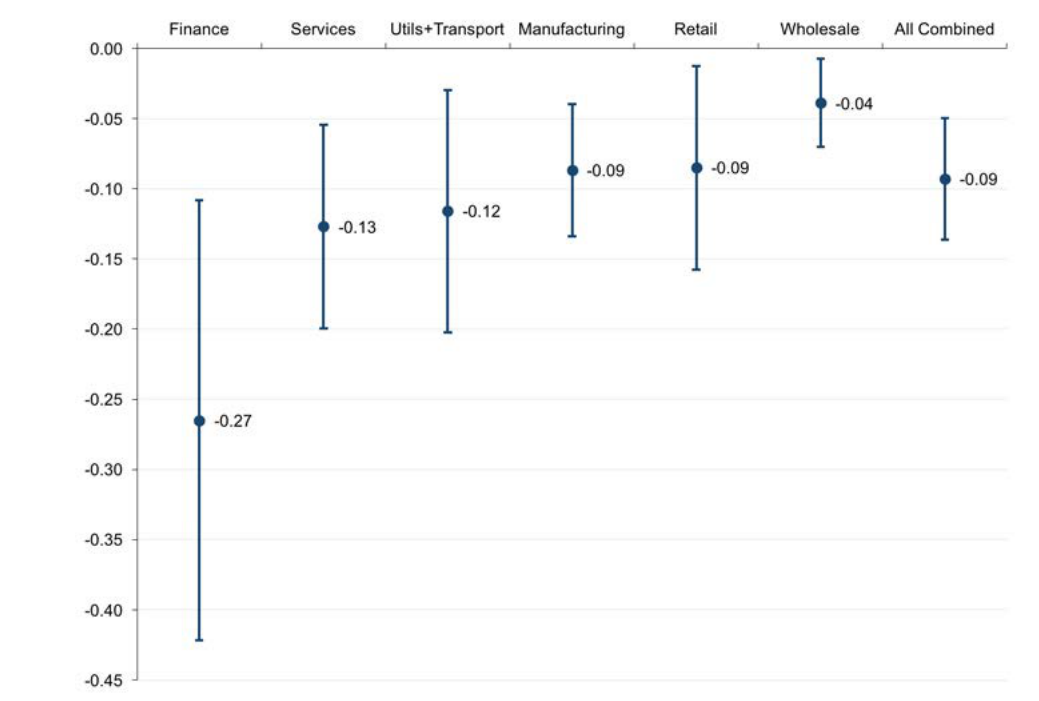
The evidence base. The core empirical analysis uses U.S. Economic Census micro/firm-level establishment- and firm-level U.S. Economic Census panel data from 1982 to 2012, covering the "six major sectors" of the U.S. economy — manufacturing, retail trade, wholesale trade, services, utilities and transportation, and finance — which the authors note "comprise approximately 80 percent of total private sector employment."[1] Within this data the authors document two central, empirically confirmed patterns: (1) sales concentration (measured by four-firm and twenty-firm concentration ratios) has risen across most of the U.S. private sector since the early 1980s; and (2) industries with larger increases in concentration show larger declines in labor's share of that industry's value added. The paper's central finding is that "the fall in the labor share will be driven largely by between-firm reallocation rather than (primarily) a fall in the unweighted mean labor share within firms"[1] — that is, the aggregate effect is a between-firm composition shift toward low-labor-share superstar firms, not every firm cutting its own labor share. The authors also report that concentration has grown disproportionately in industries experiencing faster technological change, which they read as evidence that technological dynamism — not simply weaker antitrust enforcement — is an important driver, and that the pattern of rising concentration alongside falling labor share recurs outside the U.S. as well: the paper documents falling labor shares across other developed economies and checks the concentration finding against non-U.S. firm-level data using two international sources: EU KLEMS (the industry-level OECD panel) for the cross-country labor-share trends, and the ECB's CompNet (Competitiveness Research Network) firm-level administrative data for the concentration robustness check.[1]
Relation to the Land-Rent Explanation
This paper and Rognlie (2015) are often invoked as opposing accounts of "the same" trend, but they are not measuring identical objects, and the relationship between them is better described as partially overlapping rather than strictly competing.
- Different levels and different data. Rognlie's decomposition works at the level of national accounts, splitting the aggregate rise in capital's share of income into a housing (land) component and a non-housing component, and finds the rise is concentrated in housing. Autor et al. work at the level of firm microdata within industries, explaining the fall in labor's share through the changing composition of firms — the growing weight of high-markup, low-labor-share superstar firms. "Capital share" and "labor share" are related (roughly complementary, since national income splits between the two, net of pure profit), but a macro housing/land decomposition and a micro firm-concentration decomposition are answering different questions with different data, not directly re-running the same test.
- Where they are complementary. Both papers reject the older "generic capital deepening" story — that the rising non-labor share simply reflects more physical capital per worker earning a normal return. Rognlie's answer to "what is it instead?" is land. Autor et al.'s answer to "why is labor's share falling?" is market concentration and markups. Nothing in either paper rules out the other: some of the superstar firms' advantage could in principle include land-proximate advantages (favorable urban locations, real estate portfolios), but Autor et al. do not decompose superstar-firm profits by asset type, so their paper is simply silent on land — it neither confirms nor excludes a land component within the markups it documents.
- Where they compete. The two papers do compete for explanatory share of the same broader phenomenon — the shift of national income away from labor toward other claimants. Rognlie's story is fundamentally a rent story in the classical, land-specific sense central to Georgist economics. Autor et al. present their story primarily as an efficiency story: superstar firms earn high markups substantially because they are more productive and technologically dynamic, not (in their preferred reading) because they are extracting land rent or engaging in straightforward rent-seeking. To the extent that reading is correct, it implies a meaningful share of the shift away from labor is not a land-rent story at all — a real limit on how far the land-rent explanation of falling labor share can be pushed as a complete account.
- The unresolved wedge. Whether the "superstar firm" markups the paper documents are better characterized as returns to genuine efficiency or as a species of market-power rent is itself disputed in the subsequent literature: Germán Gutiérrez and Thomas Philippon take a more market-power-centered view of rising concentration and markups (e.g., "Declining Competition and Investment in the U.S.," NBER Working Paper 23583, 2017, and "Investmentless Growth: An Empirical Investigation," Brookings Papers on Economic Activity, Fall 2017, pp. 89–190).[5] If the market-power reading is correct, the "superstar firm" story moves closer to a genuine rent story after all — just not a land rent story, but one closer to the finance/platform-rent extensions discussed on The Rentier Economy narrative page, which are explicitly flagged there as more contested than the land case.
Implications and Limits
For the wiki's rentier-economy narrative, this paper is the strongest available counterweight, and it should be represented as such rather than downplayed. It is a serious, peer-reviewed, widely-cited account showing that at least part of the aggregate shift away from labor's income share has a plausible non-land, non-rent-extraction explanation: legitimate firm-level productivity divergence amplified by concentration. That materially qualifies any strong claim that "the rise of non-labor income is a rise in rent" — the superstar-firms evidence says a meaningful part of it is instead a composition shift toward more productive firms.
At the same time, several limits bound how far this paper displaces the land-rent explanation of capital-share trends specifically:
- It is not a rebuttal of Rognlie. The paper does not analyze housing, land, or the capital share directly, and does not claim to. It is a labor-share paper built on firm concentration microdata; Rognlie's finding about the housing composition of the rising capital share is untouched by it.
- The efficiency-versus-market-power question is unresolved. The paper's own headline interpretation — that concentration is disproportionately linked to faster technological change — is contested by other economists who read similar facts as evidence of weakening competition and rising market power. This is a live empirical debate, not a settled finding, so the "efficiency" framing should be reported as the authors' interpretation, not as an established fact.
- Between-firm reallocation, not universal decline. Because the effect the authors document is concentrated in the reallocation of sales toward superstar firms rather than a uniform within-firm labor-share decline, its policy implications differ from a broad-based claim that "capital" or "rent" is squeezing labor everywhere; it is a story about winners and losers among firms within concentrating industries.
- Scope is bounded by data and period. The core findings rest on U.S. Economic Census data through 2012; more recent developments (e.g., the growth of large digital platforms since then) are not covered by the original analysis.
See Also
- Superstar Firms — the concept page for the term this paper coined
- De Loecker, Eeckhout & Unger (2020) — the same concentration pattern read as market power rather than scale economies
- Deciphering the Fall and Rise in the Net Capital Share (Rognlie) — the land/housing decomposition this paper is most often set against
- Most of the modern rise in the capital share is land, not capital — the outcome page this paper qualifies
- Narrative: The Rentier Economy — cites this paper as the leading rival account it must answer honestly
- Rent-Seeking — the concept this paper's "efficiency, not extraction" framing pushes back against
Sources
- David Autor, David Dorn, Lawrence F. Katz, Christina Patterson & John Van Reenen (2020), "The Fall of the Labor Share and the Rise of Superstar Firms," Quarterly Journal of Economics 135(2), 645–709; NBER Working Paper 23396. NBER page — open full text: nber.org/system/files/working_papers/w23396/w23396.pdf — fetched and read in full (2026-07-09); used for and verified verbatim against: the "winner take most" / "a small number of firms gain a very large share of the market" framing, the six-sector 1982–2012 Economic Census data comprising "approximately 80 percent of total private sector employment," the central "between-firm reallocation rather than… within firms" labor-share finding, and the EU KLEMS + ECB CompNet international robustness sources.
- David Autor, David Dorn, Lawrence F. Katz, Christina Patterson & John Van Reenen (2017), "Concentrating on the Fall of the Labor Share," American Economic Review: Papers and Proceedings 107(5), 180–185; NBER Working Paper 23108. NBER page — used for the companion abstract's "winner-take-most" framing and the six-sector U.S. data description (same access caveat as source 1).
- Federal Reserve Bank of Richmond, "Superstar Firms and the Falling Labor Share," Econ Focus, 2017 Q2, Research Spotlight. Richmond Fed — a plain-language secondary summary; the sector list and employment-share figures it reports are now verified directly against the primary (source 1).
- Wiki: Narrative — The Rentier Economy — internal navigation only (per editorial policy, not used as external evidentiary support); records this paper as the narrative's acknowledged strongest rival account.
- Germán Gutiérrez & Thomas Philippon, "Declining Competition and Investment in the U.S.," NBER Working Paper 23583 (2017), nber.org/papers/w23583; and "Investmentless Growth: An Empirical Investigation," Brookings Papers on Economic Activity (Fall 2017), pp. 89–190 — used for the market-power-centered counter-reading of rising concentration and markups.