The Rise of Market Power and the Macroeconomic Implications
Firm-level evidence that average U.S. markups rose from ~21% above marginal cost in 1980 to ~61% by 2016, concentrated in a rising upper tail — a leading account of falling labor share and business dynamism, contested on measurement grounds.
Summary
"The Rise of Market Power and the Macroeconomic Implications" is a 2020 article by Jan De Loecker (KU Leuven), Jan Eeckhout (UPF Barcelona / UCL), and Gabriel Unger (Harvard), published in the Quarterly Journal of Economics 135(2), pp. 561–644 (DOI: 10.1093/qje/qjz041), and circulated earlier as NBER Working Paper 23687 (2017). It is among the most cited empirical papers in macroeconomics of the past decade and is the paper most responsible for putting "rising markups" at the center of the mainstream debate over inequality, the falling labor share, and declining business dynamism in the United States. De Loecker and Eeckhout are industrial-organization and macro economists; the paper extends the firm-level markup estimator De Loecker and Frederic Warzynski developed in American Economic Review (2012) to a long, economy-wide U.S. panel. Because the paper is a peer-reviewed, methodologically explicit contribution from economists with no Georgist affiliation, and because it has since generated a substantial critical literature contesting its measurement choices, it functions on this wiki both as evidence for a modern, non-land generalization of the rent problem and as a case study in how contested the boundary between "rent" and "legitimate return" can be outside the land case.
The Core Argument and Findings
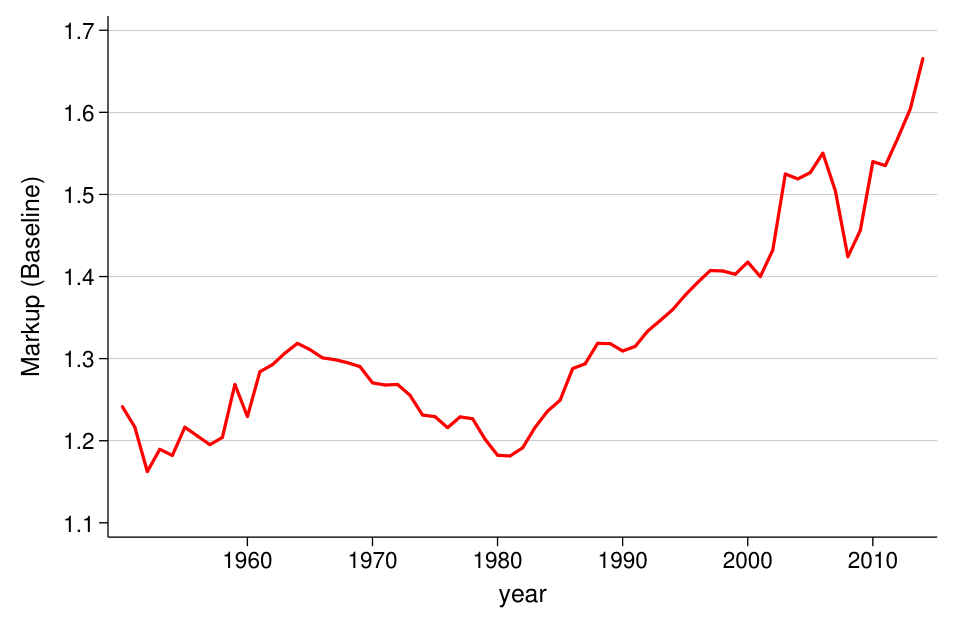
Data and method. The authors compute firm-level markups — the ratio of price to marginal cost — for essentially all publicly traded U.S. firms in Compustat from 1955 to 2016, using the "production approach" (Hall 1988; De Loecker & Warzynski 2012), which infers marginal cost from a firm's revenue, output elasticity of a variable input, and expenditure on that input, without needing to specify demand or the mode of competition directly. They use cost of goods sold (COGS) as the variable input in their baseline. This choice — treating COGS as the marginal, variable cost while excluding Selling, General & Administrative (SG&A) expenses — is exactly the methodological fork later disputed by critics (see Nuances and Limits below).
Headline finding. Aggregate markups were roughly flat (even slightly declining) from 1955 to about 1980, then began a sustained rise. The exact endpoint values differ between the working-paper and published versions, and the distinction matters:
- The 2017 NBER working paper states: "In 1980, average markups start to rise from 18% above marginal cost to 67% now," with "average markups reaching 1.67 in 2014" — i.e. a rise from a markup ratio of about 1.18 (1980) to 1.67 (2014).[1]
- The published 2020 QJE version (De Loecker, Eeckhout & Unger), after re-estimation and in response to measurement critiques, reports the widely-cited figures of about 1.21 (1980) to 1.61 (2016): "In 1980, average markups start to rise from 21% above marginal cost to 61% now," and "In 2016, the average markup charged is 61% over marginal cost, compared to 21% in 1980" — verified against the authors' final (November 15, 2019) copy of the published version.[1] Either way the qualitative finding is the same: sales-weighted average markups were roughly flat before ~1980 and rose sharply thereafter. Over the same period the aggregate average profit rate — defined in the paper as "total sales minus all cost (including overhead and the expenditure on capital) as a share of sales" — "has risen from close to 1% in 1980 to around 8% in 2016," likewise verified against the authors' copy of the published version.[1]
Distributional shape of the rise. The increase is not a broad-based shift by most firms: it is driven almost entirely by the upper tail of the markup distribution. Firms at high percentiles of the markup distribution show sharply rising markups, while the median firm's markup is reported as essentially unchanged over the same period. Alongside this, the authors document a reallocation of market share toward high-markup firms — the same firms pulling up the upper tail account for a growing share of aggregate sales over time, so the rise in the aggregate (sales-weighted) markup reflects both individual firms marking up more and market share shifting toward the firms that already charge the highest markups.
Macroeconomic implications. The authors argue this pattern can account for several secular trends in the U.S. economy since 1980: the decline in labor's share of national income, a parallel decline in the share going to (non-land) capital, and the decline in measures of business dynamism — new-firm entry rates and gross job/worker reallocation — which fell over roughly the same period. Their interpretation is that rising market power reduces firms' incentive to expand output, hire, and invest relative to a more competitive counterfactual, which mechanically depresses both labor's and capital's share of a economy increasingly weighted toward high-markup, high-profit firms, and weakens the entry and reallocation dynamics associated with vigorous competition.
International evidence: the United Kingdom. The pattern is not US-only. A Bank of England staff working paper — Aquilante, Chowla, Dacic, Haldane (then the Bank's Chief Economist), Masolo, Schneider, Seneca & Tatomir, "Market power and monetary policy" (SWP 798, May 2019) — finds that UK firm-level markups have risen noticeably, concentrated among top-performing firms rather than reflecting a broad rise in market concentration, with globally-oriented firms driving the increase more than domestic ones — the same tail-driven shape De Loecker, Eeckhout & Unger document for the US. The BoE paper's own focus is monetary policy: greater pricing power steepens the Phillips curve, and while rising markups may increase inflation variability, secular markup growth can enhance a central bank's ability to stabilise inflation without large output movements; it also notes higher markups correlate with reduced firm-level investment at the extremes. For this wiki's purposes its value is as a non-advocacy, central-bank confirmation that the concentrated markup rise appears in a second economy on independent data — drawn from the paper's published summary rather than its full text.[9]
Relation to the Georgist Case
Georgist analysis is built on a specific claim: that a persistent, growing share of national income in market economies is economic rent — payment in excess of what is needed to bring a factor into its current use — and that this rent originates in the fixed supply of land. De Loecker, Eeckhout & Unger's paper is significant for the Georgist case without being a Georgist paper at all: it documents, using mainstream firm-accounting data and a mainstream IO estimator, that a large and growing wedge between price and marginal cost has opened up across the U.S. corporate sector since 1980 — a wedge that, by definition, is a form of economic rent in the classical sense, since it is income accruing to firms in excess of the (marginal) cost of production. This is the modern, non-land generalization of the rent problem that Henry George's framework anticipated in outline: George argued that as an economy grows, an increasing share of the surplus from production is captured by owners of scarce, non-produced advantage rather than distributed to labor and ordinary capital. Rising markups — concentrated in a shrinking set of dominant firms, and associated with a falling labor share — fit that pattern structurally, even though the "scarce advantage" here is market position (patents, platform effects, brand, regulatory barriers, network effects) rather than a parcel of land.
This connects directly to rent-seeking: if a rising share of measured corporate profit is markup rent rather than a competitive return to genuine productivity, it strengthens the broader case made on The Rentier Economy narrative page that a growing share of national income rewards extraction rather than production — the same underlying logic Georgists apply to land, generalized to market power. The paper is also a close empirical cousin of Rognlie's capital-share decomposition: where Rognlie shows the rise in capital's income share is concentrated in housing (land) at the macro, national-accounts level, De Loecker, Eeckhout & Unger show a parallel rise in markup rent at the micro, firm-accounting level. The two findings are not the same claim and use different data and methods, but both point away from the older "generic capital deepening" story and toward some form of concentrated, rent-like surplus as the explanation for shifts in factor shares since around 1980.
The tech/superstar dimension and the direct rival reading. The paper's finding that the rise is concentrated in a shrinking upper tail of firms, together with reallocation of sales toward those firms, is the same underlying pattern that Autor, Dorn, Katz, Patterson & Van Reenen (2020) document and interpret very differently. Autor et al. read the growth of high-markup "superstar firms" substantially as a story of legitimate technology-driven productivity divergence — the most productive firms in an industry win disproportionate market share through genuine efficiency and scale economies, not through rent extraction, and their high markups are in significant part a return to that productivity advantage. De Loecker, Eeckhout & Unger's own framing is more agnostic about why markups rose — their paper documents the pattern and its macro correlates rather than adjudicating whether the underlying cause is efficiency, weakened antitrust enforcement, network effects, regulatory capture, or some mix — but the paper is frequently invoked in the market-power literature (including by Eeckhout in later work such as The Profit Paradox, not separately reviewed here) as evidence for a market-power-centered reading in which much of the rise is rent rather than efficiency. That dispute is not settled: the honest position is that De Loecker, Eeckhout & Unger establish the pattern (rising, concentrated, tail-driven markups) fairly robustly relative to their own methodology, while the interpretation of that pattern — rent extraction versus efficient scale — remains genuinely contested in the literature, with Autor et al. supplying the most credible efficiency-side counter-reading and Traina, Basu, and others (below) contesting whether the underlying markup measurement itself is reliable at all.
Nuances and Limits
The paper's headline numbers are more contested within economics than most work of comparable prominence; that contestation should be represented honestly rather than treating "markups have roughly tripled since 1980" as settled fact.
- The Traina critique (measurement of variable costs). James Traina, "Is Aggregate Market Power Increasing? Production Trends Using Financial Statements" (Stigler Center working paper, 2018), argues the paper's central methodological choice — using COGS alone as the variable input — misses a large and rising share of firms' genuinely variable costs, particularly Selling, General & Administrative (SG&A) expenses such as marketing and management, which have grown as a share of firm cost structures over the same period. When Traina reconstructs markups using COGS plus SG&A as the variable-cost base, the estimated rise in markups largely disappears: he finds public-firm markups increased only modestly since 1980 and remained within their historical range of variation, rather than showing the dramatic tripling De Loecker, Eeckhout & Unger report. The dispute is thus not about the raw accounting data but about which costs should count as "variable" for the purpose of a markup estimate — a genuinely unresolved question in the literature.
- The Basu critique (methodological survey). Susanto Basu, "Are Price-Cost Markups Rising in the United States? A Discussion of the Evidence," NBER Working Paper 26057 (2019), published in the Journal of Economic Perspectives 33(3), pp. 3–22, as part of a three-paper JEP symposium on markups (alongside Chad Syverson's "Macroeconomics and Market Power" and Berry, Gaynor & Scott Morton's "Do Increasing Markups Matter?"). Basu reviews the main approaches to estimating economy-wide markups — including the De Loecker-Warzynski production approach used by De Loecker, Eeckhout & Unger — and argues that different reasonable assumptions and cost measures produce substantially different conclusions, some of which are difficult to reconcile with other macroeconomic evidence (e.g., measured investment and profit-rate patterns). Basu's own conclusion is that existing methods cannot yet determine with confidence whether U.S. markups have been roughly stable or have risen only modestly over recent decades — a materially weaker claim than De Loecker, Eeckhout & Unger's headline finding.
- A further, more recent robustness challenge (Benkard–Miller–Yurukoglu, 2025). C. Lanier Benkard, Nathan H. Miller & Ali Yurukoglu, "The Rise of Market Power and the Macroeconomic Implications: Comment" (NBER Working Paper 34513, November 2025), dispute the paper's results on sample-construction grounds: they report that the published results rest on "unreported sample restrictions that drop 27% of the available observations" (the exclusion of firms that do not report SG&A, plus other restrictions appearing in the replication code but not the article), and that "Applying the methodology as described in the article to the full sample, markup increases are more muted until late in the sample period, and are almost entirely driven by Finance and Insurance firms. If these firms are removed, markup increases are modest" — specifically, from "just below 1.30 in the mid-1980s to about 1.35 in 2016."[7] De Loecker, Eeckhout & Unger's reply (October 2025) counters that BMY's full-sample results "are exclusively driven by outliers in one four-digit industry (NAICS 3254)" — a substantial number of tiny pharmaceutical/biotech firms "that have costs but negligible sales," whose inclusion "generates implausible output elasticities in sector 32" and thereby distorts the economy-wide aggregate — and that the original results are "robust to different sample restrictions, and to alternative methods to obtain output elasticities for these outliers."[7] This exchange shows the measurement debate over this paper is still active more than five years after publication, not a closed 2018–2019 dispute.
- What the paper does not show. The paper does not decompose why markups rose (antitrust weakening, network effects/winner-take-most technology, intangible-asset accounting, genuine productivity divergence, or some mix) — it establishes the pattern and its correlation with macro trends, not a single causal mechanism. It also does not identify land as a component of the markup rent it measures; the paper is entirely silent on real estate or location as a source of the firms' pricing power, so it can be cited as a parallel rent-generalization but not as direct evidence for the land-specific Georgist claim.
- Scope. The sample is limited to publicly traded U.S. firms in Compustat; it does not cover privately held firms, which are a large share of U.S. economic activity and may show different markup dynamics.
Bears On
- Rent-Seeking — the paper's finding of a large, growing wedge between price and marginal cost concentrated in a small set of firms is a modern, firm-level empirical instance of the rent concept this page defines, generalized beyond land.
- Economic Rent — markups above marginal cost are, by the standard definition this page states, a form of economic rent; the paper supplies contemporary, large-sample evidence that this wedge has grown substantially in the U.S. corporate sector.
- Narrative: The Rentier Economy — this paper is a natural addition to that narrative's "research that supports it" section as a non-land instance of rising rent capture, alongside a fair statement of the Traina/Basu measurement pushback and the Autor et al. efficiency-side rival reading already represented there.
- Autor, Dorn, Katz, Patterson & Van Reenen — superstar firms — the direct rival interpretation of the same broad concentration/high-markup pattern, reading it substantially as efficient scale rather than rent; the two papers should be read together, not as a settled contest.
- Capital share rise is land — a structurally parallel, but methodologically distinct, finding: Rognlie shows the macro capital-share rise is concentrated in housing; this paper shows a micro firm-level markup rise concentrated in a shrinking set of dominant firms. Neither directly tests the other.
- Corporate profits increasingly reflect economic rents — the claim page this paper's headline finding is carried on as supporting evidence.
See Also
- Maria Alessandra Rossi, "Aggregate Market Power: Measurement, Drivers, and Macroeconomic Effects," Journal of Economic Surveys (2026), doi.org/10.1111/joes.70160 — a 2026 survey of the macro market-power literature whose abstract summarises the post-1980s pattern as stable median markups with rising upper-tail dispersion and reallocation toward a few high-markup firms, and calls the evidence linking market power to falling labour shares and rising inequality strong while productivity and investment effects are "more nuanced and non-monotonic" (open-access article; abstract only, full text not yet read)
- De Loecker, Eeckhout & Mongey — Quantifying Market Power and Business Dynamism in the Macroeconomy — a 2026 structural general-equilibrium follow-up by two of these three authors, estimating why markups rose (overhead costs, productivity dispersion, and fewer potential competitors) and finding a net 5% welfare / 6% output loss from the same 1980–2023 period
- Economic Rent
- Rent-Seeking
- Narrative: The Rentier Economy
- Superstar Firms — the concept this paper's tech/superstar dimension bears on
- Autor, Dorn, Katz, Patterson & Van Reenen — The Fall of the Labor Share and the Rise of Superstar Firms
- Rognlie — Deciphering the Fall and Rise in the Net Capital Share
- Most of the modern rise in the capital share is land, not capital
- Kaplow — Market Power and Income Taxation
Sources
- Jan De Loecker, Jan Eeckhout & Gabriel Unger (2020), "The Rise of Market Power and the Macroeconomic Implications," Quarterly Journal of Economics 135(2), 561–644. DOI: 10.1093/qje/qjz041 · Open full text: NBER Working Paper 23687 (2017 version) — the working paper was read in full (2026-07-09); used for and verified verbatim against: the production-function markup method, the finding that markups "start to rise from 18% above marginal cost to 67% now" (a ratio of ~1.18 in 1980 to 1.67 in 2014), the services-share fact ("from 21 to 40%"), and the distributional/upper-tail shape of the rise. Version note: the published 2020 QJE re-estimation reports the widely-cited ~1.21 (1980) → 1.61 (2016) figures and the ~1%→8% profit-rate rise; the QJE version of record is paywalled, but the authors' final copy of the published version (dated November 15, 2019) is freely hosted at janeeckhout.com/wp-content/uploads/RMP.pdf and was read in full (2026-07-10), verifying verbatim the published endpoints ("from 21% above marginal cost to 61% now"; "there has been a steady increase to 1.61"), the profit-rate rise ("from close to 1% in 1980 to around 8% in 2016"), the profit-rate definition (all-cost profit as a share of sales), the overhead fact (overhead rose "from 15% to 21% of total cost" with markups rising in excess of it), and the unchanged median / upper-tail distributional shape.
- Jan De Loecker & Frederic Warzynski (2012), "Markups and Firm-Level Export Status," American Economic Review 102(6), 2437–2471. — used for the origin of the production-approach markup estimator this paper applies to the full U.S. economy (not independently re-verified; cited via secondary methodological summaries).
- James Traina (2018), "Is Aggregate Market Power Increasing? Production Trends Using Financial Statements," Stigler Center for the Study of the Economy and the State, Working Paper. PDF (ProMarket/Stigler Center) · SSRN — used for the SG&A critique and the "modest, within historical range" alternative finding (the PDF was not accessible at last review; summarized from secondary descriptions of the paper's abstract and findings).
- Susanto Basu (2019), "Are Price-Cost Markups Rising in the United States? A Discussion of the Evidence," NBER Working Paper 26057; published in Journal of Economic Perspectives 33(3), 3–22. NBER · AEA/JEP — used for the methodological survey critique and the "cannot yet determine" conclusion (same access caveat; summarized from secondary descriptions, not a first-hand read).
- Chad Syverson (2019), "Macroeconomics and Market Power: Context, Implications, and Open Questions," Journal of Economic Perspectives 33(3), 23–43. AEA — used only to identify the companion papers in the same JEP symposium; not independently scanned.
- Steven Berry, Martin Gaynor & Fiona Scott Morton (2019), "Do Increasing Markups Matter? Lessons from Empirical Industrial Organization," Journal of Economic Perspectives 33(3), 44–68. AEA — used only to identify the third companion paper in the same JEP symposium; not independently scanned.
- C. Lanier Benkard, Nathan H. Miller & Ali Yurukoglu (2025), "The Rise of Market Power and the Macroeconomic Implications: Comment," NBER Working Paper 34513 (November 2025). NBER · NBER PDF · Stanford mirror (October 22, 2025 version) — both the NBER and Stanford versions were read (2026-07-10); used for the 27%-of-observations sample-restriction claim, the Finance-and-Insurance-driven full-sample result, and the "just below 1.30 ... to about 1.35 in 2016" ex-F&I figure. Jan De Loecker, Jan Eeckhout & Gabriel Unger (2025), "The Rise of Market Power and the Macroeconomic Implications: Reply to Benkard, Miller, and Yurukoglu (2025)," October 13, 2025. Reply PDF (janeeckhout.com) — read in full (2026-07-10); used for the NAICS 3254 (pharmaceutical/biotech outlier) counter-argument. As of 2026-07-10 both documents are working papers (the Comment an NBER working paper, the Reply an authors' note), not yet published in a peer-reviewed journal.
- Wiki: Autor, Dorn, Katz, Patterson & Van Reenen — superstar firms — internal navigation only (not used as external evidentiary support); records the direct rival efficiency-side reading of the same firm-concentration pattern.
- Tommaso Aquilante, Shiv Chowla, Nikola Dacic, Andrew Haldane, Riccardo Masolo, Patrick Schneider, Martin Seneca & Srdan Tatomir (2019), "Market power and monetary policy," Bank of England Staff Working Paper No. 798 (3 May 2019). bankofengland.co.uk — used for the UK companion evidence: rising, top-firm-concentrated UK markups without a broad concentration trend, the globally-oriented-firms finding, the Phillips-curve and inflation-stabilisation implications, and the markup–investment correlation (published summary read 2026-08-14; not a full-text scan, B-claims only).