Bezemer & Hudson (2016): Finance Is Not the Economy
The peer-reviewed statement of the heterodox 'finance income is rent' thesis: credit since the 1980s has flowed to bid up asset prices — above all through household mortgages — rather than to fund production, and much of what national accounts record as financial 'income' is, in classical terms.
Summary
Dirk Bezemer (University of Groningen) and Michael Hudson's "Finance Is Not the Economy: Reviving the Conceptual Distinction" (Journal of Economic Issues 50(3), September 2016, pp. 745–768) is the peer-reviewed statement of the heterodox thesis that the FIRE sector's growth is largely rent extraction rather than production. Its organising move is a distinction the authors say classical political economy had and modern economics lost: between productive credit (lending that funds tangible investment and generates the income to repay itself) and unproductive credit (lending that bids up the price of assets already in place). Their abstract states it directly: "Conflation of real capital with finance capital is at the heart of current misunderstandings of economic crisis and recession," and that "household credit — especially mortgage credit — is the premier form of unproductive credit."[1]
The paper matters to this wiki because it is the strong, explicitly-argued version of the contested claim that the composition pages (Great Mortgaging, Greenwood & Scharfstein) deliberately stop short of: not merely that finance's growth is exposed to land through mortgages, but that financial-sector income is itself rent. Bezemer is a serious empirical macroeconomist (his prediction-record audit is on the wiki as Bezemer 2009); Hudson is heterodox and advocacy-adjacent. The wiki carries their central interpretive claim as attributed, not settled — see What It Cuts Against.
Key Findings
- Credit decoupled from income after the mid-1980s. The authors argue bank credit and nominal GDP "moved almost one on one" from the 1950s to the mid-1980s, after which credit grew structurally faster than income — the real sector "borrowing structurally more than its income."[1] Bezemer's own earlier work is cited for the magnitude: the ratio of private-debt growth to GDP growth "moved from 2:1 on average in the 1950s and 1960s to 4:1 in the 1990s and 2000s."[1]
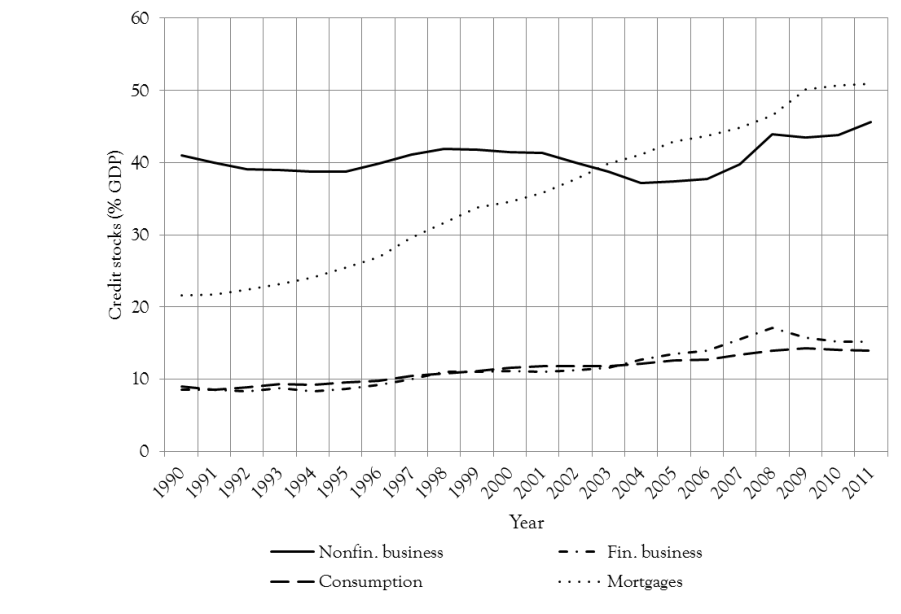
- The extra credit went to assets, chiefly household mortgages. On a balanced panel of 14 OECD economies, 1990–2011, credit to non-financial business "was stagnant at about 40 percent of GDP, while its share in overall credit plummeted," and "the share of household mortgage credit issued by banks rose from about 20 to 50 percent of all credit."[1] They fold in Jordà, Schularick & Taylor's Great Mortgaging (30%→60% of GDP since 1900) as the long-run version of the same fact.
- Mortgage credit generates capital gains, not income. The conceptual core: "Mortgage credit is extended to buy assets, mostly already existing. It generates capital gains on real estate, not income from producing goods and services."[1] Because such lending raises debt without raising the borrower's income, it increases financial fragility while contributing little to growth — the authors cite a downward-trending, eventually insignificant correlation between credit and income growth from the 1990s.[1]
- The rent claim, stated plainly. Reading Greenwood & Scharfstein's finance-share figures (2.8% of US GDP in 1950 rising to ~8% by 2007) as largely fees and markups, the authors conclude: "financial 'profits' in the classical scheme are largely rents, not profit. They are not the same thing as industrial earnings from tangible capital formation."[1] Trade in financial and real-estate assets, they argue, "is a zero-sum (or even negative-sum) activity."[1]
- Why national accounts hide it. They argue the NIPA "conflate 'rental income' with 'earnings,' as if all gains are 'earned,'" so the classical rent category "has disappeared into an Orwellian memory hole" — echoing Hudson's separate critique of Fed land-value accounting and the maxim that "what is not seen has less of a chance of being taxed."[1]
What It Supports
- The growth of modern banking is largely mortgage credit against land — this paper is the interpretive companion to that composition claim, adding the productive/unproductive-credit taxonomy and the 14-OECD 20%→50% mortgage-share figure.
- The FIRE Sector — the peer-reviewed articulation of Hudson's "two economies" (real vs. FIRE) framing that the concept page builds on.
- Narrative: The Rentier Economy — the sharpest scholarly statement of the narrative's core "income from extraction, not production" claim.
- The Great Mortgaging and Greenwood & Scharfstein — the mainstream composition evidence the authors mobilise for a stronger conclusion than those sources themselves draw.
What It Cuts Against
The paper's measured composition claims are well-supported (they rest on Jordà– Schularick–Taylor, Beck et al., and Bezemer–Grydaki–Zhang). Its central interpretive claim — that financial income is rent — is exactly the wiki's contested frontier, and several serious counter-weights bear on it:
- The unit-cost puzzle is suggestive, not a rent measurement. Philippon (2015) and Bazot (2018) show finance did not pass on its efficiency gains — consistent with rent capture, but neither author claims to measure a rent share, and Bezemer–Hudson's stronger "profits are largely rents" phrasing goes beyond what those measurements license.
- Credit dynamics need not be land-rent extraction. Borio's financial-cycle work explains the same credit–asset-price booms as a general procyclical, monetary phenomenon — "the financial system does not just allocate, but also generates, purchasing power" — a mechanism that would operate on any collateral, not only rent-bearing land. This is the steelman that credit booms are not simply land-rent extraction.
- The mainstream reply on finance's size. As the FIRE-sector page records, Cochrane (2013) argues the right question is whether finance functions well, not how large it is, and that the size data are consistent with rising demand for genuine services — a direct challenge to the "zero-sum activity" characterisation.
- Advocacy component. Hudson's contribution carries an explicit political-economy reading (the "feudal model applied in a sophisticated financial system"); per the wiki's source hierarchy, the framing travels as the authors' argument, not as an established measurement.
Honest Scope (rent gradient)
Along the wiki's rent gradient, this paper sits well beyond the clean land case. Its land-adjacent evidence — that finance's expansion is mortgage-dominated and that mortgages fund existing-asset purchases — is strong and independently corroborated. Its leap from that to "finance income is rent" is the analytically coherent but empirically thinner step the rentier-economy narrative warns deployers not to oversell. Cite Bezemer & Hudson for the framework and the productive/unproductive-credit distinction; lean on the mainstream composition sources for the facts.
See Also
- The FIRE Sector — the "two economies" framing this paper formalises
- Banking growth is largely mortgage credit against land — the composition claim it interprets
- Philippon (2015) · Bazot (2018) — the income-side unit-cost evidence, kept honest
- Borio: the financial cycle — the steelman that credit booms are a general monetary phenomenon
- Michael Hudson · Killing the Host — Hudson's book-length version
- The Rentier Economy (narrative) · Economic Rent
- Geoism — the rent-domain program and its gradient
Sources
- Dirk Bezemer & Michael Hudson, "Finance Is Not the Economy: Reviving the Conceptual Distinction," Journal of Economic Issues 50(3), September 2016, pp. 745–768, DOI 10.1080/00213624.2016.1210384 — used for the productive/unproductive-credit distinction; the abstract's "conflation of real capital with finance capital" and "household credit — especially mortgage credit — is the premier form of unproductive credit"; the credit/income decoupling after the mid-1980s and the 2:1→4:1 debt/GDP-growth ratio; the 14-OECD panel (business credit stagnant ~40% of GDP; household mortgage share 20%→50% of all credit, 1990–2011); "mortgage credit … generates capital gains on real estate, not income"; the "financial 'profits' … are largely rents, not profit" and "zero-sum (or even negative-sum) activity" characterisations; and the NIPA "rental income"/"earnings" conflation (B- and D-claims; verified against the full text). Free PDF (Hans-Böckler-Stiftung) · Author copy (michael-hudson.com) · Journal (Taylor & Francis, paywalled)