The growth of modern banking is largely mortgage credit against land
Over the past century the expansion of banking in advanced economies has been, above all, the expansion of mortgage lending — and the value that lending is secured against is overwhelmingly land, not buildings.
At a glance — Long-run cross-country data show the growth of modern banking is overwhelmingly mortgage credit against real estate whose rising value is mostly land; the further step that finance income itself is land rent is weaker and contested. Evidence: Strong for the composition claim (long-run cross-country data): finance's growth is overwhelmingly real-estate credit, and real-estate value growth is overwhelmingly land. Weaker/contested for the further step that finance income IS land rent. · 6 supporting sources · 1 challenging Strongest support: The Great Mortgaging — across 17 economies the mortgage share of bank lending roughly doubled, from ~30% in 1900 to ~60% by 2007. Strongest challenge: Cochrane (2013) — finance's growth reflects demand for genuine services (asset management, risk-bearing), not rent capture; see Honest Scope.
The Claim
The long-run growth of the financial sector in advanced economies is not mainly the growth of business lending or of genuinely new financial services. It is, above all, the growth of mortgage credit — and mortgage credit is credit secured against real estate whose rising value is, in turn, overwhelmingly land. So a large part of what is usually described as "financial deepening" is better read as the banking system becoming the machinery through which land rent is capitalised and collected. This connects the FIRE sector to the land question with unusually strong long-run evidence.
The Evidence
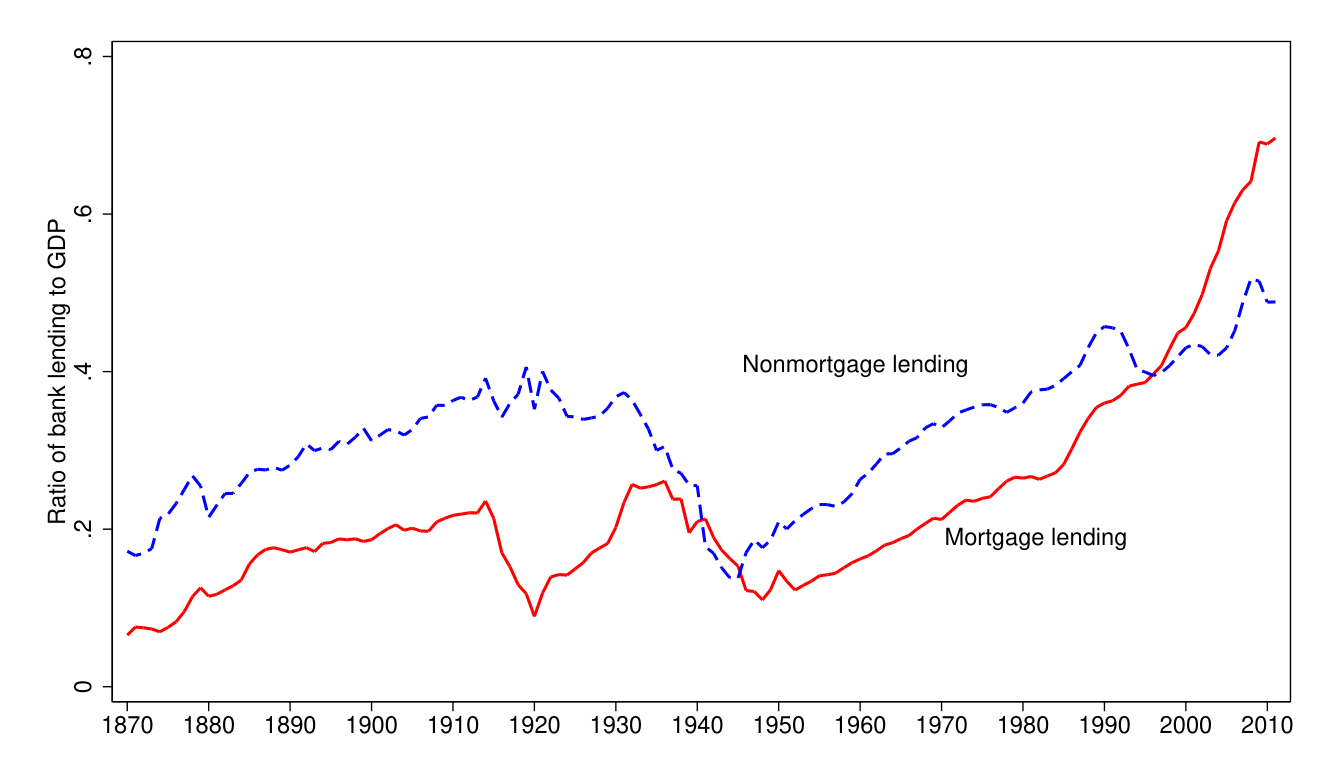
- Banks became real-estate funds. Jordà, Schularick & Taylor's Great Mortgaging — a new long-run dataset of disaggregated bank credit for 17 advanced economies since 1870 — finds the mortgage share of bank lending roughly doubled, from ~30% in 1900 to ~60% by 2007, while non-mortgage lending stayed near-constant relative to GDP (~41%→46%) and mortgage lending rose from ~20% to 69% of GDP. The authors put it bluntly: the core business model of a modern bank "resembles that of real estate funds: banks are borrowing (short)… to invest (long) into assets linked to real estate." Household borrowing — mostly mortgages — accounted for about two-thirds of the entire increase in bank credit since 1960.[1]
- What the mortgage is really against is land. Knoll, Schularick & Steger's No Price Like Home — house-price indices for 14 economies, 1870–2012 — finds that the post-1950 house-price boom is attributable mostly to rising land prices, not construction costs. Since the collateral behind the mortgage boom is real estate, and the appreciating part of real estate is land, the credit expansion is, in economic substance, lending against a claim on land rent.[2]
- Independently corroborated on a modern panel. Bezemer & Hudson (2016) reproduce the same composition fact on a balanced panel of 14 OECD economies, 1990–2011: credit to non-financial business "was stagnant at about 40 percent of GDP, while its share in overall credit plummeted," and "the share of household mortgage credit issued by banks rose from about 20 to 50 percent of all credit."[3] Their stronger interpretive step — that this credit income is itself rent — is the contested claim flagged in Honest Scope below; the mortgage-share composition figure cited here is not. The same composition finding holds on the widest panel yet assembled: Bezemer, Samarina & Zhang (2017/2020) build a new disaggregated bank-credit dataset for 74 economies, 1990–2013/2016, and document "the shift in bank credit allocation away from traditional business lending" toward household mortgages — the "debt shift" — finding it larger where financial deregulation went furthest. It measures the destination of credit (mortgages vs business loans), not the land-vs-structure split of the collateral, so the "appreciating collateral is land" step still comes from the house-price literature.[5]
- And it does not behave like productive "deepening." Mian, Sufi & Verner (2017), on an independent panel of 30 countries from 1960 to 2012, show that a rise in the household-debt-to-GDP ratio — household borrowing being overwhelmingly mortgage credit, and their credit-supply proxy being the mortgage spread itself — "predicts lower output growth and a higher unemployment rate over the medium-run," and that "a rise in household debt is not associated with increased investment growth… Instead, when household debt rises, the consumption share of output increases."[4] The mortgage-credit expansion is thus a credit-supply-driven claim on existing assets, not the productive capital allocation the phrase "financial deepening" implies — the empirical texture the land-credit reading predicts.
Put together, these findings mean that the century's great financial expansion is largely a land-credit expansion — the same conclusion the rentier-economy narrative reaches, here established from mainstream long-run data that make no reference to George or rent theory.
Why It Matters — and the Georgist Reading
If the financial sector's growth is mostly the financing of land, then two Georgist claims gain empirical footing. First, the 18-year land cycle and the land-speculation-causes-cycles account are not a fringe story about property: the mainstream credit-cycle literature — including Borio's BIS financial-cycle work, which finds the cycle "most parsimoniously described in terms of credit and property prices" — shows the credit that fuels the cycle is overwhelmingly mortgage credit. Second, a land value tax — by pulling the untaxed capital gain out of land — would shrink precisely the collateral value that the mortgage-credit machine capitalises, which is why Georgists argue it would dampen the credit cycle at its source.
Honest Scope (rent gradient)
Greenwood & Scharfstein sharpen this scope from the composition side: household credit grew "from 48 percent of GDP in 1980 to 99 percent in 2007," mostly residential mortgages — but the other driver of finance's growth, asset-management fees on financial-asset values, is not land. The land-credit claim covers the mortgage half, not the whole of finance.
The strong, well-identified result here is about composition: finance's growth is mortgage-dominated, and the appreciating collateral is land. That is robust. It does not by itself establish the further, contested claim that financial-sector income is largely economic rent — the heterodox statement of that claim is Bezemer & Hudson (2016), which the wiki carries as attributed argument, not settled fact; Philippon's efficiency puzzle is suggestive on that front but not dispositive. The wiki's strongest cited challenge to the "growth means rent" step is Cochrane (2013): he reads the same scale facts Greenwood–Scharfstein and this page rely on — quantity up, and (for component fee schedules) prices not rising — as an ordinary demand-shift response paying for genuine services (scarce managerial skill, risk-bearing, liquidity), not as evidence of rent capture, and he does not dispute that the credit itself is mostly mortgage credit; his challenge runs to the interpretation of finance's growth, not to this page's composition claim. The "FIRE" grouping itself, on his reading, can manufacture a rentier bloc by classification alone. The claim on this page is the one the evidence carries cleanly regardless of that dispute: the modern financial system is, first and foremost, in the business of lending against land.
Adjacent, distinct channels — do not merge. Two related literatures sit next to this page's claim without being evidence for it: August (2020) documents the equity side of housing financialization in Canada (which entities own rental buildings and how they reprice them — REITs from 0% to ~10% of the stock, 1996–2017), complementary to this page's credit-composition evidence but a different channel; and Lapavitsas reads mortgage profit as "financial expropriation" of the debtor's wage income — a Marxist mechanism located in the income stream, not in the appreciating land collateral this page's sources identify. Citing either as if it established the land-credit composition claim would overstate both.
Further corroboration. Stiglitz (2015) supplies the theoretical land–credit link: looser financial policy inflates land-backed wealth without adding productive capacity. Capozza, Green & Hendershott find mortgage-related tax preferences capitalize fully into residential land prices — the credit-to-land link at the metro level. Vague's survey of six countries over two centuries finds real-estate lending the dominant component of the private-debt run-ups before crises, and Werner documents bank credit steered into real estate through Japan's 'window guidance' (a contested credit-school account). Mike Bird's 2025 financial-history The Land Trap reaches the same composition point from journalism rather than economics — land's unique suitability as bank collateral (fixed, non-depreciating, immovable) is, in his account, the recurring mechanism behind credit booms from colonial America to modern China — and pairs it with Singapore's land-rent-capture system as a comparative case where that collateral channel was defused by public landlordship rather than private speculation.
See Also
- Credit Window Guidance — the sector-directed-credit tool Japan, Korea, and Taiwan used to steer bank lending toward production and, at times, away from land speculation
- Adair Turner — former FSA chairman whose Between Debt and the Devil is cited for the self-reinforcing credit–real estate cycle thesis
- Positive Money — the UK monetary-reform group whose bank-lending composition research is cited (via Doucet) alongside Jordà et al. as corroborating evidence
- Collateral Channel — the Kiyotaki-Moore mechanism explaining why land's role as preferred bank collateral links land prices to credit supply
- The FIRE Sector — the framing and the counter-view
- The Great Mortgaging · No Price Like Home — the two supporting studies
- Philippon (2015): the finance-efficiency puzzle — the income-side evidence, kept honest
- Mian, Sufi & Verner (2017): Household Debt and Business Cycles Worldwide — the independent 30-country result that the mortgage-credit expansion predicts slower growth, not the productive deepening it is taken for
- Hirano & Stiglitz: Credit, Land Speculation, and Growth — the formal growth-theoretic counterpart: real-estate-directed credit is growth-retarding, manufacturing-directed credit is growth-enhancing
- Hirano & Stiglitz: Growth and Fluctuations in Economies with Land Speculation — accommodative monetary/fiscal policy can backfire by channeling resources into land speculation
- Bezemer & Hudson: Finance Is Not the Economy — the interpretive companion that reads this composition as rent · Borio: the financial cycle — the credit-side steelman
- Cochrane (2013): Finance — Function Matters, Not Size — the strongest cited challenge to reading finance's growth as rent capture
- Bezemer, Samarina & Zhang: The Shift in Bank Credit Allocation — the widest-panel (74-economy) confirmation of the debt shift toward mortgage credit
- The 18-Year Land Cycle · Land speculation causes cycles
- Objection: cycles are driven by credit, not land — where this "credit is land credit" point does its work
- Geoism — the rent-domain program and its gradient
Sources
- Òscar Jordà, Moritz Schularick & Alan M. Taylor (2016), "The Great Mortgaging: Housing Finance, Crises and Business Cycles," Economic Policy 31(85), 107–152 (NBER WP 20501, 2014) — used for the mortgage-share doubling (~30%→60%), the "banks as real estate funds" characterisation, and the household-credit share (~two-thirds of credit growth since 1960). wiki summary · NBER PDF
- Katharina Knoll, Moritz Schularick & Thomas Steger (2017), "No Price Like Home: Global House Prices, 1870–2012," American Economic Review 107(2), 331–353 — used for the finding that the post-1950 house-price boom is mostly rising land prices, not construction costs. wiki summary
- Dirk Bezemer & Michael Hudson (2016), "Finance Is Not the Economy," Journal of Economic Issues 50(3), 745–768 — used only for the modern-panel composition figures (14 OECD economies, 1990–2011: business credit stagnant ~40% of GDP; household mortgage share 20%→50% of all credit). Its stronger "finance income is rent" interpretation is carried as attributed, contested argument, not as support for this composition claim. wiki summary
- Atif Mian, Amir Sufi & Emil Verner (2017), "Household Debt and Business Cycles Worldwide," Quarterly Journal of Economics 132(4), 1755–1817 (NBER WP 21581, 2015) — used for the finding that a rise in the household-debt-to-GDP ratio (household borrowing being predominantly mortgage credit) predicts lower subsequent GDP growth and higher unemployment across 30 countries, 1960–2012, and does not fund investment growth — the evidence that the mortgage-credit expansion is not productive "deepening." wiki summary
- Dirk J. Bezemer, Anna Samarina & Lu Zhang (2017), "The Shift in Bank Credit Allocation: New Data and New Findings," De Nederlandsche Bank Working Paper No. 559 (peer-reviewed version: Journal of Banking & Finance 113, 2020) — used for the 74-economy disaggregated-credit dataset and the documented "shift in bank credit allocation away from traditional business lending" toward household mortgages ("debt shift"). wiki summary · SSRN