The Great Mortgaging: Housing Finance, Crises, and Business Cycles
A landmark NBER working paper constructing a new long-run dataset of disaggregated bank credit for 17 advanced economies since 1870, showing that mortgage lending has come to dominate banks' balance sheets and that mortgage booms increasingly drive financial instability and deeper recessions.
Summary
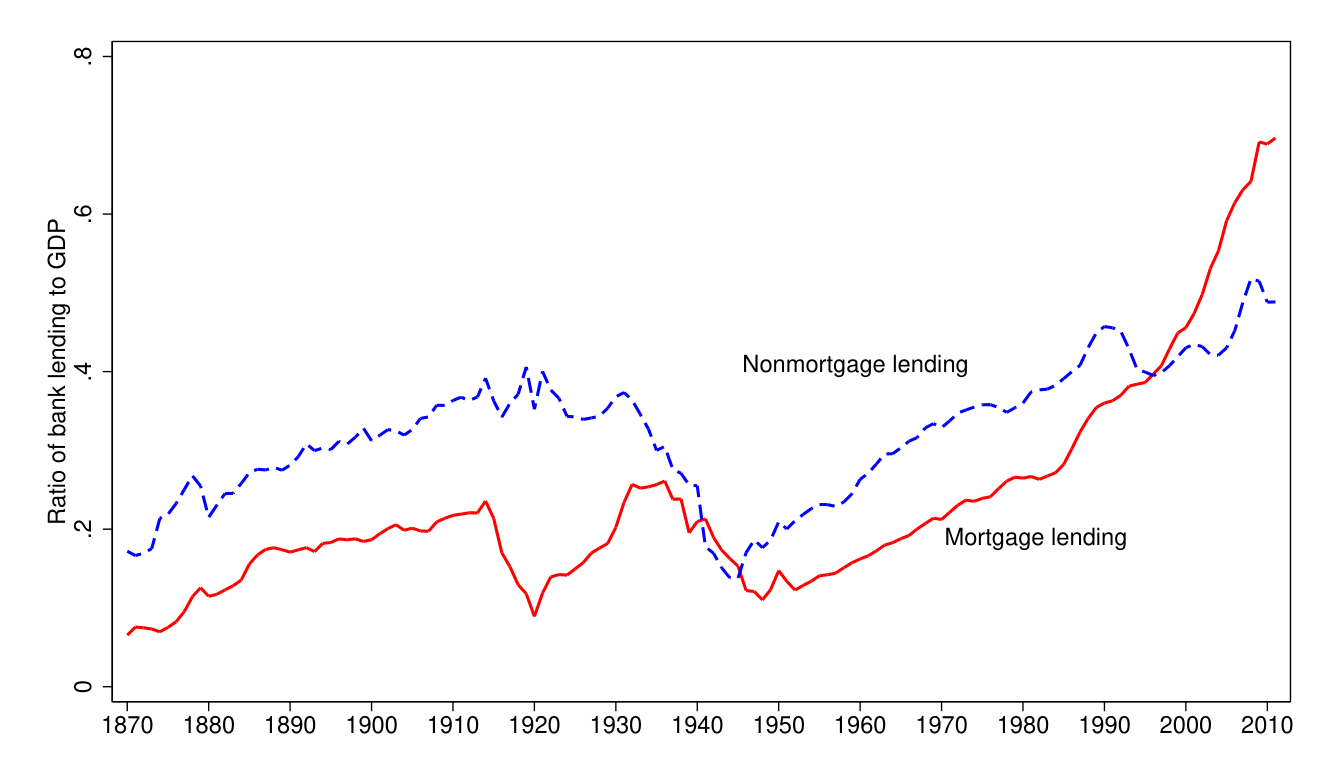
"The Great Mortgaging" (NBER Working Paper 20501, September 2014) by Òscar Jordà, Moritz Schularick, and Alan M. Taylor unveils a new long-run dataset of disaggregated bank credit for 17 advanced economies covering 1870–2011. The paper documents that the share of mortgage loans on banks' balance sheets roughly doubled over the 20th century — from about 30% in 1900 to about 60% by 2007 — and that this shift has profound consequences for financial stability and business-cycle dynamics. The authors argue that mortgage lending, not business lending, has become the central driver of credit cycles, financial fragility, and the severity of post-boom recessions in the post-WWII era.[1]
The paper is significant for the Georgist wiki not as a Georgist source — it makes no reference to Henry George, land value taxation, or rent theory — but as the mainstream credit-side complement to the land speculation cycle narrative. Where Georgist analysts argue that land speculation drives the cycle, Jordà–Schularick–Taylor provide the rigorous empirical documentation that the credit fuelling those cycles is overwhelmingly mortgage credit — that is, credit secured against real estate (land and structures). The paper is already cited on the wiki as the representative mainstream credit-centred account that the Georgist narrative must engage with.[1]
The Dataset
The dataset is the result of a large-scale, multi-year data collection effort covering bank credit to the domestic non-financial private sector (business and households) at annual frequency for 17 advanced economies: Australia, Belgium, Canada, Switzerland, Germany, Denmark, Spain, Finland, France, the United Kingdom, Italy, Japan, the Netherlands, Norway, Portugal, Sweden, and the United States. It extends and disaggregates the earlier Schularick and Taylor (2012) series in three ways:[1]
- Disaggregated credit data: For the first time, the share of mortgage lending in total bank lending is constructed for most countries back to the 19th century, alongside separate series for business and household lending.
- Broader institutional coverage: In addition to commercial banks, the data include savings banks, credit unions, and building societies, yielding a more complete picture of total credit creation.
- Larger and longer sample: Three additional countries (Belgium, Finland, Portugal) were added, and the series extends to 2011.
The authors validated their new series against BIS data for the post-WWII period, finding close correspondence where the series overlap.[1]
Key Findings
1. The Great Mortgaging
The share of mortgage lending in total bank credit rose from roughly 30% in 1900 to roughly 60% by 2007. Non-mortgage lending to GDP remained remarkably stable over 140 years — about 41% of GDP on the eve of WWI and 46% in 2010 — while mortgage lending rose from about 20% of GDP at the start of the 20th century to 69% of GDP by 2010. The authors describe the transformation in stark terms: "To a large extent the core business model of banks in advanced economies today resembles that of real estate funds: banks are borrowing (short) from the public and capital markets to invest (long) into assets linked to real estate."[1]
2. Household Leverage
The growth in credit was driven primarily by lending to households, not businesses. Household borrowing accounted for about two-thirds of the total increase in bank credit since 1960, predominantly through real estate lending. Household mortgage debt-to-asset ratios (mortgage debt relative to the value of the residential housing stock) rose substantially in several countries — in the United States from 28% in 1980 to over 40% in 2010, and in the United Kingdom from slightly above 10% to 28%.[1]
3. Mortgage Credit and Financial Instability
Using logit prediction models for financial crises, the authors find that mortgage credit became a statistically significant predictor of financial crises in the post-WWII period, whereas it was not significant pre-WWII. The AUC (area under the curve) statistic for the mortgage-based crisis prediction model rose from insignificance pre-WWII to 0.72 post-WWII — comparable to the non-mortgage model. The authors conclude that "the changing nature of financial intermediation has shifted the locus of crisis risks increasingly toward real estate lending cycles."[1]
4. Mortgage Booms and Recession Severity
Using inverse propensity score weighting (IPW) and regression-adjusted (IPWRA) local projections, the authors demonstrate that:[1]
- Financial crisis recessions are significantly worse than normal recessions, with a cumulative output loss of approximately 20% of annual output over 5 years — a gap that cannot be fully explained by observable macroeconomic controls.
- Larger credit buildups during the preceding expansion are associated with deeper recessions and slower recoveries.
- In the post-WWII period, only mortgage credit booms — not non-mortgage credit booms — are associated with deeper recessions and slower recoveries. By Year 5, real GDP is about 4% lower than it would otherwise be following a mortgage boom, regardless of whether a financial crisis occurred. The effect on investment is even larger — close to 10% after Year 5.
Significance for the Georgist Case
This paper does not make a Georgist argument. It does not discuss land value, land rent, or land taxation. Its framework is entirely within mainstream macro-finance: credit, leverage, financial stability, and business cycles. Its significance for the wiki is threefold:
- It documents the credit mechanism the land-speculation narrative depends on. The Narrative: Land Speculation Causes Boom and Bust argues that credit-financed land speculation drives the cycle. Jordà–Schularick–Taylor provide the rigorous, long-run empirical evidence that the credit in question is overwhelmingly mortgage credit — credit secured against real estate. This does not confirm the Georgist claim that land (as distinct from structures) is the driver, but it documents the channel through which land-price dynamics translate into systemic financial risk.[1]
- It is the strongest mainstream counterpoint the narrative must answer. The paper attributes financial instability to credit dynamics — mortgage lending booms — without singling out land as the causal engine. On this reading, land is one asset class among several that credit chases, and the policy implication is macro-prudential regulation of mortgage credit, not land value taxation. The Georgist reply, as articulated by Mason Gaffney and others, is that land is the asset credit is disproportionately lent against, so a tax that removes the speculative upside of land ownership blunts the demand for that credit at its source — but this reply is a Georgist interpretation, not a claim made by Jordà–Schularick–Taylor themselves.[1]
- It provides the empirical backbone for the 2008 Financial Crisis page. The paper's finding that mortgage credit became the dominant predictor of financial crises in the post-WWII era, and that the 1995–2007 credit boom was unprecedented in scale, supplies the mainstream empirical context against which the Georgist forecasts by Fred Foldvary and Fred Harrison are evaluated.[1]
Bears On
- Narrative: Land Speculation Causes Boom and Bust — the paper is cited as the representative mainstream credit-centred account that the narrative must engage with (E-claim). It documents the mortgage-credit mechanism but does not adopt the Georgist framing of land as the independent driver.
- Event: The 2008 Financial Crisis — the paper provides the mainstream empirical account of the credit boom preceding the crisis, against which the Georgist pre-crisis forecasts are set.
- Concept: 18-Year Land Cycle — the paper's finding that mortgage credit has become the dominant driver of post-WWII business cycles is convergent with (but does not confirm) the cycle narrative's claim about credit-financed land speculation.
- Person: Moritz Schularick — co-author; also co-authored Knoll, Schularick & Steger — House Prices.
Caveats
- This wiki cites the NBER working-paper version (w20501), whose front matter notes NBER working papers "have not been peer-reviewed."[1] A subsequent peer-reviewed version was published as Òscar Jordà, Moritz Schularick & Alan M. Taylor, "The great mortgaging: housing finance, crises and business cycles," Economic Policy 31, no. 85 (January 2016): 107–152 (OUP, DOI 10.1093/epolic/eiv017; RePEc). The core dataset and findings — mortgage lending's rise to dominate bank balance sheets and its link to financial instability — carry through to the published article; a future editor citing exact figures should quote the Economic Policy version where pagination differs.
- The dataset excludes direct borrowing in capital markets and private credit contracts between individuals, which were sizable in some countries in the early 19th century. The authors note that comparing their data to Goldsmith's (1969) decadal benchmark estimates indicates their series capture the largest part of total credit, but some pre-20th-century mortgage debt was held outside the banking system.[1]
- The paper does not separate land value from structure value in its analysis of real estate lending. "Real estate lending" and "mortgage lending" are used interchangeably and encompass both residential and commercial property. The paper therefore cannot speak directly to the Georgist distinction between land and improvements.[1]
- The household leverage calculations (Figure 5) rely on reconstructed historical balance sheet data for benchmark years, and the authors caution that "the margins of error are likely to be big and the numbers should be interpreted with caution."[1]
See Also
- Bezemer, Samarina & Zhang: The Shift in Bank Credit Allocation — the broadest panel (74 economies) of the same mortgage-toward-real-estate credit shift
- Narrative: Land Speculation Causes Boom and Bust
- The 2008 Financial Crisis
- 18-Year Land Cycle
- Moritz Schularick
- Knoll, Schularick & Steger — House Prices
- Mian, Sufi & Verner (2017): Household Debt and Business Cycles Worldwide — builds on this dataset to show the household/mortgage-credit expansion predicts slower growth
- Mason Gaffney
Sources
- Òscar Jordà, Moritz Schularick & Alan M. Taylor, "The Great Mortgaging: Housing Finance, Crises, and Business Cycles," NBER Working Paper No. 20501, September 2014. PDF (NBER) — used for all findings, quotations, dataset description, and the paper's framing of mortgage credit as the central driver of post-WWII financial instability and business-cycle dynamics. All claims on this page are drawn from this single source text.