Borio (2012): The Financial Cycle and Macroeconomics
The BIS's flagship statement of the 'financial cycle' — a ~16-year credit-and-property-price boom-bust whose peaks predict banking crises.
Summary
Claudio Borio's "The Financial Cycle and Macroeconomics: What Have We Learnt?" (BIS Working Paper No. 395, December 2012; later in the Journal of Banking & Finance 45, 2014) is the most-cited synthesis of the Bank for International Settlements' financial-cycle research program. Its thesis — "macroeconomics without the financial cycle is like Hamlet without the Prince" — is that boom-bust dynamics in credit and asset markets, not just short real shocks, drive the deepest recessions, and that mainstream models that treat finance as a "veil" cannot capture them.[1]
The wiki carries Borio as the steelman for the objection that credit booms are not simply land-rent extraction. His financial cycle is a general self-reinforcing mechanism — "self-reinforcing interactions between perceptions of value and risk, attitudes towards risk and financing constraints, which translate into booms followed by busts"[1] — grounded in the monetary nature of the economy: "the financial system does not just allocate, but also generates, purchasing power, and has very much a life of its own."[1] That is a credit-and-risk story that would operate on any collateral, which is why it partly cuts against the reading of financial expansion as, at bottom, the capitalisation of land rent. But its own empirical anatomy puts property prices at the centre — so it also, on closer reading, hands the land account much of what it needs.
Key Findings
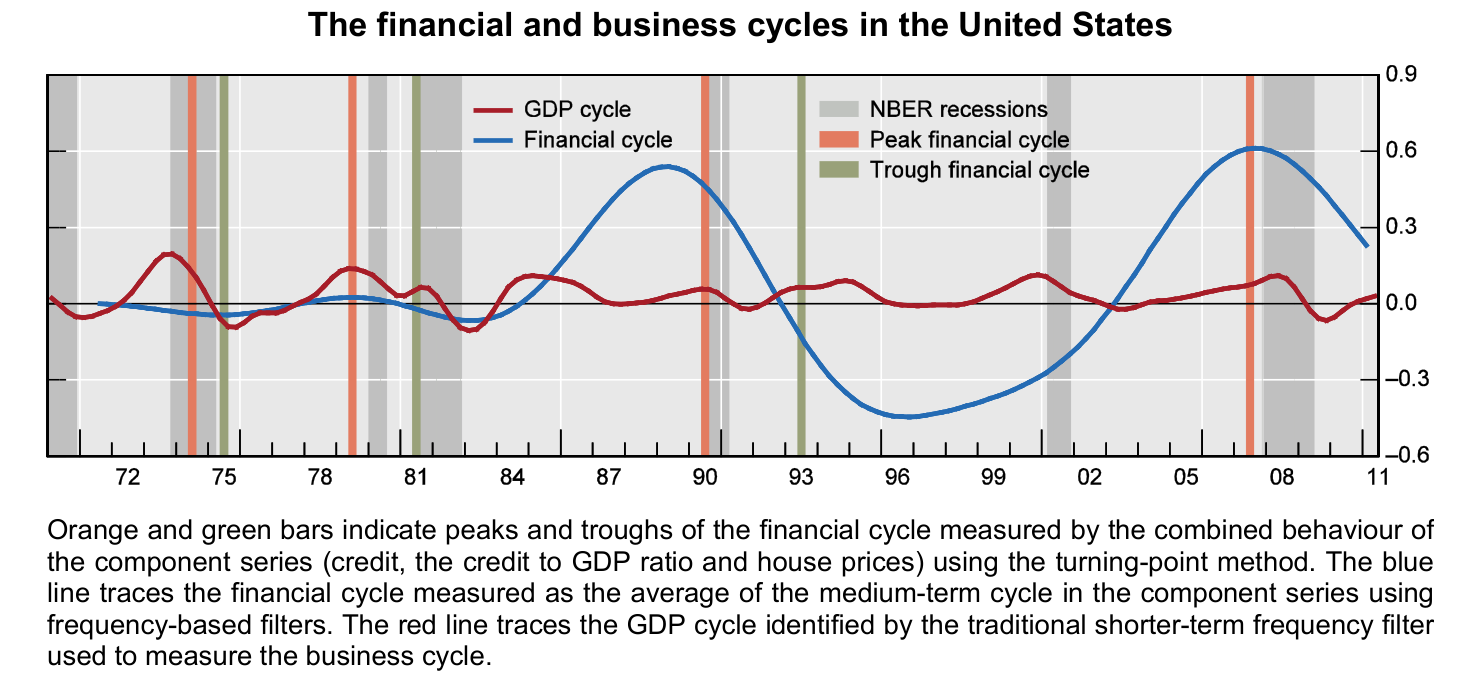
- The cycle is credit + property prices. "Arguably, the most parsimonious description of the financial cycle is in terms of credit and property prices."[1] These two co-vary closely at low frequencies; equity prices, by contrast, "can be a distraction," co-varying far less. This is the pivotal fact for the wiki: the single most authoritative account of the modern boom-bust cycle finds it is carried by property, aligning it with the land-credit reading even as its causal framing is general.
- It is long — about 16 years. "The average length of the financial cycle in a sample of seven industrialised countries since the 1960s has been around 16 years"[1] — much longer than the traditional 1–8-year business cycle. This is the mainstream, BIS-branded cousin of the practitioner 18-year land cycle; the wiki notes the resemblance without claiming Borio endorses the land-cycle literature.
- Its peaks predict crises. In the seven-country sample, "all the financial crises with domestic origin occur at, or close to, the peak of the financial cycle," and recessions coinciding with the cycle's contraction are far worse — "GDP drops by around 50% more than otherwise."[1]
- The best crisis early-warning is a joint credit + property signal. The leading indicators "are based on simultaneous positive deviations (or 'gaps') of the ratio of (private sector) credit-to-GDP and asset prices, especially property prices, from historical norms."[1] Neither variable alone is as clean as the two together.
- Booms need neither low interest rates nor a real shock — the system is over-elastic. Borio locates the cause in the "'excess elasticity' of the system … its failure to restrain the build-up of unsustainable financial booms,"[1] and argues a monetary regime "narrowly focused on controlling near-term inflation removes the need to tighten policy when financial booms take hold" against a benign inflation backdrop — the mechanism behind the pre-2008 "Great Moderation."
What It Cuts Against (the steelman)
Borio is the strongest reason not to reduce credit booms to land-rent extraction:
- The driving mechanism is endogenous credit creation and shifting risk perceptions, a monetary-and-procyclical dynamic that is logically independent of whether the collateral bears rent. On Borio's account the instability is a property of the financial system, not of land.
- It offers a remedy on the banking side — macroprudential limits, leaning against the credit-to-GDP gap — that owes nothing to rent capture, undercutting any claim that a land value tax is the uniquely-indicated policy lever.
- It thereby disciplines the heterodox Bezemer–Hudson reading: the same credit–asset-price boom can be explained without invoking a distinct category of "unproductive" rent-credit.
What It Nonetheless Supports
The steelman is real but partial, because Borio's own empirics centre on property:
- The cycle is most parsimoniously described by credit and property prices — and, when the house-price boom is decomposed, the moving part is overwhelmingly the land component (Knoll, Schularick & Steger). So "the collateral at the centre of Borio's cycle" and "land" largely coincide.
- His ~16-year cycle and property-centred crisis signal are consistent with — though not an endorsement of — the wiki's 18-year land cycle and land-speculation-causes-cycles accounts.
- The wiki's honest resolution is on the objection page: land and credit are "one machine seen from two sides," and Borio supplies the credit side's most rigorous articulation. The defensible claim is not "cycles are land, not credit" but that land is the dominant collateral through which the credit cycle runs.
Honest Scope (rent gradient)
Borio is a mainstream, institutionally authoritative source that makes no rent-theoretic claim at all — it never argues finance income is rent, and treating it as pro-Georgist evidence would misread it. Its correct use is dual: as the counter-weight that keeps the finance-rents pages honest (credit booms are a general monetary phenomenon), and as the property-centred empirics that, read against Knoll–Schularick–Steger, still route the cycle through land. Both uses are legitimate; neither should be overstated.
See Also
- Objection: property cycles are driven by credit, not land — the debate this paper anchors on the credit side
- The growth of modern banking is largely mortgage credit against land — where the property-centred cycle meets the land reading
- Bezemer & Hudson: Finance Is Not the Economy — the heterodox reading this disciplines
- The Great Mortgaging · Knoll, Schularick & Steger — the collateral is property, and the property is land
- The 18-Year Land Cycle · Land speculation causes cycles — the practitioner cousin of the ~16-year financial cycle
- The FIRE Sector · 2008 Financial Crisis
- Geoism — the rent-domain program and its gradient
Sources
- Claudio Borio, "The Financial Cycle and Macroeconomics: What Have We Learnt?," BIS Working Paper No. 395, December 2012 (published in Journal of Banking & Finance 45, 2014, pp. 182–198) — used for the "Hamlet without the Prince" thesis; the analytical definition of the financial cycle; "the most parsimonious description … is in terms of credit and property prices" (equity "a distraction"); the ~16-year average length; the "all … domestic-origin crises occur at, or close to, the peak" and "GDP drops by around 50% more" findings; the joint credit-to-GDP-and-property-price gap early-warning indicator; "the financial system … also generates, purchasing power, and has very much a life of its own"; and the "excess elasticity" framing (B- and D-claims; verified against the full PDF). BIS PDF · BIS landing page