A Firm-Level Perspective on the Role of Rents in the Rise in Inequality
Furman & Orszag's 2015 Stiglitz-honoring paper argues rising inequality is better explained by an increasingly skewed distribution of firm-level returns on capital than by a labor-to-capital income shift, and flags land-use-driven housing rents as one contributor.
Summary
"A Firm-Level Perspective on the Role of Rents in the Rise in Inequality" is a paper by Jason Furman, then Chairman of the White House Council of Economic Advisers, and Peter Orszag, then Vice Chairman of Corporate and Investment Banking at Citi and a non-resident senior fellow in economic studies at the Brookings Institution (and formerly Director of the Office of Management and Budget). It was presented on October 16, 2015, at "A Just Society," a centennial event at Columbia University honoring Joseph Stiglitz, and was later published as the opening chapter (pp. 19–47) of Toward a Just Society: Joseph Stiglitz and Twenty-First Century Economics, edited by Martin Guzman (Columbia University Press, 2018) — publication details confirmed via Crossref's DOI record for the chapter (10.7312/guzm18672-003: Chapter 1, pp. 19–47, Columbia University Press, December 2018) and Furman's own Harvard Kennedy School publications page. This wiki's summary is based on the freely available October 16, 2015 conference version; the published chapter itself sits behind De Gruyter's subscription wall (see Nuances below). Because it was written by two senior U.S. economic policymakers as a tribute to Stiglitz's own work on inequality and imperfect competition (citing Stiglitz 2012, The Price of Inequality), and because it does not argue from a Georgist or land-tax perspective at all, its independent firm-level evidence for a broad, generalized rise in economic rents carries weight as an outside-the-movement corroboration of a claim central to the Georgist case — while also being explicit that the authors regard their own hypothesis as exploratory rather than settled.
The Core Argument and Findings
Motivation: the aggregate rents story doesn't fit the timing. The authors open by testing Stiglitz's aggregate hypothesis that rising economic rents — "payments to factors of production above what is required to keep them in the market" — shifting from labor to capital drive rising inequality. They find the aggregate story does not fit the data well: inequality (the top 1% income share) started rising in the 1970s, while the capital share of income and the economy-wide profit rate did not begin rising until around 2000. Decomposing the 9 percentage-point rise in the top 1%'s share of total income from 1970–2010 (Piketty-Saez World Top Income Database data), the authors attribute 68% to increased inequality within labor income, 32% to increased inequality within capital income, and 0% to a shift in income from labor to capital. Using U.S. National Income and Product Accounts data instead (which show some labor- to-capital shift the World Top Incomes data does not), they estimate the labor-to-capital income shift accounts for at most roughly 20% of the rise in the top 1% share since 1970 — still a distinctly secondary factor next to within-labor and within-capital dispersion.
The capital-share rise is concentrated in housing, not productive capital. Examining why labor's share of income has fallen, the authors show (citing Rognlie (2015)) that the aggregate capital stock has not grown materially relative to output, and that the fall in labor's share since 2000 is due almost entirely to a rising housing capital share of gross domestic income, not a rise in the share going to productive (non-housing) capital, which has stayed close to its 1970–1999 average. Their own Figure 4 decomposes the change in shares of gross domestic income (2014 vs. the 1970–1999 average): returns to labor fell 3.8 percentage points, while returns to housing rose 2.8 points, returns to capital excluding housing rose only 0.3 points, and depreciation/government rose 0.7 points — meaning housing/land rents, not generic capital, account for the large majority of the measured shift away from labor.
Land-use restriction as a source of housing rent (Box 1). The authors devote a boxed discussion to this housing-rent finding, drawing on Glaeser and Gyourko (2002): housing prices track construction costs (implying no supernormal rent) in most U.S. cities, but a large and growing set of major population centers — New York, Los Angeles, San Francisco among them — show housing prices persistently well above construction costs, and this gap is strongly associated with more restrictive land-use regulation (as measured by the Wharton Land Use Regulatory Index). They also cite Hsieh and Moretti (2015), who estimate that reducing housing-supply constraints in high-productivity cities to the level of the median U.S. city would raise aggregate U.S. GDP by an estimated 9.5%. They further note that cities with especially stringent land-use restrictions "tend to have especially high upward mobility," and that high-mobility cities tend to have less income inequality (citing Chetty et al. 2014) — so zoning and land-use restrictions "can potentially discourage low-income families from moving to high-mobility areas — effectively relegating them to lower-mobility areas, reinforcing inequality," and housing rents therefore "have important implications for both aggregate growth and its distribution."
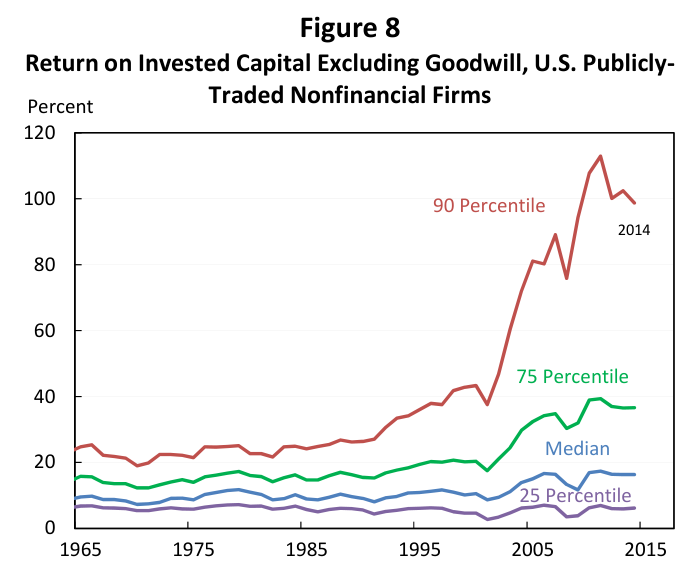
Rising dispersion in firm-level returns on capital. The paper's central firm-level evidence is that the distribution of returns to capital across publicly traded U.S. firms has grown markedly more skewed since roughly the early 1990s. Using McKinsey data (compiled by "the McKinsey Corporate Analysis tool," which the paper's figure notes describe as McKinsey analysis of Standard & Poor's data following Koller et al. 2015) on return on invested capital (ROIC) excluding goodwill for publicly traded non-financial U.S. firms, 1965–2014, the authors report the ratio of the 90th percentile of firm ROIC to the median has risen from under 3 to approximately 10, with returns at the 90th percentile of roughly 100% and at the 75th percentile of roughly 30% by 2014 — a pattern the paper explicitly flags as raising, without resolving, "the question of whether they reflect economic rents." Two-thirds of the non-financial firms averaging an ROIC of 45% or higher between 2010–2014 were concentrated in the health care or information technology sectors. The authors report the high returns appear persistent rather than one-off noise: of firms with ROIC above 25% in 2003, 85% remained in that bucket by 2013. They corroborate rising concentration with Census Bureau data showing the 50 largest firms gained revenue share in three-fourths of the broad industry sectors tracked between 1997 and 2007 (e.g. transportation and warehousing +12.0 percentage points, retail trade +7.6 points, finance and insurance +7.4 points), plus a survey of sector-specific concentration studies (banking, hospital markets, agricultural inputs, wireless telecom).
Rising inequality is between firms, not within them. Citing Barth, Bryson, Davis & Freeman (2014) and Song, Price, Guvenen, Bloom & von Wachter (2015, "Firming Up Inequality"), the authors report that increased earnings inequality is now understood to derive overwhelmingly from increased dispersion of average pay between firms rather than dispersion of pay within firms: Barth et al. estimate that increasing inequality between establishments explains more than two-thirds of the rise in overall U.S. earnings inequality between 1992 and 2007, while Song et al.'s Social-Security-linked data suggest essentially all of the rise in national wage inequality from 1978–2012 stems from increasing disparities in average pay across companies, with the within-firm gap between highest-paid and average employees explaining "almost none" of it. The authors connect this to older inter-industry wage-differential evidence (Krueger and Summers 1988) and to rent-sharing evidence from airline and trucking deregulation (Card 1996; Rose 1987), under which some of a firm's product-market rents are shared with its workers — implying that some rise in wage inequality reflects workers at high-rent firms sharing in those rents, not a pure change in individual skill returns.
Declining labor-market and business fluidity. The paper connects rising firm-level rent dispersion to a parallel decades-long decline in U.S. job creation/destruction rates, worker hires/separations, and interstate migration, and (in Box 2) to the fivefold rise in the share of the U.S. workforce covered by occupational licensing (from under 5% in the early 1950s to 25% by 2008 under state law alone), which the authors describe as, in some cases, "a classic case of rent-seeking by incumbents" who lobby to erect barriers to entry.
Relation to the Georgist Case
The paper's Georgist relevance operates on two distinct levels that are best kept separate rather than conflated.
First, the housing/land-rent finding is directly on point for the Georgist case, and unusually so for a paper not otherwise engaging with Georgist ideas at all. Furman and Orszag's own decomposition attributes the overwhelming majority of the shift away from labor's income share since 1970–1999 to rising housing capital, not productive capital, and their Box 1 explicitly identifies land-use restrictions as a driver of the resulting rents in major cities — the same mechanism this wiki's land value tax and economic rent pages treat as central to the case for taxing land rather than labor or capital. That two senior mainstream economists, writing for a Stiglitz tribute volume with no Georgist framing, independently reach "it's mostly housing/land, and land-use rules are part of why" is a meaningful corroboration of the capital share rise is land outcome, alongside Rognlie's original decomposition, which the authors cite directly as their source for this finding.
Second, the firm-level ROIC dispersion and between-firm wage-inequality findings generalize the rent concept beyond land, in the same spirit as De Loecker, Eeckhout & Unger (2020) later documented with a more rigorous markup-based estimator. Furman and Orszag's evidence — a rising 90th/50th ROIC ratio, persistence of high returns, and concentration gains by large firms — is consistent with a broader Georgist argument that a growing share of national income is captured by holders of some form of scarce, non-produced advantage (market position, licensing barriers, patents, or land) rather than distributed according to competitive contribution. But the paper is careful — more careful than some later, more confident treatments of "rising rents" — to flag this firm-level pattern as a question the evidence raises rather than a conclusion it establishes: the authors explicitly state that they "raise this perspective as a question that is worth further exploration rather than a definitive conclusion," and that rising dispersion in annual returns is "not, in and of itself, evidence of an increase in rents," since it could instead reflect compensation for risk or non-persistent year-to-year noise (a possibility they partially rule out, but do not fully exclude, via their persistence analysis).
Nuances and Limits
- This is an exploratory, non-peer-reviewed conference paper, not a refereed empirical study. Furman and Orszag repeatedly frame their contribution as raising a hypothesis for "further exploration" rather than establishing a causal finding; the paper's opening section states "Our only real conclusion is thus that more attention needs to be paid to what is driving firm-level trends in the United States," and its closing section reiterates that "our principal conclusion is that more work needs to be done." It should be cited on the wiki with that framing, not as if it settles the rents-and-inequality question.
- The authors explicitly acknowledge their rents hypothesis does not explain the initial rise in inequality. They date the firm-level return-dispersion trend to "about 1990," while inequality began rising in the 1970s — so by their own account this is, "at best, a partial explanation."
- The ROIC dispersion finding is not proof of rents. The authors themselves note two alternative readings they cannot fully rule out: (1) if all firms simply had more volatile, randomly distributed annual returns, dispersion could rise with no true increase in rents; and (2) some of the gap could reflect a legitimate risk premium. Their persistence-of-returns evidence (85% of high-ROIC firms in 2003 remained high-ROIC in 2013) is offered as partial, not conclusive, evidence against the pure-noise explanation.
- The housing-rent finding is second-hand within this paper. The Figure 3a/3b/4 decomposition and the land-use-restriction discussion in Box 1 are drawn from Rognlie (2015) and Glaeser and Gyourko (2002) respectively; Furman and Orszag synthesize and restate these findings rather than producing new housing-rent evidence of their own. Readers citing "the housing-rent finding" should ultimately credit Rognlie and Glaeser & Gyourko as the primary sources, with this paper as a secondary synthesis that links them explicitly to the inequality debate.
- Scope of the firm-return data. The McKinsey ROIC dataset covers only publicly traded, non-financial U.S. firms, excluding private firms and the financial sector, where "computing returns on invested capital" is acknowledged to be more complex; the Barth et al. and Song et al. between-firm inequality estimates are U.S.-only as well.
- The occupational-licensing rent-seeking claim is qualified, not asserted outright. The paper states licensing "can also present a classic case of rent-seeking by incumbents" while also noting licensing is "often based on sound concerns for health and safety" and that it is "unlikely that licensing is the sole driver" of declining interstate mobility — a genuinely balanced framing worth preserving if this paper is cited on an occupational-licensing objection or narrative page.
- The text reviewed is the 2015 conference version, not the 2018 published chapter. Every finding, figure, and quotation on this page was verified directly against the October 16, 2015 conference PDF hosted on the Obama White House archive. The paper's later publication as Chapter 1 (pp. 19–47) of Toward a Just Society (Columbia University Press, 2018) is confirmed via Crossref's DOI record (10.7312/guzm18672-003) and Furman's Harvard Kennedy School publications page, but the published chapter text is subscription-only (De Gruyter) and has not been consulted, so any revisions the authors made for the 2018 volume are not reflected here.
Bears On
- Problem: Corporate profits increasingly reflect economic rents — this paper's firm-level ROIC dispersion, between-firm wage-inequality, and industry-concentration findings are directly relevant evidence for that claim, alongside De Loecker, Eeckhout & Unger and Barkai's declining-shares evidence.
- Outcome: Most of the modern rise in the capital share is land, not capital — the paper's own decomposition (housing capital +2.8 points vs. non-housing capital +0.3 points, 1970–1999 average vs. 2014) independently restates and endorses Rognlie's finding, from outside the Georgist and even outside the pure academic-research context (two policymakers writing for a Stiglitz festschrift).
- Concept: Economic Rent — the paper's central definition ("payments to factors of production above what is required to keep them in the market") and its firm-level ROIC evidence are a direct, if exploratory, application of the concept beyond land.
- Concept: Rent-Seeking — the occupational-licensing discussion (Box 2) and the rent-sharing evidence from airline/trucking deregulation are concrete instances.
- Research: De Loecker, Eeckhout & Unger (2020) — markups — a later, more methodologically rigorous firm-level treatment of the same broad "rising rents" hypothesis Furman and Orszag raise more tentatively with ROIC data.
- Research: Rognlie — Deciphering the Fall and Rise in the Net Capital Share — the primary source for this paper's housing/land capital- share decomposition.
- Concept: Superstar Firms — the paper's finding that the 50 largest firms gained revenue share in most tracked industries (1997–2007) is an earlier, cruder precursor to the superstar-firms concentration literature.
See Also
- Economic Rent
- Rent-Seeking
- Most of the modern rise in the capital share is land, not capital
- Rognlie — Deciphering the Fall and Rise in the Net Capital Share
- De Loecker, Eeckhout & Unger — The Rise of Market Power and the Macroeconomic Implications
- Autor, Dorn, Katz, Patterson & Van Reenen — superstar firms
- Superstar Firms
Sources
- Jason Furman & Peter Orszag (2015), "A Firm-Level Perspective on the Role of Rents in the Rise in Inequality," presentation at "A Just Society: A Centennial Event in Honor of Joseph Stiglitz," Columbia University, October 16, 2015. PDF (Obama White House Archive) — used for all findings, figures, data sources, and quotations above; read in full, 2026-07-10 (24 pages).
- Jason Furman & Peter Orszag, "A Firm-Level Perspective on the Role of Rents in the Rise in Inequality," in Martin Guzman (ed.), Toward a Just Society: Joseph Stiglitz and Twenty-First Century Economics (Columbia University Press, 2018), pp. 19–47. Chapter DOI · Publisher page · Furman's HKS publications page — used to confirm the paper's later publication as Chapter 1 of the Stiglitz festschrift volume. Crossref's metadata record for the chapter DOI confirms the title, authors, pages 19–47, publisher, and December 2018 publication date, and Furman's own Harvard Kennedy School page carries the matching citation. The chapter text itself remains behind De Gruyter's subscription wall, so the wiki's summary is based on the freely available 2015 conference version rather than the final published chapter — see the provenance note in Nuances and Limits above.
- Matthew Rognlie (2015), "Deciphering the Fall and Rise in the Net Capital Share," Brookings Papers on Economic Activity, BPEA Conference Draft, March 19–20, 2015. — cited by Furman & Orszag as the primary source for the housing/non-housing capital-share decomposition (Figures 3a, 3b, 4); see this wiki's own Rognlie summary for a dedicated treatment.
- Edward L. Glaeser & Joseph Gyourko (2002), "The Impact of Zoning on Housing Affordability," NBER Working Paper No. 8835. — cited by Furman & Orszag as the primary source for the land-use-restriction and housing-price-versus-construction-cost evidence in Box 1; see this wiki's Glaeser & Gyourko summary for a dedicated treatment.
- Chang-Tai Hsieh & Enrico Moretti (2015), "Why Do Cities Matter? Local Growth and Aggregate Growth," NBER Working Paper No. 21154. — cited by Furman & Orszag for the estimate that reducing high-productivity-city housing constraints to the median city's level would raise U.S. GDP by 9.5%; see this wiki's Hsieh & Moretti summary for a dedicated treatment.
- Erling Barth, Alex Bryson, James C. Davis & Richard Freeman (2014), "It's Where You Work: Increases in Earnings Dispersion across Establishments and Individuals in the U.S.," NBER Working Paper No. 20447. — used for the finding that between-establishment inequality explains more than two-thirds of the 1992–2007 rise in U.S. earnings inequality; cited via Furman & Orszag's discussion, not re-checked against the primary text.
- Jae Song, David J. Price, Fatih Guvenen, Nicholas Bloom & Till von Wachter (2015), "Firming Up Inequality," NBER Working Paper No. 21199. — used for the finding that essentially all of the 1978–2012 rise in U.S. wage inequality stems from between-firm rather than within-firm pay disparities; cited via Furman & Orszag's discussion, not re-checked against the primary text.
- Morris M. Kleiner & Alan B. Krueger (2013), "Analyzing the Extent and Influence of Occupational Licensing on the Labor Market," Journal of Labor Economics 31(2), S173–S202. — used for the occupational-licensing growth statistics in Box 2; cited via Furman & Orszag's discussion, not re-checked against the primary text.
- Joseph E. Stiglitz (2012), The Price of Inequality: How Today's Divided Society Endangers Our Future, W. W. Norton & Company — the aggregate rents-and-inequality hypothesis this paper sets out to test and ultimately qualifies; cited via Furman & Orszag's own reference list.