The Economic Implications of Housing Supply
Glaeser and Gyourko show US house prices in coastal/regulated metros far exceed minimum production cost, and attribute the gap to zoning, not land scarcity or LVT — a paper about regulation, not tax policy.
Summary
"The Economic Implications of Housing Supply" is a survey-style essay by Edward L. Glaeser (Fred and Eleanor Glimp Professor of Economics, Harvard University) and Joseph Gyourko (Martin Bucksbaum Professor of Real Estate, Finance and Business Economics, the Wharton School, University of Pennsylvania), published in the Journal of Economic Perspectives, Vol. 32, No. 1 (Winter 2018), pp. 3–30. It circulated earlier as NBER Working Paper No. 23833 (September 2017). Both authors are mainstream urban economists with long individual and joint publication records on housing supply and land-use regulation, and the paper carries weight for the Georgist case for the same reason as the Mirrlees Review and Hsieh and Moretti's paper: it reaches conclusions consonant with Georgist concerns about land rent from entirely outside the Georgist tradition, using standard public-finance and urban-economics tools rather than any Georgist framework.
This is a paper about zoning and land-use regulation, not land value taxation. The word "tax" appears in the paper only in the sense of an "implicit tax" or "regulatory tax" that zoning imposes on new construction (a metaphor for the price-cost wedge, not a proposal to tax land value), and once in a brief reference to the "optimal tax on new building" in the Pigouvian-externality sense. A systematic read of the abstract, introduction, all four substantive sections, the conclusion, and the full reference list found no discussion of land value taxation, site value taxation, or any fiscal instrument targeting land as a policy lever. This absence matters for how the paper should be used on this wiki (see "Relation to the Georgist Case" below).
The Core Argument and Findings
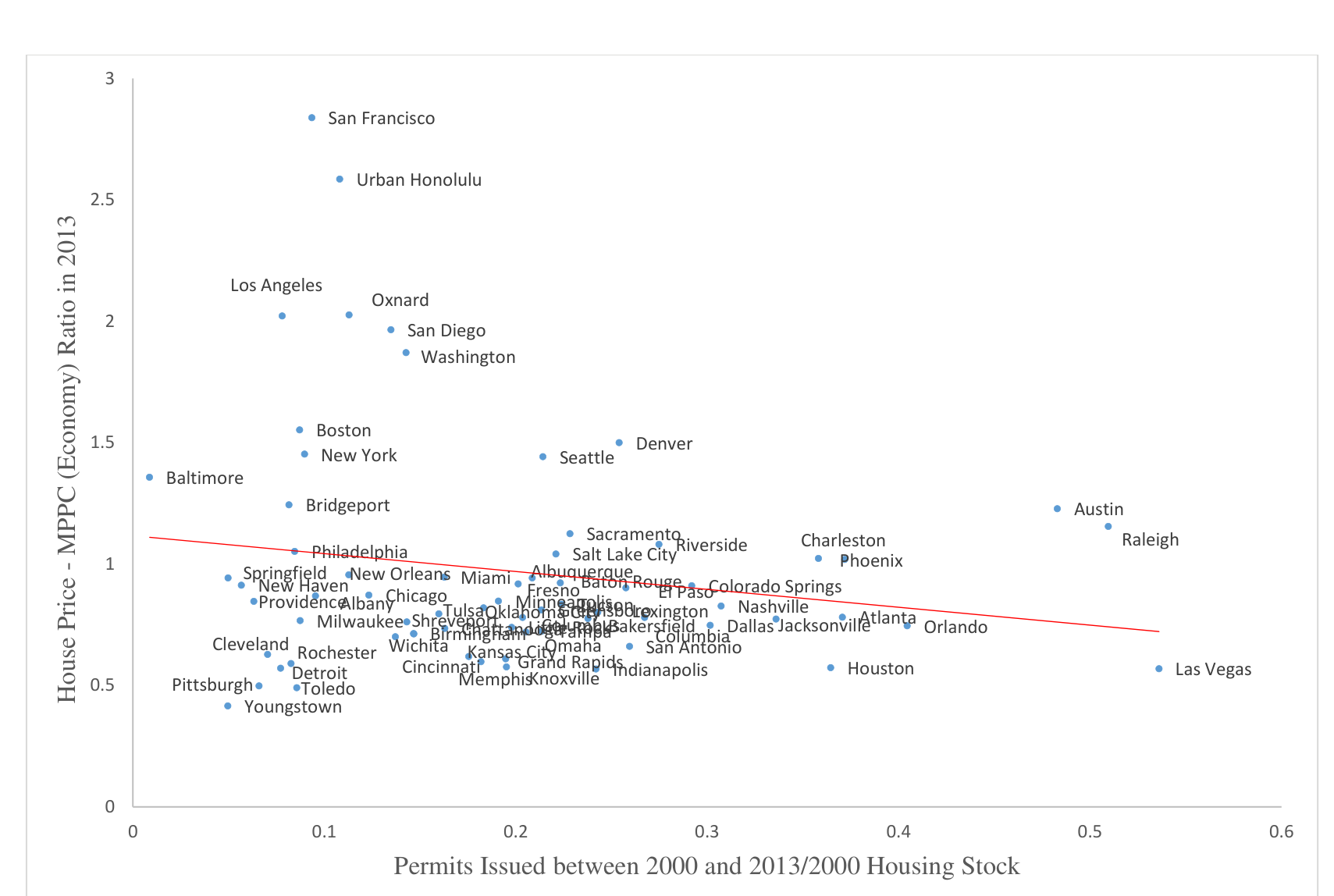
Glaeser and Gyourko's organizing method is a cost-based test of whether a housing market is "well-functioning." They define the Minimum Profitable Production Cost (MPPC) of a housing unit as MPPC = (Land + Construction Cost) × Entrepreneurial Profit, using an industry rule of thumb that land is no more than 20% of construction-plus-land cost in a lightly regulated market, and a stabilized gross margin of about 17% (derived from long-run homebuilder returns of 9–11% per annum). Physical construction costs are taken from R.S. Means Company data across more than 100 US markets for a modest, "economy-quality," single-family home. If a market's house-price-to-MPPC ratio (HP/MPPC) is at or below 1, the authors treat the market as efficiently supplying housing near its true production cost; ratios well above 1 indicate prices detached from the physical cost of building.
Using this metric on individual-unit micro-data from the American Housing Survey (1985–2013) across 98 metropolitan areas, the authors report that, as of 2013, roughly three-quarters of observations (73.6%) were priced at or below MPPC, with just over one-quarter (26.4%) priced above it and about 10% priced at more than double MPPC. The expensive tail is spatially concentrated: only a small number of metros — heavily coastal California, Hawaii, the New York City area, and a handful of others — account for nearly all of the observations priced well above production cost.
The paper classifies US housing markets into three stylized types, each illustrated with a case study:
- Declining, durable-stock markets (Detroit): demand has fallen for decades, housing supply is durable so the stock does not shrink, and prices sit below MPPC for the existing (older, depreciated) stock; permitting activity is minimal because developers rationally will not build at a loss.
- Elastic, well-functioning markets (Atlanta): supply responds strongly to demand, so despite large swings in permitting intensity (from roughly 4.5% of stock built annually at the 2005 peak down to well under 1% after 2009), the median HP/MPPC ratio stays close to 1 throughout — the textbook case of price pinned to cost.
- Inelastically supplied, high-demand markets (San Francisco): demand has grown for decades but new construction has not responded, so price has decoupled from cost. In the San Francisco-Oakland-Hayward metro, the authors calculate a median HP/MPPC ratio of 2.84 in 2013, with the median-priced unit selling for about $800,000 against an estimated MPPC of about $281,690 (of which about $192,938 is physical construction cost). Backing out the implied land value, they estimate the underlying lot cost roughly $490,000 — about ten times the land value implied by the industry rule-of-thumb land share used in the MPPC formula, and about 61% of total home value. The published text puts it: "Clearly, San Francisco housing developers cannot actually earn super-normal profits on the margin. Instead, what makes San Francisco housing so expensive is the bidding up of land values" (Glaeser and Gyourko 2018, pp. 16–18). An earlier draft phrased the same point more explicitly — "Because the scarce factor is land, not building materials or construction labor, what makes San Francisco housing so expensive is the bidding up of land values" (Zell/Lurie Working Paper #802 draft, January 2017) — but that sentence appears only in the Wharton draft, not in the NBER working paper or the published JEP text.
The authors attribute this price-cost gap primarily to land-use regulation rather than to a physical scarcity of land per se, drawing on their own and coauthors' prior empirical work: the Wharton Residential Land Use Regulatory Index (Gyourko, Saiz and Summers, 2008), evidence that minimum lot sizes and other zoning rules are strongly correlated with restricted new building in Greater Boston (Glaeser and Ward, 2009), and Gyourko and Saiz's (2006) finding that the variance of physical construction costs across markets is far smaller than the variance in house prices — implying that cost heterogeneity cannot explain most of the price dispersion. They also correlate 2013 median house prices with the Wharton regulatory index (correlation ≈ 0.5) and with Saiz's (2010) geographic/regulatory housing-supply-elasticity measure, finding a similarly sized relationship in the expected direction. On this basis they conclude that regulatory constraints, not raw land scarcity, best explain why some metros show large, persistent price-cost gaps while geographically similar or even more land-constrained metros do not.
The paper also estimates broader economic costs of this supply constraint: using a capitalization framework, the authors estimate that a long-term San Francisco homeowner who bought in the mid-1980s experienced "a near tripling of real land value" over the following three decades (a calculation that appears in the working-paper versions — NBER Working Paper No. 23833 appendix and the Wharton #802 draft — but was cut from the published JEP text), illustrating how binding supply constraints transfer wealth from later buyers and renters to earlier owners rather than reflecting new value creation. Drawing on Hsieh and Moretti's labor-misallocation model, Glaeser and Gyourko present illustrative back-of-envelope calculations suggesting the aggregate output cost of restrictive land-use regulation in a small number of high-productivity metros is "at least 2 percent of national output" per year under conservative labor-demand-elasticity assumptions, while noting this figure is highly sensitive to modeling choices and that "there can be a fairly wide range of outcomes depending upon model and parameter assumptions" (Glaeser and Gyourko 2018, p. 5). Both the "at least 2 percent" lower bound and this caveat appear verbatim in the published JEP text (p. 5, verified against the published PDF on 2026-07-10) as well as in the NBER and Wharton working-paper drafts.
Beyond prices, the paper documents distributional consequences. Using Survey of Consumer Finances data from 1983 to 2013, the authors find that the large rise in aggregate US housing wealth accrued "almost exclusively among the wealthiest, older Americans" — younger cohorts had flat or declining real home equity through the 90th percentile of their wealth distributions — a pattern they describe as "consistent with binding land use restrictions in a select group of markets leading to transfers to now older households who happen to have bought in those markets some decades ago" (Wharton #802 working-paper draft, Section III; the published JEP text states the same finding as "the Survey of Consumer Finances shows sharp home wealth increases only among the richest members of the oldest cohorts," p. 21). They connect this to the macro capital-share debate: citing Rognlie (2015), they note the post-war rise in the net capital share attributable to housing (from 3% to 8% of domestic value added) and observe that if that rise reflects supply-constrained markets, "then perhaps the right policy conclusion from Piketty (2014) is not redistribution, but deregulation of housing supply in cities from San Francisco to Paris" (Wharton #802 working-paper draft, Section III — note this sentence was cut before publication and does not appear in the published JEP text, which retains the Rognlie/Piketty capital-share discussion at p. 20 without the policy line; see Rognlie on the capital share).
Relation to the Georgist Case
This paper cuts both ways for the Georgist case, and neither direction should be overstated.
It supports the affordability outcome insofar as the value in question is precisely the kind of unearned locational rent LVT targets. Glaeser and Gyourko's own accounting shows that in constrained markets like San Francisco, the price-cost gap is overwhelmingly a land-value phenomenon, not a construction-cost phenomenon — physical building costs are strikingly similar across US metros, while land values diverge by an order of magnitude. That land, not labor or materials, is "the scarce factor" bidding up prices is the mainstream-economics mirror of the Georgist claim that land rent, not production cost, drives housing unaffordability in high-demand cities. To the extent land value taxation discourages speculative land-holding and rewards development relative to non-taxed alternatives (a mechanism this wiki documents elsewhere, e.g. under split-rate taxation increases construction), a jurisdiction that both taxed land value and relaxed its own zoning would be capturing exactly the rent Glaeser and Gyourko describe while also incentivizing the new supply their paper implies is being withheld.
It complicates the outcome because the paper's own diagnosis and policy conclusion are about zoning, not taxation, and the authors never propose LVT. Glaeser and Gyourko's central empirical claim is that the binding constraint on supply in cities like San Francisco is regulatory — minimum lot sizes, permitting delays, height limits, and the political economy of existing homeowners controlling land-use decisions — not a shortage of the tax instruments available to local governments. Their conclusion argues for "welfare gains from reducing these restrictions" and discusses only non-fiscal interventions (state-level zoning overrides such as Massachusetts's Chapter 40B, fiscal transfers to compensate incumbent residents for allowing development) as the paths to change; land value taxation is not among the tools they discuss. This is precisely the substance of the (as-yet undrafted) objection "zoning is the binding constraint, not LVT": a land value tax, without accompanying zoning reform, may capture the land rent Glaeser and Gyourko document without doing anything to relax the legal restrictions that Glaeser and Gyourko identify as the actual cause of undersupply — because it remains illegal to build more housing on the land regardless of how that land is taxed. Readers should not conclude from this paper that LVT would resolve the affordability problem in a market like San Francisco; the paper's own policy discussion points squarely at land-use liberalization instead, echoing the same "necessary complement" caveat this wiki already attaches to LVT improves housing affordability via the Singapore/Hong Kong objection.
Note for the orchestrator (suggested wiring, not created here): this paper is a strong primary source for the queued objection "zoning-not-lvt-is-the-binding-constraint" (tracked in BACKLOG.md as tier:T2, status BACKLOG). No file for that objection exists yet in objections/, so this page does not create a /wiki/ link to it (that would fail lint against a nonexistent file). Once that objection page is drafted, it should cite this paper directly — particularly the MPPC methodology, the San Francisco case study, and the conclusion's exclusive focus on regulatory (not fiscal) remedies — and this page's frontmatter/Bears On section should then be updated to link to it.
Nuances and Limits
- Survey/synthesis, not a single new empirical study. As a Journal of Economic Perspectives essay, this piece is explicitly a non-technical synthesis aimed at a broad audience of professional economists, not a standalone econometric paper. Its empirical content draws heavily on the authors' and their coauthors' prior published work — notably Glaeser, Gyourko and Saks (2005) on Manhattan and the "zoning tax," Gyourko and Saiz (2006) on construction-cost heterogeneity, Gyourko, Saiz and Summers (2008) on the Wharton Residential Land Use Regulatory Index, Saiz (2010) on the geographic determinants of housing supply elasticity, and Gyourko and Molloy's (2015) Handbook of Regional and Urban Economics review of the regulation literature — rather than presenting a single new identification strategy of its own. Readers should treat this JEP piece as an accessible synthesis and entry point to that broader empirical literature, not as the primary citation for any one specific estimate.
- Cross-sectional and correlational, not a natural experiment. The correlations the authors report between prices, the Wharton regulatory index, and Saiz's elasticity measure are cross-sectional; the paper does not claim a causal research design isolating regulation's effect on prices from other confounds. The authors themselves note (echoing prior work by Turner, Haughwout and van der Klaauw, 2014, and others) that "there is no consensus about the welfare implications of heightened land use controls" and that the underlying data limitations mean much of this literature "mostly is cross sectional in nature, and thus subject to standard potential biases associated with omitted variables and reverse causality."
- The 2-percent-of-GDP misallocation estimate is explicitly provisional and derivative. The authors caution that their aggregate-output calculations, built on Hsieh and Moretti's modeling framework, depend heavily on assumed labor-demand elasticities and that "there can be a fairly wide range of outcomes depending upon model and parameter assumptions." Because Hsieh and Moretti's own headline multiplier has since been the subject of an active, unresolved correction dispute (see Hsieh-Moretti page), any output-cost figure derived from that framework — including Glaeser and Gyourko's "at least 2 percent" lower bound — should be read as illustrative rather than a settled estimate.
- The MPPC/land-share assumptions are contestable. The 20%-land-share rule of thumb and the 17% gross-margin assumption are calibrated from industry conventions — "an industry rule of thumb based on an ad hoc survey of home builders," a metric the authors say they "have used … in earlier research (Glaeser and Gyourko 2003, 2008)" — not from directly observed vacant-land transactions, which the authors note "are rarely observed in the United States" (Glaeser and Gyourko 2018, p. 8). A published methodological critique by Cameron K. Murray (2021, Environment and Planning A: Economy and Space, 53(1): 191–209) challenges the related Glaeser–Gyourko technique of inferring a "regulatory tax" from the gap between marginal and average land prices, concluding that "there is no information regarding the effect of planning controls on the supply of new dwellings in a comparison of marginal and average land prices" (Murray 2021, abstract). Note the target: Murray's critique is aimed at the marginal-versus-average method introduced in Glaeser and Gyourko (2003) and used in related empirical work such as Glaeser, Gyourko and Saks (2005) — not at this JEP essay's land-share-based MPPC calculation itself — but this essay draws on that same body of "zoning tax" evidence, so the critique bears on the essay's regulatory diagnosis indirectly. Bryan Caplan's commentary "The Zoning Tax: A Mere Illusion?" (Bet On It, May 26, 2022) airs Murray's critique but largely rejects its strong conclusion — "to conclude that low value of marginal land 'contains no information' is still false" — and argues that Gyourko and Krimmel's vacant-lot-based estimates (Journal of Urban Economics, 2021) sidestep the marginal/average objection while still finding large zoning taxes. The precise size of the price-cost gap attributable to regulation should nonetheless be treated as contested in parts of the literature.
- Does not address land value taxation, incidence, or administrability. As established above, the paper offers no evidence on LVT specifically. Its bearing on the Georgist case is limited to (a) identifying land rent, not construction cost, as the source of the price-cost gap in constrained markets, and (b) diagnosing the cause of that constraint as regulatory rather than fiscal — a diagnosis that, if correct, implies LVT alone (absent zoning reform) would leave the underlying supply constraint untouched even while capturing more of the land rent it generates.
Bears On
- Outcome: LVT improves housing affordability — supports the outcome's premise that the value LVT would capture in high-cost cities is genuine, largely locational/regulatory land rent rather than construction cost; complicates it by showing the paper's own authors locate the remedy in zoning reform, not in tax policy, reinforcing this wiki's existing point that LVT must be paired with permissive land-use policy to improve affordability.
- Research: Hsieh and Moretti (2019), Housing Constraints and Spatial Misallocation — Glaeser and Gyourko draw directly on this paper's labor-misallocation framework for their own aggregate-output estimates; both papers independently locate the cost of restrictive zoning in high-productivity coastal metros.
- Outcome: The rise in the capital share is land — the paper's Section III explicitly ties the housing-driven rise in the measured capital share (citing Rognlie 2015 and La Cava 2016) to supply-constrained markets, i.e., to land values under binding regulation.
- Research: The Mirrlees Review: Tax by Design — a parallel example of a mainstream, non-Georgist institutional source reaching conclusions favorable to taxing land value, though via a different mechanism (explicit LVT proposal for business/agricultural land) than this paper (zoning diagnosis only).
- Suggested wiring for the orchestrator: once drafted, the objection page "zoning-not-lvt-is-the-binding-constraint" should cite this paper as a primary source for the claim that regulatory, not fiscal, constraints bind housing supply in expensive US metros.
See Also
- Objection: Planning and Zoning Restrictions, Not Land, Cause High House Prices — the queued YIMBY/supply-side objection this paper was flagged as a primary source for; adjudicates the Houston/zoning-vs-land debate.
- Saiz (2010), The Geographic Determinants of Housing Supply
- LVT improves housing affordability
- Hsieh and Moretti (2019): Housing Constraints and Spatial Misallocation
- The Mirrlees Review: Tax by Design
- Objection: Land capture didn't make housing cheap (Singapore/Hong Kong)
- Split-rate taxation increases construction
Sources
- Edward L. Glaeser & Joseph Gyourko (2018), "The Economic Implications of Housing Supply," Journal of Economic Perspectives, 32(1): 3–30. AEA/DOI — the published version; used for venue, volume/issue/page details, framing, and (as of 2026-07-10) the page-level verification of every figure used on this page. The published text ("Journal of Economic Perspectives—Volume 32, Number 1—Winter 2018—Pages 3–30") was read in full, 2026-07-10. The published text confirms: the 98-CBSA American Housing Survey sample, 1985–2013; the 73.6%/26.4% price-to-cost distribution (p. 11); the 20%-land-share rule of thumb and 17% gross margin (p. 8); San Francisco's 2.84 ratio, $800,000 median price, $281,690 MPPC, and $192,938 construction cost (p. 16); the ~$490,000 implied land value, "roughly 10 times the amount presumed" (p. 18); the "at least 2 percent of national output" lower bound (p. 5); the "optimal tax on new building" Pigouvian reference (p. 26); and the complete absence of any land value taxation or site-value taxation discussion in the published text.
- Edward Glaeser & Joseph Gyourko (2017), "The Economic Implications of Housing Supply," NBER Working Paper No. 23833. NBER PDF — read in full at last review (2026-07-10), covering the abstract, introduction, Sections II–V, conclusion, and reference list; used for the MPPC methodology, the Detroit/Atlanta/San Francisco case studies, the specific San Francisco price-cost figures, the 2-percent-of-GDP misallocation estimate, the policy conclusion, and confirmation that the paper does not discuss land value taxation anywhere in the text.
- Ed Glaeser & Joe Gyourko, "The Economic Implications of Housing Supply," Zell/Lurie Working Paper #802, draft of January 4, 2017 (written for the Journal of Economic Perspectives). Wharton Real Estate Center PDF — an earlier, independent pre-publication draft, also read in full at last review (2026-07-10); used for the Survey of Consumer Finances household-wealth findings and the Rognlie/Piketty capital-share discussion (Section III), and as a second primary text confirming every figure used on this page (San Francisco $800,000 price / 2.84 ratio / $281,690 MPPC / ~$490,000 implied land value; the "at least 2 percent" output-cost figure; the absence of any land value taxation discussion). Note that several vivid quotations used on this page exist only in this draft: the "Because the scarce factor is land…" sentence, the "wealthiest, older Americans" and "transfers to now older households…" SCF phrasings, and the Piketty "San Francisco to Paris" policy line were all revised or cut before publication and do not appear in the published JEP text; each is explicitly attributed to this draft where quoted above.
- Joseph Gyourko, Albert Saiz & Anita A. Summers (2008), "A New Measure of the Local Regulatory Environment for Housing Markets: The Wharton Residential Land Use Regulatory Index," Urban Studies, 45(3): 693–721 — cited by Glaeser and Gyourko (2018) as the source of the WRLURI regulatory index used in their cross-metro comparisons; used here for identifying this index by name and authorship.
- Albert Saiz (2010), "The Geographic Determinants of Housing Supply," Quarterly Journal of Economics, 125(3): 1253–1296 — cited by Glaeser and Gyourko (2018) as the source of the housing-supply elasticity measure they correlate with prices; used here for identifying that measure and its author.
- Joseph Gyourko & Raven Molloy (2015), "Regulation and Housing Supply," in Handbook of Regional and Urban Economics, Vol. 5b — cited by Glaeser and Gyourko (2018) as the standard literature review of housing-supply regulation; used here to characterize this paper as a synthesis drawing on a wider empirical literature rather than a standalone new study.
- Cameron K. Murray (2021), "Marginal and average prices of land lots should not be equal: A critique of Glaeser and Gyourko's method for identifying residential price effects of town planning regulations," Environment and Planning A: Economy and Space, 53(1): 191–209 (published online July 22, 2020; free access). SAGE/DOI — used for the published methodological critique of the marginal/average land-price approach underlying the "zoning tax" estimates this essay draws on. Verified against the publisher's article page on 2026-07-10 (title, journal, volume/issue/pages, and full abstract, including the conclusion that "there is no information regarding the effect of planning controls on the supply of new dwellings in a comparison of marginal and average land prices"). Note: this article is in Environment and Planning A, not Urban Studies as an earlier draft of this page stated.
- Bryan Caplan, "The Zoning Tax: A Mere Illusion?" May 26, 2022. Bet On It — used for the commentary-level discussion of Murray's critique. Verified against the primary post on 2026-07-10: Caplan presents Murray's indivisibility/"lumpiness" objections but concludes that "to conclude that low value of marginal land 'contains no information' is still false," and points to Gyourko and Krimmel (2021, Journal of Urban Economics) vacant-lot evidence as sidestepping the critique while still finding large zoning taxes.
Note: The specific figures quoted above (San Francisco's $800,000 price / $281,690 MPPC / ~$490,000 land value; the "at least 2 percent of national output" misallocation estimate) are now confirmed against all three versions of the paper: the Wharton #802 draft (verified 2026-07-05), NBER Working Paper No. 23833, and — as of 2026-07-10 — the final published JEP text (32(1): 3–30, Winter 2018), read in full. Every quantitative figure used on this page appears unchanged in the published version. Where a quotation exists only in a working-paper draft (the "scarce factor" sentence, the SCF wealth-distribution phrasings, and the Piketty "San Francisco to Paris" line), that is flagged inline at the point of quotation.