Wealth Inequality in the United States since 1913 (Saez & Zucman)
The Saez–Zucman capitalized-income study of top wealth shares — the primary source behind Doucet's Part 1 point that wealth (land included) is heavily concentrated among the very top of the distribution.
Summary
Wealth Inequality in the United States since 1913: Evidence from Capitalized Income Tax Data, by Emmanuel Saez and Gabriel Zucman, was published in the Quarterly Journal of Economics (2016, 131(2): 519–578); an earlier version circulated as NBER Working Paper 20625.[1] It reconstructs the US wealth distribution back to 1913 by capitalizing the capital-income flows reported on income-tax returns — dividing each asset class's reported income by its economy-wide rate of return to recover the underlying stock, then benchmarking to Financial Accounts totals.
The practitioner-author Lars Doucet draws on Saez–Zucman in Does Georgism Work? Part 1 for the proposition that ownership of wealth — real estate and land included — is heavily concentrated among the wealthy, part of his case that land is a large and unequally held share of national assets. The paper is the most-cited modern primary source for that concentration claim.
Key Findings
Verified against the published QJE PDF:[1]
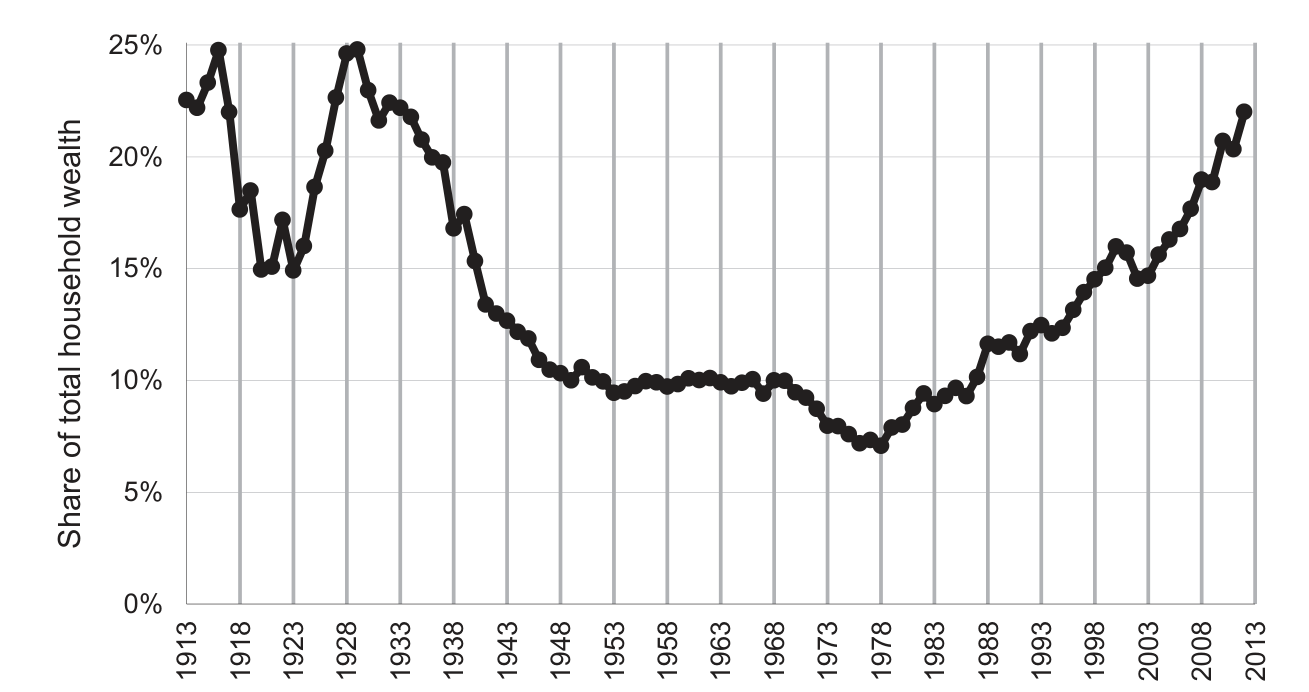
- Top-share surge. "The top 0.1% wealth share has risen from 7% in 1978 to 22% in 2012, a level almost as high as in 1929."[1] This U-shaped path — high in the 1920s, falling to 1978, rising since — is the paper's headline result.
- Housing as an asset class. The method decomposes household wealth into components including "Housing (net of mortgages)… owner- and tenant-occupied housing net of mortgage debt," alongside business assets (which include "farms including land and equipment"), fixed-income claims, equities and pensions.[1] Real estate is thus an explicit, separately-tracked part of the concentration picture.
- Method. The capitalization approach combines "income tax returns with macroeconomic household balance sheets to estimate the distribution of wealth"[1] — sidestepping the survey undercoverage of the very rich that plagues alternative wealth estimates.
What It Supports / Cuts Against
- Supports the concentration premise. For the Georgist argument that capturing land rent is progressive, Saez–Zucman supplies the distributional half: assets whose returns are capitalized — prominently including real estate and land-bearing business assets — are held disproportionately at the top. This bears on the wiki's treatment of who bears an LVT and the fairness case.
- Land is not broken out separately. The paper reports housing and business assets, not pure land value; the land-specific concentration Doucet asserts is an inference from these categories, not a figure the paper isolates. The magnitude of aggregate US land value comes from other sources (Albouy et al., Larson, the AEI indicators), which Saez–Zucman's concentration result complements rather than replaces.
- Contested magnitudes. The capitalization method's top-share levels have been debated (e.g., over the return heterogeneity assumption); the direction and broad scale of rising concentration are widely accepted, the precise top-0.1% level less so. Cite the trend, attribute the exact level.
Sources
- Emmanuel Saez & Gabriel Zucman (2016), "Wealth Inequality in the United States since 1913: Evidence from Capitalized Income Tax Data," Quarterly Journal of Economics, 131(2): 519–578, DOI 10.1093/qje/qjw004. Free full text: author PDF (Berkeley); working-paper version NBER WP 20625 — used for the top-0.1% wealth share rising from 7% (1978) to 22% (2012), the housing/business-asset decomposition of household wealth, and the capitalized-income-tax methodology. Quotes verified verbatim against the QJE PDF (2026-07-11).
See Also
- Doucet, Does Georgism Work? — Part 1, the land/wealth-concentration point
- AEI Land Price and Land Share Indicators — the Part 1 land-share companion
- What's Manhattan Worth? (Barr, Smith & Kulkarni) — the Part 1 land-magnitude companion
- Piketty, Capital in the Twenty-First Century — the wealth-in-land framing
- Dray, Landais & Stantcheva (2026) — this study's 19th- and early-20th-century predecessor, built from General Property Tax assessment records rather than capitalized income-tax flows
- Land Value Tax