Mian, Sufi & Verner (2017): Household Debt and Business Cycles Worldwide
A 30-country panel (1960–2012) showing that a rise in the household debt to GDP ratio — household borrowing being overwhelmingly mortgage credit — predicts lower subsequent GDP growth, not the investment boom a productivity story would imply, and is driven by credit-supply shocks proxied by.
Summary
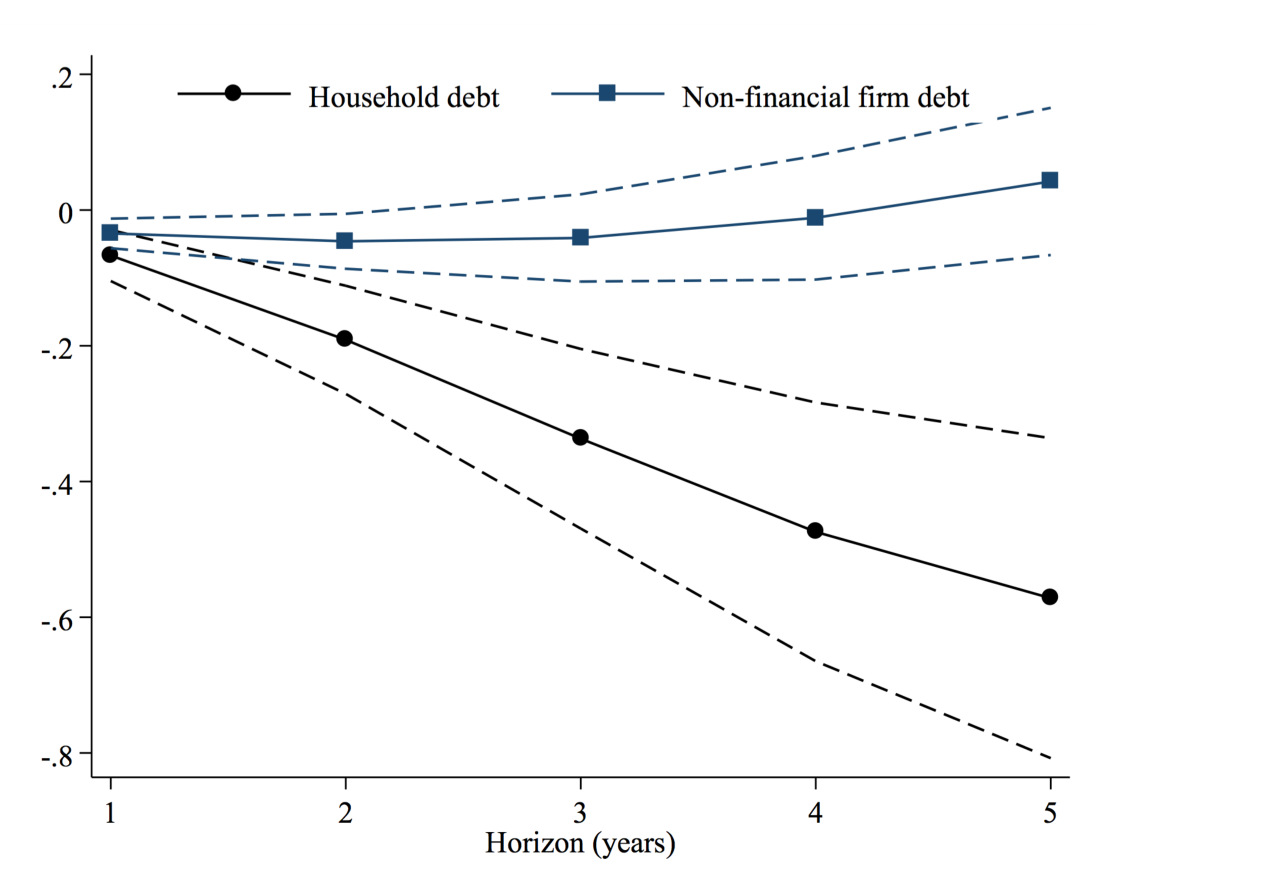
Atif Mian, Amir Sufi, and Emil Verner's "Household Debt and Business Cycles Worldwide" (Quarterly Journal of Economics, 2017; NBER Working Paper 21581, 2015) compiles data for "30 (mostly advanced) countries from 1960 to 2012" and asks what the long postwar rise in household debt has done to the macroeconomy.[1] Its headline result runs against the intuition that credit growth reflects healthy expectations of future income: "A rise in the household debt to GDP ratio predicts lower output growth and a higher unemployment rate over the medium-run."[1]
The paper is the natural companion to Jordà, Schularick & Taylor's Great Mortgaging, which it cites as documenting "the dramatic rise in household credit to GDP ratios over the last 50 years." Where JST establish the composition fact — that the growth of bank lending is overwhelmingly the growth of mortgage credit — Mian–Sufi–Verner supply the distinct analytical result that this household/mortgage-credit expansion is (a) driven by credit-supply shocks rather than productive fundamentals and (b) followed by slower, not faster, growth. That is the evidence the banking-is-land-credit claim needs to argue that much of what is called "financial deepening" is not the productive allocation of capital it appears to be.
Why the Debt Is Mortgage Debt
Household borrowing in these advanced economies is overwhelmingly mortgage borrowing, and the paper's identification strategy runs directly through the mortgage market. To isolate credit-supply shifts (as distinct from demand driven by good news about future income), the authors use mortgage spreads as the key credit-supply proxy: in the paper's own summary, "Low mortgage spreads are associated with an increase in the household debt to GDP ratio and a decline in subsequent GDP growth, highlighting the importance of credit supply shocks."[1] The debt that predicts recessions is, in substance, mortgage debt — credit secured against real estate, whose appreciating component is overwhelmingly land.
Key Findings
1. Household debt predicts slower growth
An increase in the household-debt-to-GDP ratio over three years robustly predicts lower GDP over the following three years, and the magnitude is large: a one-standard-deviation rise "(6.2 percentage points) is associated with a 2.1 percentage point decline in GDP over the next three years."[1] The same rise predicts higher future unemployment, "suggesting that the decline in output growth reflects an increase in economic slack."[1] The relation is "robust across time and space" and holds in the pre-1990 sample too.[1]
2. It is not the productive credit a deepening story assumes
The result is inconsistent with the standard representative-agent open-economy model, in which more debt reflects news of better future income and so should predict higher growth. Crucially, "a rise in household debt is not associated with increased investment growth as would be predicted by a productivity shock-based model. Instead, when household debt rises, the consumption share of output increases," alongside a worsening current account.[1] Non-financial firm debt, by contrast, "has little predictive power after controlling for a rise in household debt."[1] The credit that drove the expansion did not fund productive investment.
3. Forecasters miss it
GDP forecasts by the IMF and OECD "underestimate the importance of a rise in household debt to GDP," so an increase in the ratio predicts systematic negative growth-forecasting errors — evidence the authors read as "flawed expectations" rather than rational responses to genuine productivity news.[1]
Significance for the Georgist Case
Mian–Sufi–Verner make no Georgist argument and never mention land rent or land taxation. Their contribution to this wiki is to close a gap the composition studies leave open. JST and Greenwood–Scharfstein show that finance's growth is mortgage-dominated; Knoll–Schularick–Steger show the collateral is mostly land. But a defender of finance can still call this "financial deepening" — the efficient extension of credit to households. Mian–Sufi–Verner undercut that reading on an independent 30-country panel: the household/mortgage-credit expansion behaves like a credit-supply-driven consumption boom that lowers subsequent growth, not like productive investment. That is precisely the empirical texture the banking-is-land-credit claim and the rentier-economy narrative predict, reached from mainstream top-journal macro-finance rather than from rent theory.
Honest Limits
- The paper is about household debt, not land specifically. It does not decompose mortgage collateral into land and structures; the land step comes from Knoll–Schularick–Steger, not from here.
- It documents that household/mortgage credit is followed by slower growth and behaves like a demand shock — it does not establish that finance-sector income is economic rent (the contested claim flagged on the claim page's Honest Scope).
- "Predict" is used in the time-series sense (in-sample predicted values), and the demand-externality interpretation is the authors' preferred model among those consistent with the facts, not a proven causal channel.
See Also
- Banking growth is largely mortgage credit against land — the claim this paper supports
- The Great Mortgaging — the composition study this paper builds on and cites
- Knoll, Schularick & Steger — House Prices — the land step in the collateral chain
- Greenwood & Scharfstein (2013): The Growth of Finance — the US composition companion
- Land speculation causes cycles — the narrative this credit evidence bears on
- The FIRE Sector — the framing and the counter-view
- Moritz Schularick — co-author of the companion Great Mortgaging dataset
- Geoism — the rent-domain program and its gradient
Sources
- Atif Mian, Amir Sufi & Emil Verner, "Household Debt and Business Cycles Worldwide," Quarterly Journal of Economics 132(4), 2017, pp. 1755–1817 (DOI 10.1093/qje/qjx017; NBER Working Paper 21581, 2015) — used for the 30-country/1960–2012 panel description, the "household debt predicts lower output growth and higher unemployment" result, the 6.2pp→2.1pp magnitude, the finding that rising household debt raises the consumption share rather than investment, the mortgage-spread credit-supply proxy, and the IMF/OECD forecasting-error result (B-claims; quotations verified against the paper this session). Free PDF (BFI Chicago) · NBER · RePEc