Landlords cannot pass a land value tax on to tenants
Because land supply is fixed, the economic incidence of a land value tax falls on the landowner — capitalized into lower land prices, not shifted to tenants through higher rents. The theory, the capitalization evidence, and the rental-market measurements, with the honest caveats.
At a glance — Standard incidence theory is near-unanimous that the land portion of a land value tax falls on the landowner rather than tenants, and the capitalization evidence supports it — but direct rental-market measurement is thinner and the Danish quasi-experiments disagree on magnitude, so the empirical case is supportive rather than settled. Evidence: Strong (theory near-unanimous on the land component; direct rental-market measurement supportive but thinner) · 12 supporting sources · 4 challenging Strongest support: DØRS (2018) — the closest direct test of land-tax incidence finds full capitalization of future land taxes into house prices, with the burden landing on owners at the time of the change. Strongest counter: Nielsson, Wroblewski & Yding (2024) — a second Danish quasi-experiment estimates a precise zero effect on home prices and reads incidence as shared with tenants, so even in Denmark the magnitude is disputed.
The Claim
A landlord cannot raise rents to pass a land value tax on to tenants. The tax is borne by the landowner, showing up as a lower land sale price and lower net rental income — not as higher rents.
Why — the Incidence Argument
Rents are set by supply and demand for the use of land, which the tax does not change: the land is still there and still as useful. A landlord already charges the maximum the market will bear; an LVT does not let them charge more. Because land supply is perfectly inelastic, standard tax-incidence theory assigns the entire burden to the factor that cannot respond — the landowner. This is the same property that gives LVT its zero deadweight loss.
Contrast a tax on buildings: structures can be built or not built, so a building tax can raise the cost of supplying housing and be partly passed on. Land is different precisely because its quantity does not respond — which is also why evidence about the property tax (which mostly taxes buildings) sets a ceiling on what could pass through under a pure land tax, not an estimate of it.
The Evidence
Theory — every camp agrees on the land component. Property-tax incidence is a famously three-sided theoretical debate, but the land portion is where the sides converge:
| Source | What it establishes |
|---|---|
| Mieszkowski (1972), J. Public Economics — the founding "new view" paper | In the general-equilibrium framework, land is the factor that cannot relocate between jurisdictions at all, so the land-value portion of any property tax is borne entirely by landowners, capitalized into a lower land price. |
| Zodrow (2001), National Tax Journal — the standard survey of all three incidence views | The traditional, new/capital-tax, and benefit views disagree about who bears the tax on structures; none of the three assigns the land component to tenants. The claim survives whichever theory wins. |
The practitioner-author Lars Doucet's Does Georgism Work? Part 2 (2021) walks a general audience through this literature; it is a route into the primary studies above rather than independent evidence.
Capitalization — owners' asset prices absorb tax differentials. If landlords could pass taxes forward, tax differences would not show up as discounts in what buyers pay for the taxed asset. They do: Palmon & Smith (1998), JPE, using Houston utility-district variation designed to isolate tax effects from service quality, find capitalization of 62–64% under conservative discounting — and cannot reject full capitalization under their preferred discount rate. The burden lands in the asset price, i.e., on the owner. (Founding study: Oates 1969.) A second, non-US quasi-experiment reaches the same place: Borge & Rattsø (2014), Public Finance Review, exploit the fact that many Norwegian municipalities choose not to levy a property tax — instrumenting for adoption — and find full capitalization at realistic discount rates, stating that full capitalization means "current owners bear the entire burden." On the subsidy side of the same coin, Capozza, Green & Hendershott (1996), in Brookings' Economic Effects of Fundamental Tax Reform, find US income-tax preferences for homeownership are fully capitalized into house — chiefly residential land — prices (removing the mortgage-interest and property-tax deductions is estimated to cut housing values ~13–17%, borne by owners at the moment of change): the fixed factor, land, absorbs the tax variable because structures are elastically supplied. A general-equilibrium simulation reaches the same qualitative place by a different route: Choi & Sjoquist's (2015) Atlanta-calibrated urban CGE model finds that, holding the city's spatial boundaries fixed, "landowners bear the entire burden of the tax... it is not possible for landowners to avoid the tax." This is model evidence, not measurement — internally consistent given the model's assumed elasticities, weaker than the capitalization studies above — but it corroborates the same incidence result from a third method.
Rental markets — direct measurement, both directions. Carroll & Yinger (1994), NTJ, examine actual rents across 147 Boston-area municipalities: a $1.00 property-tax increase raises rent by only about $0.15 — landlords absorb roughly 85% directly. Schwegman & Yinger (2020), using New York's Homestead Tax Option as a quasi-experiment, find essentially the same: ~14% shifting onto renters. Against these, Tsoodle & Turner (2008) find US property taxes do raise rents (~$400–450 per year per standard deviation of rate), and Löffler & Siegloch, exploiting ~5,200 German municipal reforms, find full pass-through to rents within three years. All four measure the building-inclusive property tax; notably, Löffler & Siegloch's own heterogeneity result — pass-through falls as housing supply becomes inelastic — points exactly where the theory says a pure land tax (perfectly inelastic base) sits. Hilber's (2017) survey of the capitalization literature is the systematic statement of this bridge: capitalization onto owners "is more pronounced in locations with strict regulatory and geographical supply constraints," and is incomplete where supply can respond through construction. The more inelastic the base, the more fully the tax lands on the owner — and land is the limiting case.
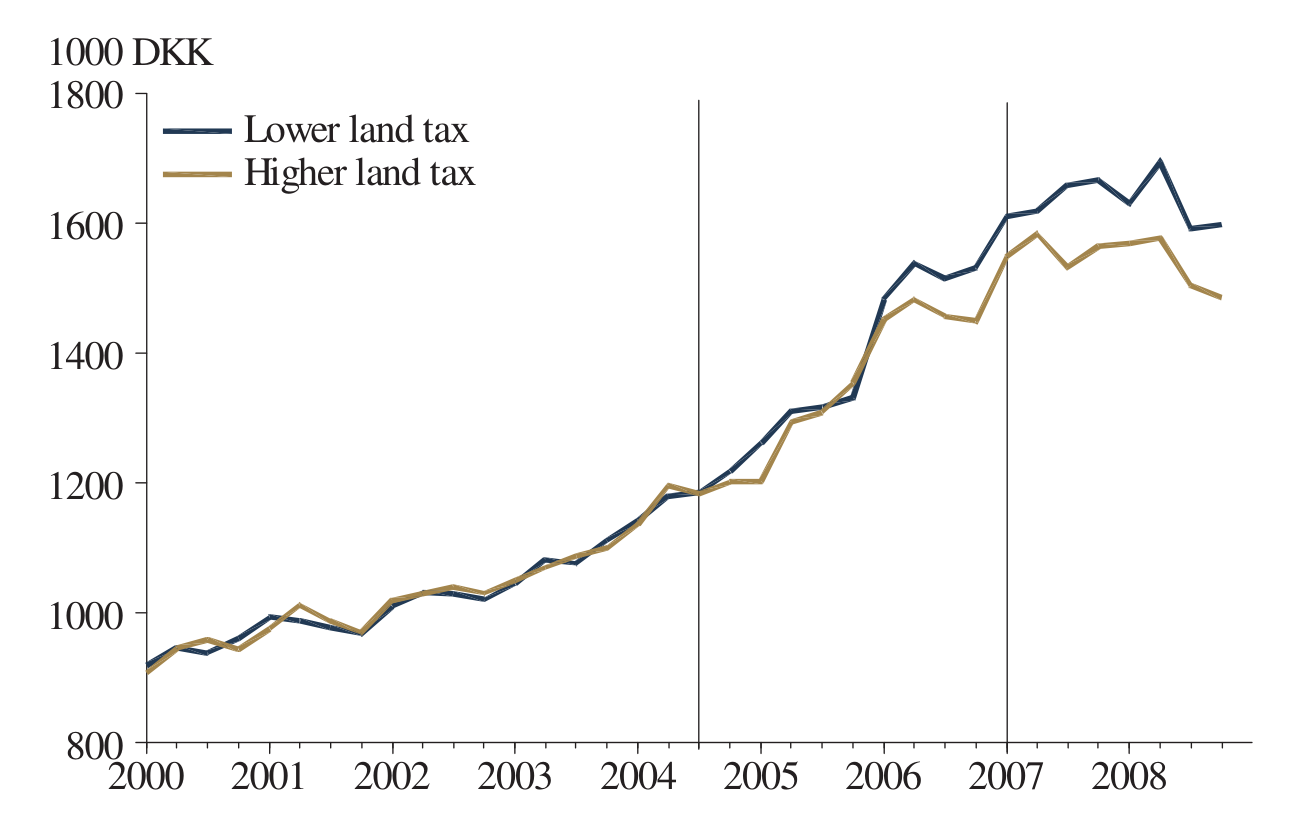
The land-tax-specific test. Denmark levies a recurrent tax on land value alone, and the Danish Economic Councils' 2018 study of the 2007 municipal-reform rate changes finds full capitalization of future land taxes into house prices — the burden lands on the owner at the time of the change, leaving no channel to tenants. This is the closest direct test of the outcome's actual claim.
Strength of Evidence — and the Honest Caveats
Strong on theory, strong on capitalization, thinner on direct rental measurement. The theoretical result is among the least disputed claims about LVT in economics — it holds in all three rival incidence frameworks. The empirical caveats a fair reader should know:
- Property-tax pass-through is institution-dependent and genuinely disputed. The building-inclusive literature splits: no-to-low shifting in the US studies (Orr 1968; Carroll & Yinger; Schwegman & Yinger) against real pass-through in others (Tsoodle & Turner; Heinberg & Oates 1970; Dusansky et al. 1981; and fully, in Germany, Löffler & Siegloch). The outcome's claim survives because it concerns the land component — where theory is unanimous and the Danish land-tax evidence points — not because the property-tax record is clean. Anyone quoting this page should preserve that distinction.
- The land-specific empirical base is small — and now two-sided. The Danish capitalization result is well-identified but single-country. A second land-tax-specific test agrees: Buettner (2003) finds German municipal land-tax rates capitalize fully into land prices while leaving monthly rents unaffected. But a 2024 Danish quasi-experiment cuts the other way: Nielsson, Wroblewski & Yding estimate a precise zero effect of land taxes on residential home prices on the same national setting as the DØRS study, rule out full capitalization, and read the incidence as "shared with tenants and future purchasers" — a direct challenge that has yet to be reconciled with the earlier Danish result. Replications in other land-taxing jurisdictions (Estonia, Taiwan, Pennsylvania land rates) would materially settle the question.
- Short-run frictions are real. The inelastic-supply argument is a long-run equilibrium claim; in the short run individual landlords may attempt pass-through in tight markets, and the theory says competition unwinds it, not that no tenant ever sees a rent notice citing taxes. The frictions have a literature of their own: Genesove found substantial nominal rigidity in American apartment rents, with many units seeing no change from one year to the next and rents stickier downward than upward, and Gallin and Verbrugge model sticky rents as the outcome of search and bargaining under incomplete information; the German evidence on building-inclusive property taxes shows pass-through arriving over years as leases turn over (Löffler & Siegloch). What such stickiness governs is the speed and path of adjustment, not where the burden of a tax on land finally rests.[9][10]
- A theory-side challenge to full capitalization exists — on a different margin. The claim that the burden lands entirely on the owner (full capitalization into a lower land price) is not literally unanimous in theory: Feldstein (1977) shows that in a general-equilibrium growth model a tax on pure rent is "at least partly shifted" and the land price "may be increased," because taxing land pushes household saving into produced capital. Crucially, that shifting runs to capital owners (a lower interest rate) and workers (a higher wage) through an economy-wide savings channel — it is not a mechanism by which a landlord raises the rent charged to a tenant (pre-tax land rent actually rises in his model). So Feldstein qualifies the full-incidence-on-owner claim without vindicating rent pass-through, and the result is itself contested (Calvo-Kotlikoff-Rodriguez 1979; Fane 1984 restore the classical answer). It belongs here as an honest caveat to "theory is unanimous," not as support for the landlord's side.
The 2026 Exchange: Hammer and Doucet
The objection surfaced in its sharpest recent form in September 2026, when a pseudonymous Substack writer, Doctor Hammer, answered the four "change my mind" questions Lars Doucet had posed in his five-year retrospective. Hammer's argument runs on rental-market frictions rather than on incidence theory: rents respond to cost increases faster than to cost decreases; housing supply cannot expand quickly, so a cost that hits every landlord at once is passed on; contract rents sit between the parties' reservation prices and most tenants do not haggle; and increases arrive as leases renew. "The short answer is that they do," he writes of pass-through, "but it takes a long time and is often swamped by other factors, so that on net the changes are not obvious" (§1). His examples, though, are conventional property and excise taxes, and he treats a tax on land as a cost of supplying housing. Doucet's reply in the comments pressed two cruxes, whether landlords already charge what the market will bear and whether abolishing property taxes would lower rents and prices, and asked what evidence would change his interlocutor's mind; the thread ended on the question that matters here, whether a tax on land alone falls on land prices or on rents, with Hammer conceding that "the price of the land would be lower after an LVT than before, as a matter of net present value."[11]
Neither writer is an authority on incidence, and the exchange settles nothing by itself. Read against the literature above, Hammer's frictions are the short-run mechanisms the mainstream model already allows for, consistent with slow, asymmetric rent adjustment and with the gradual pass-through observed for building-inclusive property taxes; his inferences from them are not. Inelastic supply is the reason a tax falls on the owner rather than the tenant; a tax on land is not a marginal cost of producing housing and does not shift the supply curve; and the concession on net present value is the capitalization result itself. The open empirical question remains the one the Danish and Finnish studies address: how fast and how fully land taxes capitalize.
See Also
- Choi & Sjoquist (2015) — an Atlanta-calibrated CGE simulation finding full capitalization onto landowners under fixed boundaries plus a progressive welfare gain across income groups (model evidence; full findings on its dedicated page, part of the site-value GE simulations cluster)
- Karp: Private Government at Home — Landlord Power and Rental Residential Domination — a political-theory register on the same landlord-tenant relationship this page treats through tax-incidence economics
- Buettner (2003): Tiebout Visits Germany — German municipal-level evidence that variation in local land tax rates capitalizes into land prices without raising rents.
- Economic Rent · Deadweight Loss · Tax Capitalization
- Mieszkowski (1972) · Zodrow (2001) — the theory
- Palmon & Smith (1998) · Carroll & Yinger (1994) — the measurement
- Narrative: Tax Land, Not Labor — deploys this outcome
- Gaffney (1971): The Property Tax Is A Progressive Tax — an independent, ownership-concentration-based argument against forward shifting, published essentially simultaneously with Mieszkowski's "new view"; historical context, not wired into the evidence tables above (a Gaffney policy-conference argument, not a peer-reviewed incidence result)
Sources
- Peter Mieszkowski (1972), "The Property Tax: An Excise Tax or a Profits Tax?", Journal of Public Economics 1(1): 73–96. DOI · wiki summary — used for the result that the land component falls entirely on landowners in the general-equilibrium framework (C-claim).
- George R. Zodrow (2001), "The Property Tax as a Capital Tax: A Room with Three Views," National Tax Journal 54(1): 139–156. DOI · wiki summary — used for the point that all three incidence traditions assign the land component to owners (C-claim).
- Oded Palmon & Barton A. Smith (1998), "New Evidence on Property Tax Capitalization," Journal of Political Economy 106(5): 1099–1128. DOI · wiki summary — used for the 62–64%-to-full capitalization into asset prices (B-claim).
- Robert Carroll & John Yinger (1994), "Is the Property Tax a Benefit Tax? The Case of Rental Housing," National Tax Journal 47(2): 295–316. DOI · wiki summary — used for the $1.00 tax → ~$0.15 rent finding; landlords absorb ~85% (B-claim).
- Lars Doucet (2021), "Does Georgism Work? Part 2: Can Landlords Really Pass on Land Value Tax to Tenants?", Astral Codex Ten. Original · wiki summary — used for the popular synthesis and as navigation to the primary studies now ingested individually (D-claim).
- Lars-Erik Borge & Jørn Rattsø (2014), "Capitalization of Property Taxes in Norway," Public Finance Review 42(5): 635–661. DOI · wiki summary — used for the non-US IV quasi-experiment finding full capitalization at realistic discount rates, i.e. current owners bear the burden (B-claim).
- Dennis R. Capozza, Richard K. Green & Patric H. Hendershott (1996), "Taxes, Mortgage Borrowing, and Residential Land Prices," in Aaron & Gale (eds.), Economic Effects of Fundamental Tax Reform, Brookings. Working-paper full text · wiki summary — used for full capitalization of income-tax preferences into residential land prices and the ~13–17% price-decline simulation (B-claim).
- Christian A. L. Hilber (2017), "The Economic Implications of House Price Capitalization: A Synthesis," Real Estate Economics 45(2): 301–339. DOI · wiki summary — used for the supply-elasticity conditional (capitalization onto owners is fuller where supply is inelastic), the bridge from property-tax pass-through to the pure-land-tax case (C/B-claim).
- David Genesove (2003), "The Nominal Rigidity of Apartment Rents," Review of Economics and Statistics 85(4): 844–853, DOI 10.1162/003465303772815763 (NBER Working Paper 7137, 1999). doi.org · NBER — used for the nominal rigidity and downward stickiness of US apartment rents (B-claim; peer-reviewed; abstract and working-paper summary consulted).
- Joshua Gallin & Randal Verbrugge (2019), "A theory of sticky rents: Search and bargaining with incomplete information," Journal of Economic Theory 183: 478–519, DOI 10.1016/j.jet.2019.06.003 (Federal Reserve Bank of Cleveland Working Paper 17-05). doi.org — used for the search-and-bargaining account of rent stickiness (C-claim; theory; abstract consulted).
- Doctor Hammer, "Georgism Does Not Work The Way Its Advocates Believe," Substack, 26 September 2026, with the comment thread including Lars Doucet's replies of 28–29 September 2026. dochammer.substack.com — used only for the objection's own statement and the exchange (D-claims; a pseudonymous writer with no stated credentials, Tier 3, and a practitioner-author, Tier 2: origin of the objection and of the reply, never support; quotations located by the post's section numbers and by comment date).