Land Taxes and Housing Prices (Danish Economic Councils)
The closest thing to a direct test of pure land-tax incidence: exploiting Denmark's 2007 municipal reform, which raised land taxes in some municipalities and cut them in others, this Danish Economic Councils working paper finds full capitalization of future land taxes into house prices — the burden.
Summary
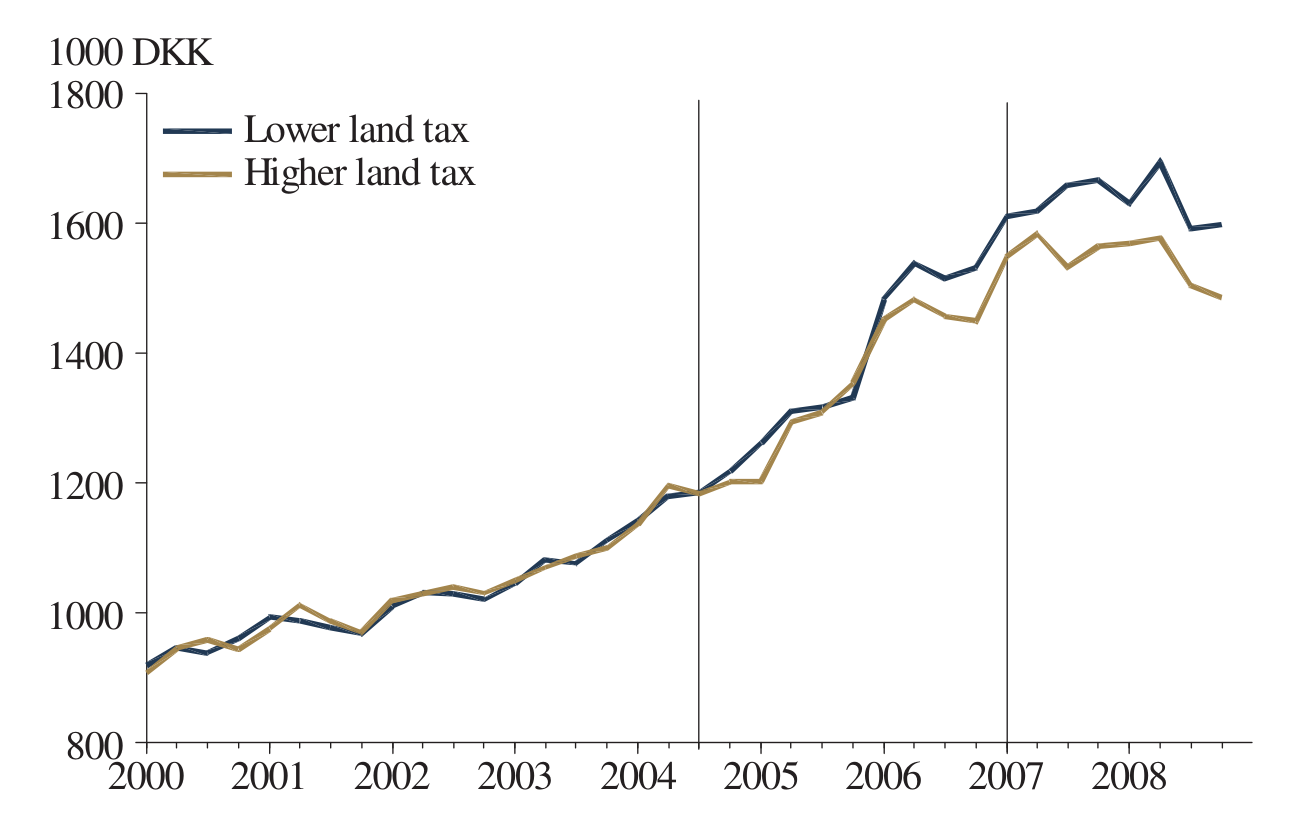
"Land Taxes and Housing Prices" is Working Paper 2017:1 from the Secretariat of De Økonomiske Råd (the Danish Economic Councils, DØRS — the Danish government's independent economic advisory body), by Anne Kristine Høj, Mads Rahbek Jørgensen & Poul Schou. It is the closest available thing to a direct quasi-experimental test of pure land-tax incidence: Denmark levies a recurrent municipal tax on land value alone (grundskyld), and the country's 2007 local-government amalgamation reform produced exogenous variation — land-tax rates rose in some municipalities and fell in others as merged municipalities harmonized rates. Tracking house prices across that variation, the study's results "imply full capitalization of the present value of future taxes" into house prices.[1]
Full capitalization is the incidence result the classical theory predicts for a tax on a fixed base: the burden falls entirely on the owner at the time of the change, whose asset repriced; later buyers are compensated through the lower price, and there is no channel left through which tenants pay.
Why It Carries Unusual Weight
- It is about a land tax, not a property tax. Nearly all pass-through evidence (Tsoodle & Turner, Löffler & Siegloch, Schwegman & Yinger, Carroll & Yinger) concerns taxes that include structures. Denmark's grundskyld isolates the land base — the object of the Georgist claim.
- Institutional source. DØRS is a mainstream official advisory body, not an advocacy organization.
- Clean variation. The 2007 reform moved rates for administrative reasons unrelated to local housing conditions.
Nuances and Limits
- Capitalization into prices is measured; rents are the inference. The study measures house prices, and full capitalization implies owners bear the tax; the no-pass-through-to-rents conclusion follows from that plus arbitrage, rather than from a direct Danish rent regression reported here.
- Point estimates (direct read). The main model's coefficient on the effective land-tax rate grows (in absolute value) from −0.0225 in 2004 to −0.0426 in 2007 as the reform is announced and implemented; the 2007 coefficient implies a discount rate of about 2.3% — squarely within the paper's independently argued "reasonable" 2–3% range, which is what makes the estimate "compatible with a 100 per cent capitalization of the future land tax changes." Descriptively (Table 2), single-family house prices in areas where land taxes rose grew on average about 76,000 DKK less over 2003–2007 than in areas where they fell — roughly 7 percentage points slower price growth.
Bears On
- Outcome: Landlords cannot pass LVT to tenants — the land-tax-specific evidence
- Outcome (adjacent): Public investment capitalizes into land — same capitalization mechanism, opposite sign
- Place: Denmark — grundskyld context
See Also
- Nielsson, Wroblewski & Yding (2024) — a second Danish quasi-experiment estimating a precise ZERO capitalization effect on the same national setting; the two results are in direct, unreconciled tension
- Tax Capitalization
- Doucet, Does Georgism Work? — the practitioner-author's popular synthesis, which treats this study as its culminating evidence on pass-through; the wiki cites the paper itself rather than the synthesis
Sources
- Anne Kristine Høj, Mads Rahbek Jørgensen & Poul Schou, "Land Taxes and Housing Prices," De Økonomiske Råds Sekretariat (Danish Economic Councils) Working Paper 2017:1. DØRS listing · full-text PDF — used for authorship, the design (2007 reform variation), the full-capitalization finding, and the point estimates (2004–07 coefficients, implied 2.3% discount rate, Table 2 price differences); full text read directly (2026-07-12).