Löffler & Siegloch, "Welfare Effects of Property Taxation" — German Rent Pass-Through Evidence
German study of 5,200+ municipal Grundsteuer reforms finds property-tax increases are fully passed through to rents within about three years — the strongest empirical counter-evidence to the claim landlords cannot pass a land tax to tenants.
Summary
"Welfare Effects of Property Taxation" is a working paper by Max Löffler (Maastricht University / ROA) and Sebastian Siegloch (University of Cologne, ECONtribute, CESifo, and IZA), studying the incidence and welfare effects of Germany's local property tax, the Grundsteuer. It has circulated since 2021 under several outlets — CESifo Working Paper No. 8952, IZA Discussion Paper No. 14195, and ZEW Discussion Paper No. 21-026 — and was substantially revised as ECONtribute Discussion Paper No. 331 (2024). As of July 2026 the paper had not yet completed peer review at a journal — it continues to circulate as a working paper across IZA, CESifo, CEPR DP15927, and the 2024 ECONtribute revision — so it should be treated and cited as a working paper, most recently the 2024 ECONtribute version, rather than as a published article. Siegloch is an established labor/public economics researcher with peer-reviewed publications on local tax incidence (e.g., business-tax incidence work with Andreas Peichl and others), and the paper has been presented at outlets including the AEA/ASSA meetings and the IZA/SOLE and Maxwell School (Syracuse) property-tax seminar series, indicating mainstream engagement rather than advocacy. This is not a Georgist or advocacy publication; it is a mainstream public-finance study, and it is the paper flagged in Carroll & Yinger (1994) as the most important piece of contrasting rental-incidence evidence for this wiki to address directly.
The Core Argument and Findings
Löffler and Siegloch set out to measure the full incidence and welfare consequences of a local recurrent property tax, using a "sufficient statistics" framework: rather than only estimating one reduced-form pass-through coefficient, they model how a property-tax change affects (i) housing prices/rents, (ii) household labor and other income (via local labor-market responses and mobility), and (iii) local public-goods provision funded by the tax, then combine these channels to compute a welfare effect.
Their empirical identification exploits Germany's institutional setup: the Grundsteuer is levied as an assessed property value multiplied by a municipal multiplier (the Hebesatz), which each of Germany's thousands of municipalities sets independently and changes at different times. This generates a large number of quasi-experimental rate changes — the paper's working-paper versions describe roughly 5,200 municipal tax reforms (the 2024 ECONtribute revision cites approximately 5,500), allowing an event-study/difference-in-differences design around the timing of each municipality's rate change, holding the underlying assessed values fixed.
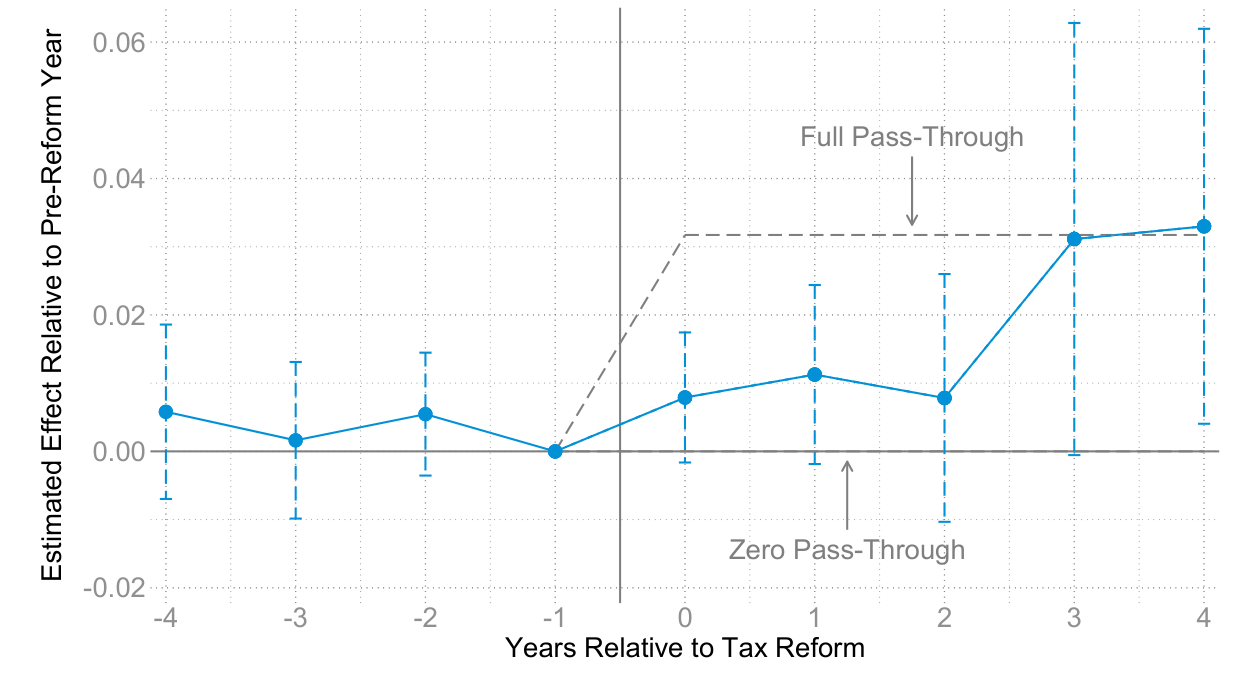
The central empirical finding, consistent across the 2021 and 2024 versions: a property-tax rate increase is passed through to rents substantially and, per the earlier IZA/CESifo/ZEW versions, essentially fully within about three years of the reform; the 2024 ECONtribute revision reports a pass-through estimate of 83 percent of the tax burden landing on rental prices, alongside comparatively modest labor-market effects. The two figures are reconcilable and reflect a refinement rather than a contradiction: the 2021 IZA abstract states verbatim that "higher taxes are fully passed on to rental prices after three years," while the 2024 version's headline mechanism is that "a one percentage point increase in the local property tax rate... leads to a 3.4 percent increase in total rents after three years," which — related to the average tax-to-rent ratio of 4.1% reported in the German Income and Expenditure Survey (EVS, 2013) — "translates into an 83% pass-through of property taxes on renters." (Both quotations are taken from the primary working-paper texts.) In short: the 2021 language rounded a point estimate near full shifting to "full," and the 2024 revision reports the more precise 83% figure against the measured tax-to-rent ratio; the three-year horizon is unchanged across versions. The paper also reports that pass-through is lower where local housing supply is less elastic — i.e., pass-through is not a fixed universal constant but varies with local housing-market conditions, consistent with standard incidence theory (a less elastic supply response leaves more of the burden on the fixed factor, though here that still shows up substantially in rents given Germany's assessed-value base includes structures). Combining these reduced-form estimates with their theoretical model, the authors simulate the welfare effects of the Grundsteuer and conclude the tax, as currently structured and passed through, is regressive — falling relatively more heavily on lower-income renter households — and that it approaches distributional neutrality only under public-goods-preference assumptions the authors characterize as implausibly strong.
Relation to the Georgist Case
This paper is properly read as challenging material relative to the outcome Landlords cannot pass a land value tax on to tenants, not as supporting evidence for it — the opposite of most other research in this wiki's incidence cluster. Its headline finding — that a large majority (and, in the earlier working-paper language, close to the full amount) of a property-tax increase shows up in higher rents within a few years — runs directly counter to the standard argument, repeated on that outcome page and elsewhere on this wiki, that a tax on a fixed factor cannot be shifted to renters because landlords are already charging what the market will bear.
This paper's finding does not, however, transfer directly to a pure land value tax, and the difference is the analytical heart of why it counts as a complication rather than a refutation. Three distinctions matter:
- Tax base: land-plus-improvements, not land alone. The German Grundsteuer, during essentially the entire period these reforms cover (pre-2025), is assessed on a unit value (Einheitswert, later transitioning to the Grundsteuerwert) that combines the value of the land with the value of the structure built on it — standardized construction costs are added to the land's standard ground value (Bodenrichtwert). A tax on this combined base is not a tax on a factor in perfectly inelastic supply: the amount and quality of housing structures supplied to a given plot does respond to taxation and market conditions over time (new construction, renovation, maintenance, redevelopment), and standard incidence theory (see Mieszkowski's "new view" and Zodrow's survey) predicts that the building component of a property tax behaves more like a tax on reproducible capital — shiftable in the medium-to-long run — while only the land component should, in principle, fall on owners. Löffler and Siegloch estimate pass-through for the combined land-plus-structure tax; they do not decompose their estimate into a land-value share and a structure-value share of the incidence, and the data do not permit it: the paper states that the Grundsteuer B "applies to the land and built structures" as a single combined base and that German "assessment notices do not provide any detail on how specific parts of the building contribute to the assessed value" (2024 ECONtribute version). A land-only incidence estimate therefore cannot be separated out from their combined Grundsteuer effect — confirmed from the primary text, not merely inferred from secondary summaries.
- Market context: an active tenant-occupied rental market with responsive housing supply, not a hypothetical pure-LVT economy. The paper's own finding that pass-through is lower where housing supply is less elastic is itself evidence that the mechanism generating rent pass-through in this setting is at least partly a housing-supply story (a tax that raises the cost of holding or building rental structures reduces the amount landlords are willing to supply at a given rent, raising equilibrium rents) rather than a pure land-rent story. A tax confined strictly to unimproved land value would not, under the standard model, generate this same supply-side channel, because the model assumes the quantity of land itself does not respond to the tax.
- Assessment and timing dynamics specific to a periodically-revalued unit-value system. Because Grundsteuer assessments in the pre-reform period were often based on outdated valuations (some dating to the 1930s/1960s in different parts of Germany) updated only via the municipal multiplier, a Hebesatz increase functions differently from a revaluation-driven change in a live land-value assessment roll, and the three-year adjustment dynamic the paper documents may partly reflect lease-renewal and local-market adjustment frictions specific to Germany's rental-housing institutions rather than a general property of land taxation.
Read this way, the paper is best summarized as: strong empirical evidence that a conventional, structure-inclusive local property tax is substantially passed through to renters in the contemporary German rental market — a finding that should push back against treating "landlords can't pass property taxes to tenants" as a universal, base-independent empirical law — while not being direct evidence that a pure land value tax (assessed on unimproved land value alone, with the building component removed from the base) would show the same pass-through, since the mechanism the paper's own results implicate (elastic housing-supply response) is precisely the channel a land-only tax is theoretically designed to avoid.
Nuances and Limits
- Working-paper status. As of July 2026 the paper had not yet been published in a peer-reviewed journal (it continues to circulate as IZA, CESifo, CEPR, and 2024 ECONtribute working papers) — treat findings as provisional pending peer-reviewed publication, though the identification strategy (thousands of municipal reforms, event-study/difference-in-differences around rate changes) is methodologically serious and has been presented at competitive economics conferences and seminars (Berkeley, Columbia, Stanford, NBER Summer Institutes, Michigan, Oxford, and others per the 2024 acknowledgments).
- Figures across versions, reconciled. Both working-paper versions have been read in full. The 2021 IZA abstract states "higher taxes are fully passed on to rental prices after three years"; the 2024 ECONtribute abstract states "83 percent of the tax burden is passed through to rental prices." These are not contradictory: the 2024 body derives the 83% figure from a 3.4% total-rent increase (per 1pp rate hike, after three years) measured against the 4.1% average tax-to-rent ratio, and the 2021 "full" language rounds a near-full point estimate. The three-year adjustment horizon is common to both. The current authoritative figure to cite is the 2024 revision's 83% pass-through, with the qualitative "substantial-to-full" reading carried by the 2021 version.
- Combined land-and-structure base, as discussed above — the single largest reason this cannot be read as a direct test of land-value-tax incidence specifically.
- Single country, specific institutional context. Germany's rental-market institutions (widespread long-term renting, rent-index/Mietspiegel regulation in many cities, different vacancy dynamics than the U.S.) may not generalize to other property-tax settings; this is one national case study, not a cross-country result.
- Consistent with, and possibly reconcilable with, other property-tax pass-through evidence in the wiki's incidence cluster. Carroll & Yinger (1994) find low (~15%) pass-through in 1980s Boston-area residential rentals, while Lyndsey Rolheiser's MIT dissertation work finds high (80–90%) pass-through in Massachusetts commercial office rents, and this paper finds high pass-through in German residential rents. Rather than one of these being simply "right" and the others "wrong," the spread across studies is itself informative: measured property-tax pass-through to rents varies with housing/commercial-space supply elasticity, market structure, lease-adjustment frictions, and — per the analysis above — how much of the taxed base is land versus structure. A single universal pass-through rate for "the property tax" should not be asserted from any one of these studies alone.
- Welfare/regressivity finding is a modeled simulation, not a directly observed distributional outcome. The paper's regressivity conclusion combines the reduced-form pass-through estimates with a structural welfare model and assumptions about public-goods preferences; it is a step further removed from direct observation than the rent pass-through estimate itself.
Bears On
- Outcome: Landlords cannot pass a land value tax on to tenants — this paper is the strongest available counter-evidence in the wiki's incidence literature: it finds a combined land-and-structure property tax is substantially or fully passed through to German rents, which should push the outcome page to acknowledge this finding explicitly (as
challenged_by) while explaining why a pure land-only tax is theoretically expected to behave differently. - Research: Carroll & Yinger (1994) — the direct point/counterpoint: Carroll & Yinger find low (~15%) pass-through in 1980s Boston rental housing; this paper finds high pass-through in contemporary German rental housing. Both are legitimate empirical estimates from different institutional contexts, and the contrast is itself the lesson (pass-through is context-dependent, not a fixed law).
- Research: Mieszkowski (1972), the "new view" of property tax incidence — supplies the theoretical basis for why a land-plus-structure tax is expected to be more shiftable than a land-only tax, which is exactly the distinction this page relies on to explain the finding without overturning the LVT-specific claim.
- Research: Zodrow (2001), "A Room with Three Views" — situates this paper's high-pass-through finding among the competing traditional/new/benefit views of property-tax incidence Zodrow surveys.
- Concept: Tax Capitalization — the paper's finding that pass-through depends on local housing-supply elasticity is the mirror image of the capitalization mechanism that gives a land-only tax zero pass-through under standard theory.
- Concept: Split-Rate Taxation — the policy implication of this paper's land-vs-structure distinction: a two-rate system that lowers the tax on structures while raising it on land would, per the mechanism this paper implicates, be expected to reduce the rent-pass-through this paper documents for Germany's combined base.
- Objection: LVT is just a property tax with extra steps — this paper is a useful illustration of the opposite point: incidence evidence on a combined land-and-structure property tax cannot be mechanically read across to a land-only tax, precisely because the objection's premise (that they are equivalent) is false.
See Also
- Landlords cannot pass a land value tax on to tenants
- Carroll & Yinger (1994), rental-housing property-tax incidence
- Mieszkowski (1972), the "new view" of property tax incidence
- Zodrow (2001), "A Room with Three Views"
- Tax Capitalization
- Split-Rate Taxation
Sources
- Max Löffler & Sebastian Siegloch, "Welfare Effects of Property Taxation," IZA Discussion Paper No. 14195 (2021). IZA PDF — used for the paper's framing, the 5,200-municipal-reform identification strategy, and the "fully passed on to rental prices after three years" characterization, whose wording is confirmed against the primary text (see [4]).
- Max Löffler & Sebastian Siegloch, "Welfare Effects of Property Taxation," CESifo Working Paper No. 8952 (2021). IDEAS/RePEc — used as a corroborating abstract source for the same 2021 findings (sufficient-statistics framework; regressivity conclusion).
- Max Löffler & Sebastian Siegloch, "Welfare Effects of Property Taxation," ZEW Discussion Paper No. 21-026 (2021). ZEW PDF — parallel working-paper outlet for the same study; listed for completeness and cross-verification.
- Max Löffler & Sebastian Siegloch, "Welfare Effects of Property Taxation," ECONtribute Discussion Paper No. 331 (2024 revision). ECONtribute PDF — used for the updated 5,500-reform sample and the "83 percent... passed through to rental prices" figure; both this 2024 version and the 2021 IZA version were read in full, and the quantitative findings above are quoted from the primary text: the 2024 abstract's "5,500 municipal property tax changes" and "83 percent of the tax burden is passed through to rental prices," the body's "3.4 percent increase in total rents after three years" against the "4.1%" tax-to-rent ratio, the 2021 abstract's "5,200 municipal tax reforms" and "higher taxes are fully passed on to rental prices after three years... pass-through is lower when housing supply is inelastic," and the combined land-plus-structure tax base ("applies to the land and built structures"; "assessment notices do not provide any detail on how specific parts of the building contribute to the assessed value").
- Robert Carroll & John Yinger (1994), "Is the Property Tax a Benefit Tax? The Case of Rental Housing," National Tax Journal 47(2): 295–316 — see wiki page — used as the contrasting low-pass-through U.S. finding this paper is compared against, and as the page that originally flagged Löffler & Siegloch for a dedicated write-up.
- Information on the German Grundsteuer's historical unit-value (Einheitswert) assessment base, combining land and structure value, and the municipal multiplier (Hebesatz/Realsteuerhebesatz) mechanism — used for the land-plus-improvements distinction central to this page's Georgist-relevance analysis. This is now sourced directly from the Löffler & Siegloch paper's own institutional section (Sources 1 and 4 above), which documents that the Grundsteuer B "applies to the land and built structures," that the tax liability equals "Assessed Value × Federal Tax Rate × Municipal Scaling Factor," that "the last general assessment of property values in Germany took place in 1964" (West Germany) with valuation "based on prices as of 1964 using historical rent indices" and "no regular reassessment," and that reassessment "only occur[s] if the owner creates a new building or substantially improves an existing structure." The authors in turn cite the primary legal/administrative literature: P. Bernd Spahn (2004), "Land Taxation in Germany," in International Handbook of Land and Property Taxation (Edward Elgar), and the Grundsteuergesetz itself.