Housing unaffordability is a land problem, not a construction-cost problem
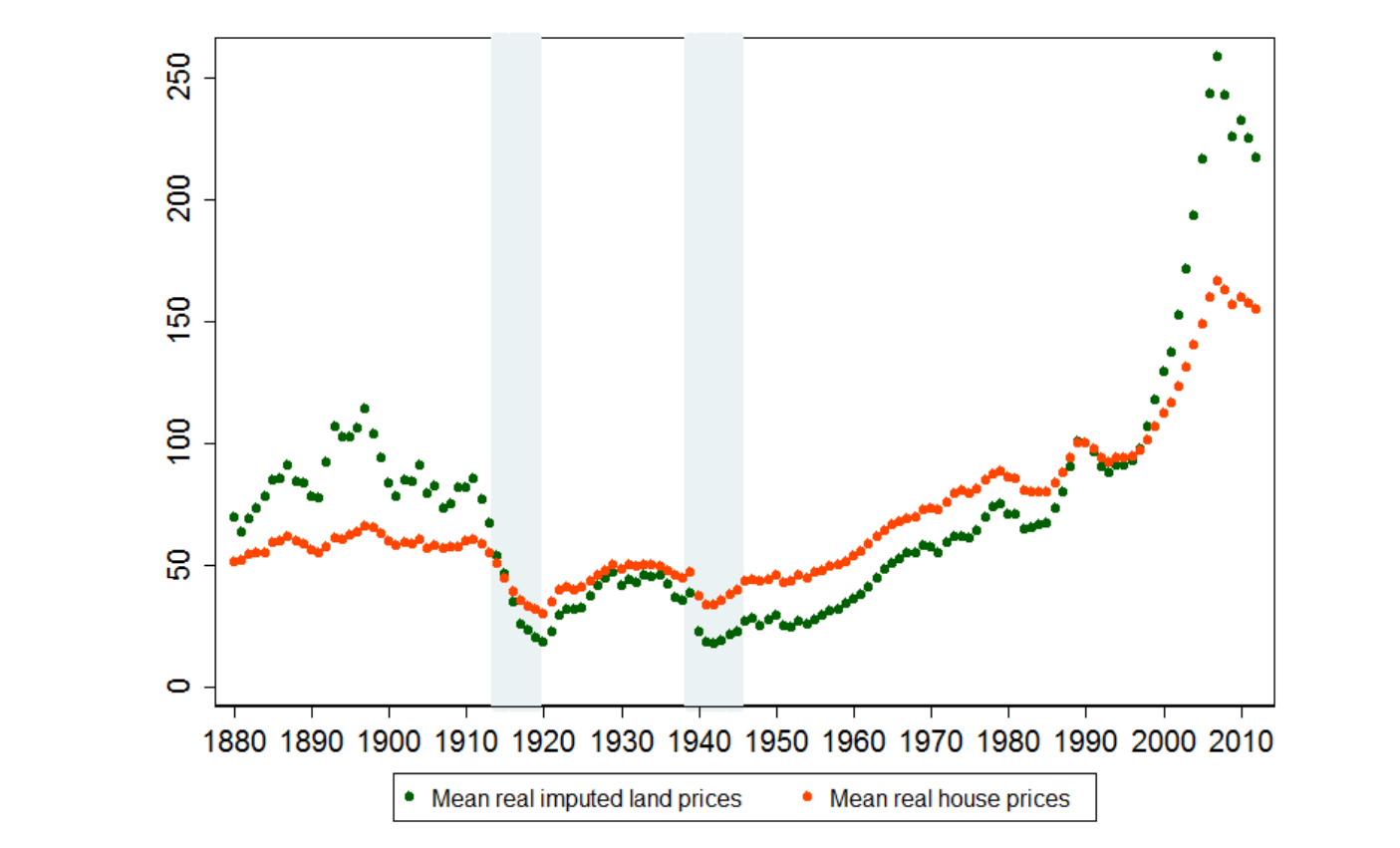
Where housing is expensive, decomposition shows it is the land under the house — not the cost of building it — that has appreciated: 80% of the post-1950 global house-price boom is land, and in constrained US metros land is the gap between price and build cost.
At a glance — In high-demand, supply-constrained markets it is the price of land, not the cost of building, that has made housing unaffordable — independent 140-year cross-country and US micro decompositions converge on land. Evidence: Strong (independent decompositions — 140-year cross-country panel and US micro data — converge on land; scope limited to high-demand, supply-constrained markets) · 6 supporting sources · 0 challenging Strongest support: Knoll, Schularick & Steger (2017) — across 14 economies, rising land prices explain about 80% of the post-war house-price boom. No structural counter-evidence is currently wired; see Limits.
The Claim
Where housing has become unaffordable, the driver is the price of land, not the cost of building. Decomposing house prices into their land and structure components shows the structure component — materials, labor, builder margin — tracks ordinary production costs, while the land component is what has actually appreciated.
The three strongest anchors, in order of evidential weight:
- Knoll, Schularick & Steger (2017, American Economic Review) — assembling the first long-run house-price panel for 14 advanced economies over 1870–2012, they conclude: "Land prices, not replacement costs, are the key to understanding the trajectory of house prices. Rising land prices explain about 80 percent of the global house price boom that has taken place since World War II."
- Glaeser & Gyourko (2018, Journal of Economic Perspectives) — comparing US house prices to the minimum cost of physically producing a home, they find physical construction costs are strikingly similar across metros while prices diverge enormously; in San Francisco the median 2013 price (~$800,000) was 2.84 times production cost, and "what makes San Francisco housing so expensive is the bidding up of land values."
- Hsieh & Moretti (2019, AEJ: Macroeconomics) — model the aggregate stakes: when high-productivity cities constrain housing supply, rising demand shows up as higher prices and rents rather than more homes, misallocating labor nationally (the specific output magnitude is contested — see below).
Honest limits, up front: this is a claim about expensive markets, not all markets — Glaeser and Gyourko's own data show roughly three-quarters of US housing units in 2013 were priced at or below production cost; and in the US the proximate reason land is scarce is substantially regulatory (zoning), a policy-made scarcity that a land tax alone does not repeal.
What the Evidence Shows
The 140-year decomposition: it was never the building
Knoll, Schularick and Steger built annual house-price indices for 14 advanced economies back to 1870 and decomposed them into land and structure components. Real house prices were roughly flat for eight decades, then rose sharply after 1950 — and the rise is overwhelmingly attributable to land: about 80 percent of the global post-war boom, per the AER abstract (verified 2026-07-05 on this wiki's research page). Construction costs, by contrast, broadly tracked the price of other produced goods over the long run. The authors' explanation for the pre-1950 flatness — transport improvements kept expanding the effective supply of usable land, and then stopped — is their hypothesis rather than a separately identified causal test, but the decomposition itself is a data finding, published in a top-five journal by mainstream macroeconomists with no Georgist framing.
The US micro test: price minus construction cost equals land
Glaeser and Gyourko run the same logic through US micro data. Using R.S. Means construction-cost data across more than 100 markets, they compute the minimum profitable cost of producing a modest home and compare it to actual prices. Physical construction costs vary little across US metros (Gyourko and Saiz 2006 found price variance dwarfs cost variance); prices vary by multiples. In elastic markets like Atlanta, price stays pinned near production cost through boom and bust. In San Francisco, the median unit sold for about $800,000 against roughly $282,000 in production cost (of which about $193,000 is physical construction) — implying land at roughly $490,000, about ten times the industry rule-of-thumb land share. Their published conclusion: "Clearly, San Francisco housing developers cannot actually earn super-normal profits on the margin. Instead, what makes San Francisco housing so expensive is the bidding up of land values" (JEP 2018, pp. 16–18). Where housing is unaffordable in America, the unaffordability is the land value.
The same method transplants to Canada: Dachis (2023) applies the Glaeser–Gyourko price-versus-production-cost decomposition to 24 Canadian metro areas over 2011–2021, finding a new single-detached home in Vancouver cost nearly $1.3 million (about 63% of sale price) more than its estimated minimum profitable production cost, with Toronto's gap at $350,000 — while slower-growing markets show no gap at all, the signature of a land-and-barriers problem rather than a construction-cost one (with the caveat, carried on the entry, that the raw price-cost gap conflates several supply-side causes). Canada's federal housing agency corroborates the direction from outside the academic literature: CMHC's September 2021 assessment rated the national market High-vulnerability on persistent overvaluation — prices above what income, population, and rate fundamentals justify — though without decomposing the excess into land and structure.
The aggregate stakes
Hsieh and Moretti supply the macro reading: when land access in the most productive cities is rationed by price, workers who would gain most from being there are priced out, and national output falls. Their headline multiplier is the subject of a live, unresolved published dispute (Greaney 2026 argues the corrected effect is two orders of magnitude smaller; Hsieh has replied) — this page leans on the mechanism, which is widely accepted independent of the exact number, not on any specific percentage. Related decomposition work the wiki carries separately corroborates the land channel from other directions: Davis and Heathcote's land-price series, Albouy, Ehrlich and Shin's metro land-value index, and Hilber and Vermeulen's English supply-constraint estimates. A Canadian growth-accounting study using directly observed (not imputed) land prices — Stewart (2022) — adds an honest wrinkle that actually reinforces the scoping: land is the dominant contributor to house-price growth in some cities but, in Stewart's words, "this varies greatly by city," so the land-problem reading holds where demand pressure is high and weakens where it is not.
Why It Matters
If unaffordability were a construction-cost problem, the remedies would be industrial: cheaper materials, better building technology, more construction labor. Because the appreciating component is land — a factor no one produces — the problem is instead about who captures locational value and whether supply is allowed to respond. That is the diagnosis behind both the Georgist instrument (a land value tax that captures the economic rent instead of letting it accrue to incumbent owners) and the mainstream one (land-use liberalization). The same decomposition underlies the wiki's finding that the modern rise in the capital share is land, and it frames what LVT can and cannot do for housing affordability.
Counter-Evidence and Limits
- Most US housing is not priced above construction cost. The strongest scope limit comes from the claim's own second anchor: as of 2013, 73.6 percent of US housing-survey observations were priced at or below minimum production cost (Glaeser & Gyourko 2018, p. 11). The "land problem" diagnosis applies to high-demand, supply-constrained markets — coastal California, New York, and their international analogues — not to housing markets generally. In Detroit the binding problem is the opposite (prices below replacement cost); in Atlanta prices track construction cost.
- Construction costs did rise — construction productivity has stagnated for decades. The long-run "construction tracks produced-goods prices" pattern in Knoll et al. does not mean building costs are a solved problem. Goolsbee and Syverson (2023) document "a large and decades-long decline in construction sector productivity" in US aggregate data, large enough to drag on economy-wide productivity growth. D'Amico, Glaeser, Gyourko, Kerr and Ponzetto (2024) find homes built per construction worker "boomed after World War II, and then plummeted after 1970." Rising real construction costs are a genuine, additional contributor to expensive housing — though notably, D'Amico et al.'s own explanation for the stagnation is land-use regulation constraining project size, which folds much of the construction-cost story back into the land-policy story rather than refuting it.
- The proximate cause of high land values in the US literature is regulation, not physical scarcity. Gyourko and Molloy's (2015) handbook review concludes that "regulation appears to raise house prices, reduce construction, reduce the elasticity of housing supply, and alter urban form." Glaeser and Gyourko attribute the price-cost gap to zoning, not raw land scarcity — geographically similar metros without the regulation do not show the gap. This does not contradict the decomposition (the value still sits in land), but it matters for remedies: taxing land value does not by itself make it legal to build more on that land, and the anchor authors' own policy conclusions point at zoning reform, not tax policy. The wiki carries this caveat in full at land capture didn't make housing cheap and in the Glaeser-Gyourko research page.
- Parts of the measurement apparatus are contested. Murray (2021) published a methodological critique of the Glaeser-Gyourko marginal-versus-average technique behind "zoning tax" estimates; Gyourko and Krimmel's (2021) vacant-lot evidence sidesteps that objection while still finding large land-value wedges (a "zoning tax" of about $400,000 per quarter-acre in San Francisco) — direct micro evidence that the price-minus-construction-cost gap in expensive metros is land value, not building cost — though the precise size of the regulatory component remains debated. Hsieh and Moretti's output magnitude is under an active published correction dispute (Greaney 2026). Neither dispute touches the core decomposition finding — that the appreciating component of expensive housing is land — which stands on the KSS panel and the price-cost comparisons independently.
- The cross-country decomposition inherits data-quality limits. The KSS land/structure split rests on heterogeneous national sources spanning 140 years; cross-era comparability is inherently harder to verify than a single-country series.
Strength of Evidence
Strong, within its scope. Two independent research programs — a 140-year, 14-country panel decomposition (AER) and US price-versus-production-cost micro comparisons (JEP, drawing on two decades of prior work) — using different data and methods converge on the same conclusion: in expensive markets, land, not construction cost, is what appreciated. The grade is not higher-than-warranted: the claim is scoped to high-demand, supply-constrained markets; construction-cost inflation is real and additional; and the misallocation magnitude (as opposed to mechanism) is contested.
Further corroboration. The FHFA tract-level land-price project (Davis, Larson, Oliner & Shui) turns millions of appraisals into county, ZIP and tract land prices, showing the land component is separately measurable and large across the US. La Cava traces the postwar rise in the US housing income share to imputed rent concentrated in supply-constrained states — land scarcity, not construction cost.
See Also
- The Problems — the index of geoism's diagnostic claims
- LVT improves housing affordability — the prescription side, with its zoning-pairing caveat
- Most of the modern rise in the capital share is land, not capital — the same decomposition at the income/wealth level
- High land rents suppress productivity — the macro cost of the same scarcity
- Stewart (2022), How Important Are Land Values in House Price Growth? Evidence from Canadian Cities — a directly-measured Canadian decomposition whose city-by-city heterogeneity sharpens the claim's scope
- Peruffo & Check: Overseas Migration and Australian Housing Markets — a well-identified demand-shock case showing migration raises rents most where supply is most constrained
- Saiz (2010), The Geographic Determinants of Housing Supply · Barker Review · Ryan-Collins, Lloyd & Macfarlane, Rethinking the Economics of Land and Housing
- Economic Rent · Land Value Tax
Sources
- Katharina Knoll, Moritz Schularick & Thomas Steger (2017), "No Price Like Home: Global House Prices, 1870–2012," American Economic Review 107(2): 331–353. DOI · AEA abstract · free working-paper version, Dallas Fed — used for the 80-percent land attribution and the flat-then-rising real house-price pattern; abstract wording verified first-hand on this wiki 2026-07-05 (see research page).
- Edward L. Glaeser & Joseph Gyourko (2018), "The Economic Implications of Housing Supply," Journal of Economic Perspectives 32(1): 3–30. AEA/DOI · NBER WP 23833 — used for the price-versus-production-cost method, the San Francisco figures ($800,000 price, ~$282,000 production cost, ~$490,000 implied land), the "bidding up of land values" quotation (pp. 16–18), and the 73.6% at-or-below-cost scope limit (p. 11); all figures verified against the published JEP text on this wiki 2026-07-10 (see research page).
- Chang-Tai Hsieh & Enrico Moretti (2019), "Housing Constraints and Spatial Misallocation," American Economic Journal: Macroeconomics 11(2): 1–39. AEA · NBER WP 21154 — used for the misallocation mechanism only; the quantitative headline is treated as contested per Greaney (2026) and the correction record documented on the research page.
- Joseph Gyourko & Raven Molloy (2015), "Regulation and Housing Supply," NBER Working Paper No. 20536 (published in Handbook of Regional and Urban Economics, Vol. 5). NBER — used for the literature-review conclusion that regulation "appears to raise house prices, reduce construction, reduce the elasticity of housing supply"; abstract fetched and verified 2026-07-10.
- Austan Goolsbee & Chad Syverson (2023), "The Strange and Awful Path of Productivity in the U.S. Construction Sector," NBER Working Paper No. 30845 (published in Journal of Economic Perspectives 37(1)). NBER · BFI WP 2023-04 PDF — used for the counter-evidence that construction-sector productivity has declined for decades; abstract fetched and verified 2026-07-10.
- Leonardo D'Amico, Edward L. Glaeser, Joseph Gyourko, William R. Kerr & Giacomo A. M. Ponzetto (2024), "Why Has Construction Productivity Stagnated? The Role of Land-Use Regulation," NBER Working Paper No. 33188. NBER · IDEAS/RePEc abstract — used for the post-1970 collapse in homes built per construction worker and its attribution to land-use regulation; abstract fetched and verified 2026-07-10.
- Brian Greaney (2026), "Housing Constraints and Spatial Misallocation: Comment," American Economic Journal: Macroeconomics 18(2): 409–428. AEA — used to flag the Hsieh-Moretti magnitude as contested; verified at abstract level on this wiki 2026-07-10.
- Cameron K. Murray (2021), "Marginal and average prices of land lots should not be equal," Environment and Planning A: Economy and Space 53(1): 191–209. DOI — used for the published methodological critique of zoning-tax estimation carried in the limits section.