Resource-rent dividends are workable and durable
Alaska's decades-long Permanent Fund Dividend shows that capturing natural-resource rent and distributing it as a citizen's dividend is administratively and politically durable — joined more recently by the Cherokee casino dividend (since 1996) and Maricá, Brazil's oil-royalty dividend.
At a glance — Capturing a natural resource's rent and paying it out as an equal per-capita dividend is administratively simple and politically durable — Alaska's dividend has run continuously since 1982 across four decades and changing administrations. Evidence: Strong (decades of real-world operation across three independent cases) · 8 supporting sources · 1 challenging Strongest support: Guettabi (2019) — the authoritative synthesis of four decades of Alaska dividend evidence: durable operation, substantial poverty reduction, and no detectable aggregate labor withdrawal. Strongest counter: Martinez (2018) — Colombian municipalities receiving large resource-rent transfers show weaker local tax effort and accountability, a local resource curse showing distribution design matters.
The Claim
Capturing the rent of a natural resource and distributing it equally as a citizen's dividend is not just theory — it works, is administratively simple, and is politically durable over decades.
The Evidence
The Alaska Permanent Fund has, since 1982, paid every Alaska resident an annual dividend funded by the state's oil-resource rents. It has operated continuously across changing administrations, remains highly popular, and demonstrates that:
- A resource-rent fund can be saved and invested transparently.
- Equal per-capita distribution is administratively trivial.
- The dividend becomes a durable entitlement that voters protect — politically resilient in a way many transfer programs are not.
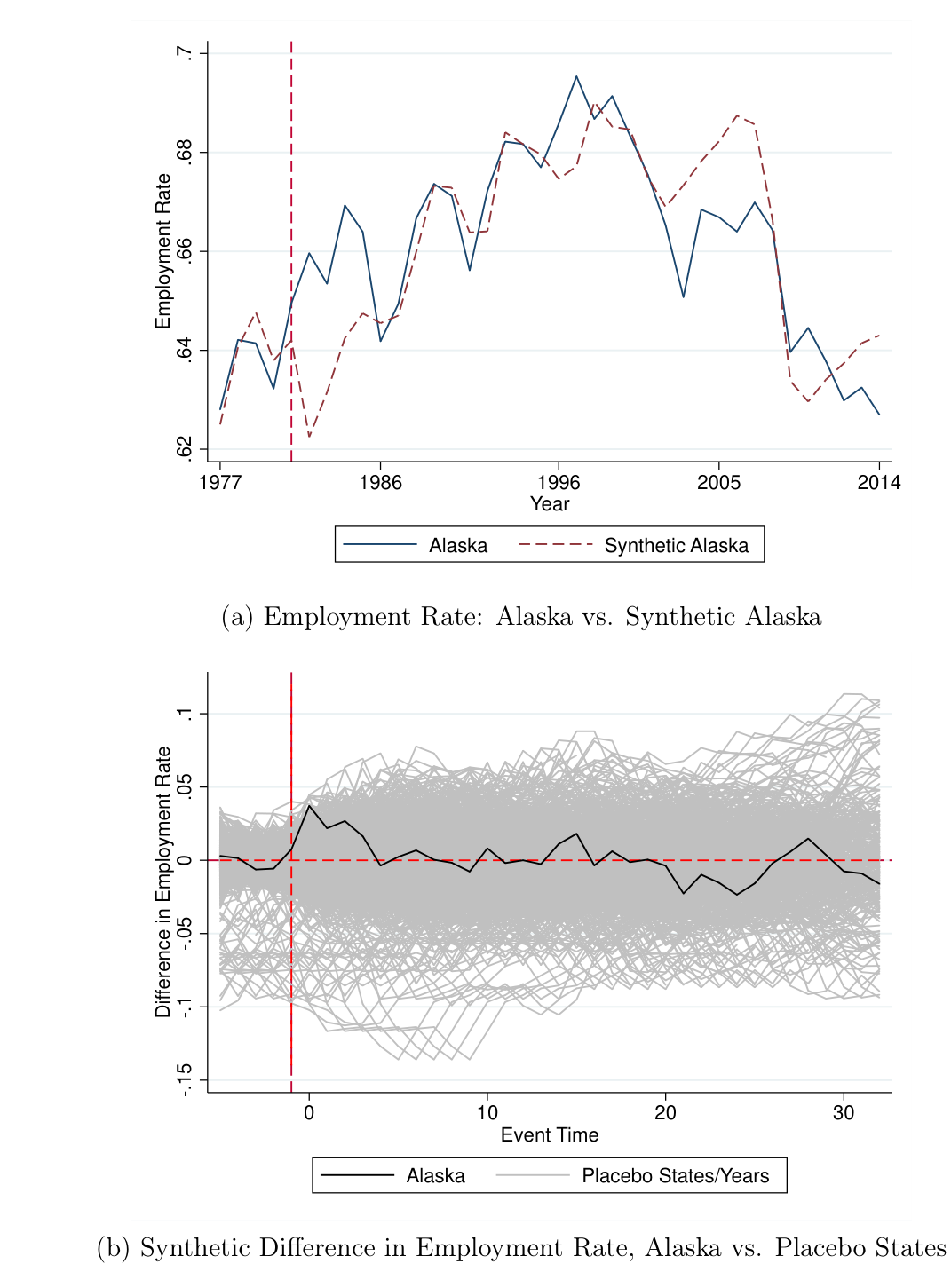
Guettabi's synthesis of the PFD-effects literature is the authoritative summary of four decades of evidence: substantial poverty reductions (largest for rural Alaska Natives) with no detectable aggregate labor-market withdrawal — the workability claim, confirmed across studies rather than in any single one. One honest timing nuance from the same literature: Watson, Guettabi & Reimer find substance-abuse incidents rise briefly right after disbursement while property crime falls, with small net annual effects — a lump-sum-timing cost that monthly payment designs would avoid.
Significance
Alaska is the closest large-scale, long-running proof of concept for the Georgist idea that the rent of natural resources belongs to all and can be returned directly to citizens.
Caveats
Alaska is not the sole long-running per-capita dividend from a co-owned asset. The Great Smoky Mountains casino-dividend natural experiment documents the Eastern Band of Cherokee Indians distributing an equal per-capita share of casino profits to every tribal member every six months since 1996 — an unconditional common-asset dividend that, like Alaska's, ran durably and showed no detectable labor-supply withdrawal (Akee et al. 2010), while also improving recipients' children's long-run outcomes, including personality-trait and psychiatric-symptom measures through age 16 (Akee, Simeonova, Costello & Copeland 2018). (The underlying rent is gaming/monopoly rent rather than resource rent, but the distributive mechanism is the same.)
And the model is no longer confined to rich or isolated economies. Maricá, Brazil has, since the mid-2010s, paid a permanent, unconditional, per-capita dividend funded from oil royalties channelled through a municipal sovereign fund (the Fundo Soberano de Maricá) — now the largest basic income in Latin America. Balakrishnan, Costa, Haushofer & Waltenberg (2024, NBER) find recipients' household income rose about 9% and consumption 5%. The measured effects are modest and the design quasi-experimental, but Maricá establishes that the capture-and-distribute mechanism operates durably in a large middle-income country — direct evidence against the objection that Alaska's dividend is a curiosity of oil wealth and a small, homogeneous population.
Not every resource-rent windfall behaves like Alaska's transparent, per-capita dividend. Martinez (2018) finds that in Colombia, municipalities receiving large resource-rent transfers show weaker local tax effort and accountability — a local "resource curse" that cuts the other way. The lesson is that how rent is captured and distributed (transparent, equal, direct dividend vs. opaque government transfer) matters as much as the fact of capture itself.
The clearest failure mode on record is Mongolia's Human Development Fund (2010–12) — which the World Bank's UBI guide calls "the only country that has ever had a full-fledged UBI": transfer levels were set by electoral promise against future mining revenue rather than paid from realized fund earnings, the shortfall was debt-financed (public debt rose from 31% to 48% of GDP in two years), and the program was replaced by a targeted child grant. The design lesson runs the same direction as Alaska's success: durability requires the dividend to track actual realized rent, not projected rent.
The Evidence in Detail
The case runs from theory through operation to rigorous evaluation. Hartwick (1977) supplies the theoretical foundation: investing resource rents in reproducible capital sustains consumption across generations — the formal warrant for treating resource rents as common wealth. Goldsmith (2002) reviews the first twenty years of the dividend from inside Alaska: income growth for the poorest fifth of families far outpacing the richest fifth (+28% vs +7%), the dividend supplying more than 10% of cash income in some rural areas, and no serious political proposal to end it (his 2010 follow-up adds Alaska Native poverty falling 25%→19% across the 1980–1990 censuses; the widely circulated "20–40% poverty cut" figures appear in neither paper — corrected 2026-07-10). Jones & Marinescu (2022) add the causal test: a synthetic-control design finds the universal dividend caused no reduction in aggregate employment, with a rise in part-time work consistent with local demand stimulus. Widerquist & Howard's edited volume (2012) weighs whether all this is a genuine model or a product of Alaska's peculiar circumstances — the exportability question. And Segal (2011) scales the idea globally: resource rents paid as equal per-capita dividends in developing countries would cut extreme poverty by roughly 27–66%, depending on year and assumptions.
Book Findings
Barnes: Alaska as Proof-of-Concept for Universal Dividends
The journalist and commons advocate Peter Barnes presents the Alaska Permanent Fund as the working proof-of-concept for universal resource-rent dividends in both Capitalism 3.0 (2006) and With Liberty and Dividends for All (2014). In the latter, Barnes examines the Alaska model in detail (Ch. 6), arguing that it demonstrates the administrative simplicity and political durability of per-capita dividend distribution from co-owned wealth (Barnes 2014, Ch. 6). For Barnes, the model's significance is that dividends from common-asset rent are not merely theoretical — the operational record summarized under The Evidence above. As an advocacy source his framing is attributed, not independent corroboration of that record.
Barnes argues that the Alaska model can be extended beyond oil rents to other forms of co-owned wealth, including the atmosphere (via carbon pricing), the electromagnetic spectrum, and mineral resources (Barnes 2014, Ch. 7, 9, Appendix). His Appendix, "The Dividend Potential of Co-owned Wealth," estimates the dividend potential of various common assets: charging for private uses of co-owned assets "could produce between $1 trillion and $1.48 trillion, which in turn could generate dividends for . . . [a] family of four of $13,428 and $19,812" (Bollier's review, reporting the book's calculations) — consistent with Barnes's own contemporaneous summary that "such dividends could grow to about $5,000 per person per year" (Barnes, PBS NewsHour, Aug 2014). The Appendix itself is paywalled in accessible editions, so the aggregate figures rest on these two corroborating summaries rather than direct page citation.
Barnes's cautionary tale (Ch. 8) examines carbon capping as implemented through cap-and-trade, arguing it delivered windfalls to polluters rather than dividends to citizens — illustrating that the design of the rent-capture mechanism matters as much as the fact of capture. The lesson for the dividend outcome is that opaque or poorly designed mechanisms can fail to deliver the transparency and political durability that makes Alaska's model work.
See Also
- Maricá, Brazil: an oil-royalty-funded basic income — the second real-world permanent resource-rent dividend beyond Alaska (income +9%, consumption +5%)
- Rent dividends reduce poverty and inequality — the distributional evidence for the same three studies, with counter-evidence, kept distinct from the workability claim here
- The Great Smoky Mountains casino-dividend natural experiment — a second durable per-capita dividend from a co-owned asset, with causal outcome evidence
- Narrative: A Dividend from Common Wealth
- Citizen's Dividend · Resource Rents · Alaska Permanent Fund
- Capitalism 3.0 — Barnes's commons trust dividend evidence
- With Liberty and Dividends for All — Alaska as proof-of-concept for universal dividends
Sources
- Alaska Permanent Fund Dividend program (operating since 1982) — used as the flagship operating example; the study-level evidence is cited on the research pages walked through above.
- Peter Barnes, With Liberty and Dividends for All (Berrett-Koehler, 2014) — used for Alaska as proof-of-concept and the extension to other co-owned wealth (B/C-claims). Book page
- Peter Barnes, Capitalism 3.0: A Guide to Reclaiming the Commons (Berrett-Koehler, 2006) — used for the commons trust dividend model (C-claim). Book page