The Labor Market Impacts of Universal and Permanent Cash Transfers: Evidence from the Alaska Permanent Fund
Using a synthetic-control design, this AEJ:Economic Policy paper finds Alaska's universal cash dividend caused no reduction in aggregate employment, and a rise in part-time work consistent with local demand stimulus.
Summary
"The Labor Market Impacts of Universal and Permanent Cash Transfers: Evidence from the Alaska Permanent Fund" is a peer-reviewed paper by Damon Jones (University of Chicago Harris School of Public Policy) and Ioana Marinescu (University of Pennsylvania School of Social Policy & Practice, and NBER), published in the American Economic Journal: Economic Policy, vol. 14, no. 2 (May 2022), pp. 315–340. It circulated earlier as NBER Working Paper No. 24312 (first issued February 2018, revised through January 2020). It is one of the very few empirical studies of a real, large-scale, unconditional and permanent cash transfer — most cash-transfer and basic-income research studies temporary pilots or lottery-style windfalls — which is why it carries particular weight for questions about labor-supply effects of a standing citizen's dividend.
The Core Argument / Findings
The paper asks a question of direct relevance to Georgist proposals to fund a citizen's dividend from resource or land rent: does giving every resident of a jurisdiction an annual, no-strings cash payment, indefinitely, reduce how much people work? Standard labor-supply theory predicts an income effect that should push aggregate labor supply down, at least somewhat, when people receive unconditional income they did not have to work for.
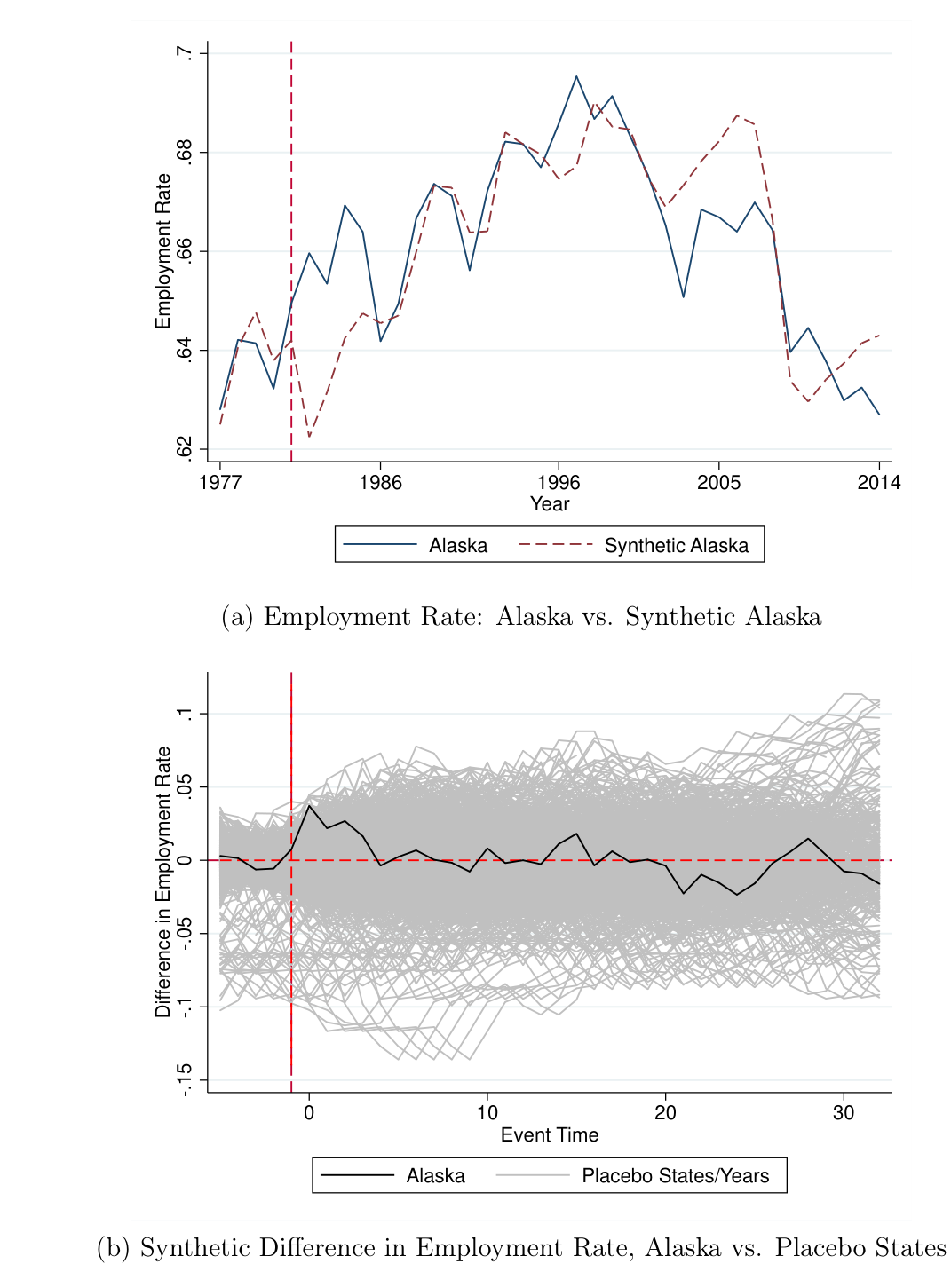
Jones and Marinescu study the Alaska Permanent Fund Dividend (PFD), which has paid every Alaska resident an annual, universal, unconditional cash dividend since 1982, funded from the state's oil-resource rents. Using Current Population Survey (CPS) data on Alaska and other US states, they construct a synthetic control for Alaska — a weighted combination of other states, chosen to reproduce Alaska's pre-1982 labor-market trends (employment rate, demographic and industry composition) — and then compare Alaska's actual post-1982 labor-market trajectory to what the synthetic control predicts it would have been absent the dividend.
Their headline empirical findings:
- No detectable reduction in the aggregate employment rate. The synthetic-control estimate finds no statistically significant effect of the PFD on the overall share of Alaskans employed, contrary to the standard prediction that a permanent unconditional income would reduce aggregate work.
- Part-time employment rose. The dividend is associated with an increase in the share of workers employed part-time of about 1.8 percentage points, roughly a 17% relative increase. This is consistent with some Alaskans using the extra income to shift from full-time to part-time work at the margin, without leaving employment altogether.
- A general-equilibrium (local demand) channel appears to offset the standard income-effect prediction. The authors calibrate microeconomic and macroeconomic responses using estimates from the prior cash-transfer literature and find the pattern of results is consistent with the dividend stimulating local economic demand — money paid out gets spent in Alaska, supporting local employment — which can offset the tendency of individual recipients to work somewhat less.
- The demand-stimulus channel shows up asymmetrically by sector. Non-tradable sectors (local services, retail, and other goods/services that must be produced and consumed locally) show a more positive employment response than tradable sectors (which compete nationally/globally and are less exposed to a purely local demand boost); tradable-sector employment does not show the same gain and the paper reports employment reductions are concentrated there.
The authors' overall conclusion, stated cautiously: a universal and permanent cash transfer of this kind does not significantly decrease aggregate employment, even though it does appear to shift some workers toward part-time hours.
Relation to the Georgist Case
This paper is directly relevant to — and complicates in a productive way — the Georgist claim that resource or land rent can be safely and durably returned to citizens as a dividend (see resource-rent dividends are workable and durable). A frequent objection to funding a citizen's dividend from land or resource rent is that unconditional cash payments will reduce labor supply and shrink the tax base that funds public goods, or simply reduce national output. Jones and Marinescu supply the best available real-world evidence against the strong version of that worry: in the one long-running, large-scale, genuinely universal and permanent cash transfer that exists, aggregate employment did not fall. That is a meaningful piece of evidence supporting the practical viability of a citizen's dividend funded from resource rents, and by extension the Georgist proposal to fund a broader dividend from land rent: the core labor-supply objection to a universal dividend does not show up unambiguously in Alaska's data.
At the same time, the paper is not unambiguous support. It documents a real behavioral response — more part-time work — and attributes the absence of an aggregate employment decline partly to a local demand-stimulus effect that is specific to Alaska's setting (a small, geographically isolated economy where cash spent locally has an outsized local multiplier). That mechanism may not generalize to a national-scale dividend, where the "local economy" being stimulated is the entire economy and the demand-stimulus offset could look different. The paper should be read as evidence that a universal cash dividend does not automatically collapse employment — not as proof that any scale or design of dividend has zero labor-supply cost.
Nuances and Limits
- External validity to a national UBI is limited and the authors do not claim otherwise. Alaska is a single, small, resource-rich, geographically isolated state economy; a national citizen's dividend funded from land rent would operate in a very different macroeconomic setting where the "leakage" of spending to a wider local economy that helps drive Alaska's demand-stimulus channel would work differently.
- The dividend amount is modest relative to full income. The PFD has typically been on the order of $1,000–$2,000 per resident per year (varying with fund performance) — not the scale of a full livable basic income — so the paper speaks to labor-supply effects of a supplemental dividend, not to a transfer large enough to fully replace earned income.
- Synthetic-control identification rests on the quality of the donor pool. Like all synthetic-control designs, the credibility of the result depends on how well the weighted combination of other states reproduces Alaska's counterfactual trend; oil-boom-era Alaska's economy (including the concurrent Trans-Alaska Pipeline construction boom in the same period as the dividend's introduction) is unusual, which is a common critique of single-state synthetic-control studies of this kind. The authors' choice of pre-period matching on demographic/industry composition is designed to address this, but readers should treat the counterfactual as an estimate, not a controlled experiment.
- The paper measures employment and hours margins, not effort, wages, or long-run career effects. It does not speak to earnings, occupational choice, entrepreneurship, or multi-decade life-cycle effects of receiving a dividend from birth, which are separate open questions in the UBI literature.
- Part-time increase is a genuine, if modest, labor-supply response, not a null result across the board — the paper should not be summarized as "no effect at all," only as "no effect on the aggregate employment rate," alongside a real shift toward part-time hours.
Bears On
- Outcome: Resource-rent dividends are workable and durable — this is the best available rigorous econometric evidence (as opposed to descriptive/administrative evidence) that Alaska's dividend has not visibly damaged the state's labor market over decades of operation, strengthening the "durable and workable" claim with a causal-design test of its most obvious risk.
- Event: Establishment of the Alaska Permanent Fund — this paper is the leading academic evaluation of the labor-market consequences of the Fund's dividend, the mechanism the event page describes.
- Concept: Citizen's Dividend — supplies empirical grounding for the "administratively workable" and "does not obviously discourage work" components of the citizen's-dividend concept.
- Objection (implicit): the standard "cash transfers reduce work" objection to a Georgist dividend — this paper is the strongest available real-world counter-evidence, though its Alaska-specific general-equilibrium channel means it should be cited carefully rather than as a blanket rebuttal to labor-supply concerns at national scale.
See Also
- Alaska Permanent Fund
- Citizen's Dividend
- Resource-rent dividends are workable and durable
- Resource Rents
- Natural Resource Rents, Local Taxes, and Government Performance: Colombia
Sources
- Damon Jones & Ioana Marinescu (2022), "The Labor Market Impacts of Universal and Permanent Cash Transfers: Evidence from the Alaska Permanent Fund," American Economic Journal: Economic Policy, 14(2): 315–340. AEA — used for the published abstract, journal citation, and headline findings (no aggregate employment effect; +1.8 pp / ~17% part-time employment; general-equilibrium/local-demand interpretation; tradable vs. non-tradable sector asymmetry).
- Damon Jones & Ioana Marinescu, "The Labor Market Impacts of Universal and Permanent Cash Transfers: Evidence from the Alaska Permanent Fund," NBER Working Paper No. 24312 (issued Feb. 2018, revised Jan. 2020). NBER — used for the working-paper history/dates and as the earlier circulating version of the same study.
- IZA Institute of Labor Economics, Discussion Paper No. 11356 (same title/authors). IZA — used as a corroborating independent listing of the abstract and findings.
- SSRN working-paper listing, Damon Jones & Ioana Elena Marinescu. SSRN — used as a corroborating independent listing confirming authorship and title.
[VERIFIED 2026-07-11 (Hermes fact-check lane): the AEA article page (aeaweb.org/articles?id=10.1257/pol.20190299) was fetched directly and its published abstract confirms the headline findings verbatim — the PFD "had no effect on employment" and "increased part-time work by 1.8 percentage points (17 percent)"; "the empirical results are consistent with cash stimulating the local economy—a general equilibrium effect"; "Nontradable sectors have a more positive employment response than tradable sectors"; and "a universal and permanent cash transfer does not significantly decrease aggregate employment." The full text, exact point estimates, standard errors/confidence intervals, and table-level detail remain behind the AEA/NBER paywall and were not read first-hand; a future editor with working full-text access should confirm those against the primary AEJ:Economic Policy text or the NBER PDF.]