Unveiling the Hidden Impact of Urban Land Rents on Total Factor Productivity
Finds that high urban land rents suppress total factor productivity by misallocating labour and capital across cities.
Summary
This 2023 IMF working paper examines how high urban land rents affect aggregate productivity. It connects the microeconomics of land to a macroeconomic outcome — total factor productivity (TFP).
Key Finding
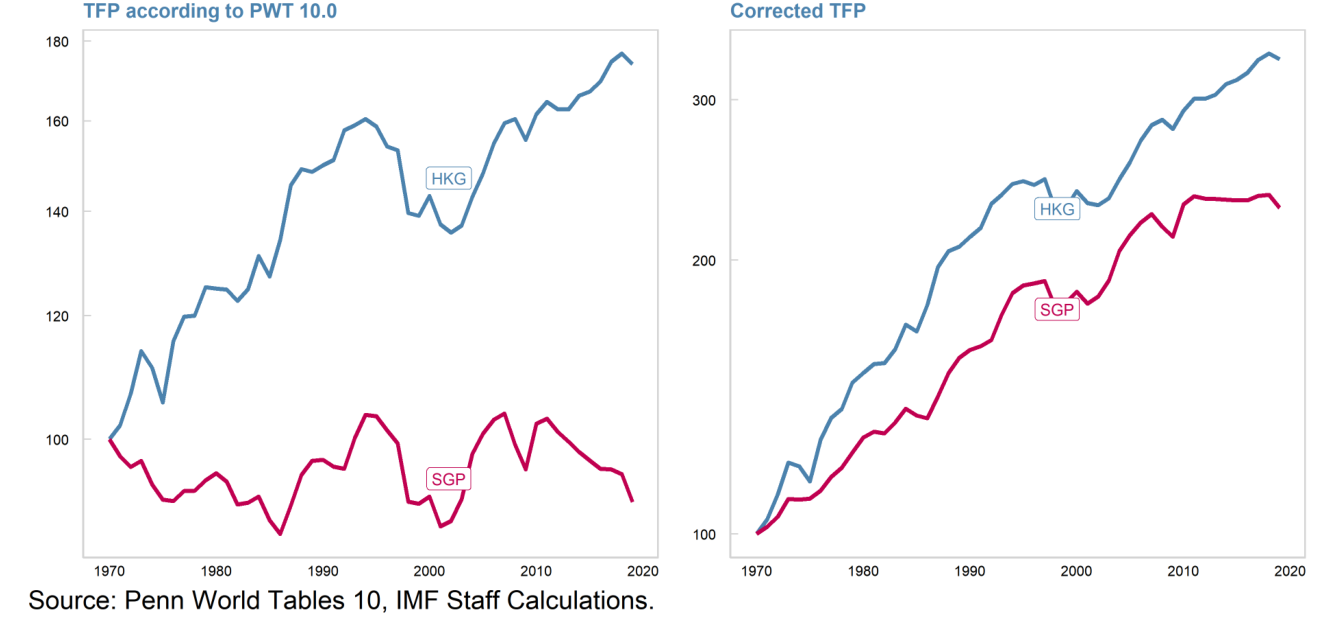
Bakker's actual argument is about TFP mis-measurement, not misallocation: "standard growth decompositions have underestimated TFP growth by overestimating the contribution of capital, failing to account for the substantial part of capital income directed to urban land rents" (abstract, verbatim). Because a substantial share of what national accounts book as capital income is in fact urban land rent, measured TFP understates true productivity growth — in his Singapore case, true TFP is higher than measured. The paper's Georgist payoff is therefore on the factor-shares side: it is evidence that recorded capital income is partly land rent, bearing on the capital-share claim. An earlier version of this page read Bakker as a misallocation/"priced out" result — that reading is not in the paper and was corrected 2026-07-10.
Bears On
- Outcome: Most of the modern rise in the capital share is land, not capital
- Bears on, as a measurement caveat rather than support: High land rents suppress productivity
Sources
- Bas Bakker (2023), "Unveiling the Hidden Impact of Urban Land Rents on Total Factor Productivity," IMF Working Paper — used for the finding that standard growth decompositions misattribute urban land rents to capital, understating true TFP growth (a measurement result, not misallocation evidence). PDF