Originally published on Progress and Poverty on May 19, 2026. Republished on Progress.org with permission.
LVT Landscape Live
In the last six months, Kentucky and Virginia passed LVT enabling legislation. And local governments are actively looking into implementation.
Join us June 3rd at 7PM ET for a webinar with the folks introducing, researching, and passing LVT legislation:
Ohio State Senator Louis Blessing, Louisville Abundance Fellow Jackson Arnold, Charlottesville Planning Commissioner Lyle Solla-Yates, and Institute for Progress Fellow Reed Schwartz
To receive new posts and support my work, consider becoming a free or paid subscriber.
Kevin Erdmann, a housing economist and fellow substacker, recently wrote a piece suggesting that property taxes are land value taxes. The basic argument is that (at least in the cases he outlines) conventional property tax falls entirely on land value anyways, so all we need to do to achieve Georgist goals is to increase property taxes.
We like Erdmann, and although we respectfully disagree with this particular take, a) Substack beefs are good for both sides’ engagement, and b) we’ve actually been meaning to talk about this exact subject for a while, so we will happily take the bait and repay our fellow housing blogger with some considered opinions about what he’s missing.
First, Erdmann’s right that the property tax contains a land value tax, and he’s certainly not wrong in endorsing property tax as a pretty good tax (something we’ve done ourselves), especially over alternatives such as sales tax, income tax, etc.
However, to suggest that property taxes are equivalent to land value taxes, or that we can achieve all our goals with property taxes alone, is wrong.
Contra Erdmann, we argue that the building tax component of a property tax is a much bigger deal than he’s giving it credit for, that it creates real distortions and disincentives to build (and therefore incentives to hoard land speculatively), and that this all becomes much clearer when you take into account the fact that the building tax applies repeatedly year over year upon the same asset.
Erdmann’s Argument
Erdmann’s article is quite short, so we recommend reading it in full, but we will summarize it here; it’s all about the mathematical incidence of taxes. “Incidence” here being a fancy tax word for “where does the burden of the tax mostly (or entirely) fall – on the building value or on the land value?”
The argument starts with a few opening premises:
A property is a bundle of land and building that are sold or rented together as one piece.
The rent a landlord gets from the property is fixed by local supply and demand for such land/building bundles
Building price is fixed at its replacement cost (what you would have to pay to rebuild it from scratch today, minus depreciation).
Land price clears based on whatever residual rent is left after the building earns its required yield
Let’s now play Erdmann’s argument out. Imagine a $600,000 home. Half of its value ($300,000) is building, the other half is land. In Erdmann’s model the building’s yield is 8% annually. Now let’s apply a 2% property tax to the whole property. What happens? Here’s what Erdmann says:
The rent doesn’t change, it’s a function of supply and demand and the tax hasn’t changed that. In this model, it is $2,750 both before and after the tax.
However, the building requires a $2,000/month return (8% of $300,000)
The building will keep making that return before and after the tax, the rent will stay the same, and the difference therefore comes out of the “land rent”, which also drops the land price in response:
Before:
After:
(Those are Erdmann’s charts, by the way)
The market re-equilibrates, with the same $300,000 structure now sitting on a $60,000 lot instead of a $300,000 lot. Erdmann’s conclusion: on any parcel with locational scarcity rent, “any marginal increase in property tax is a 100% land value tax.”
One Graphic Disproves Erdmann
If property taxes were truly economic equivalents to land value taxes, then the incentive systems they create would be the same. But, they are not.
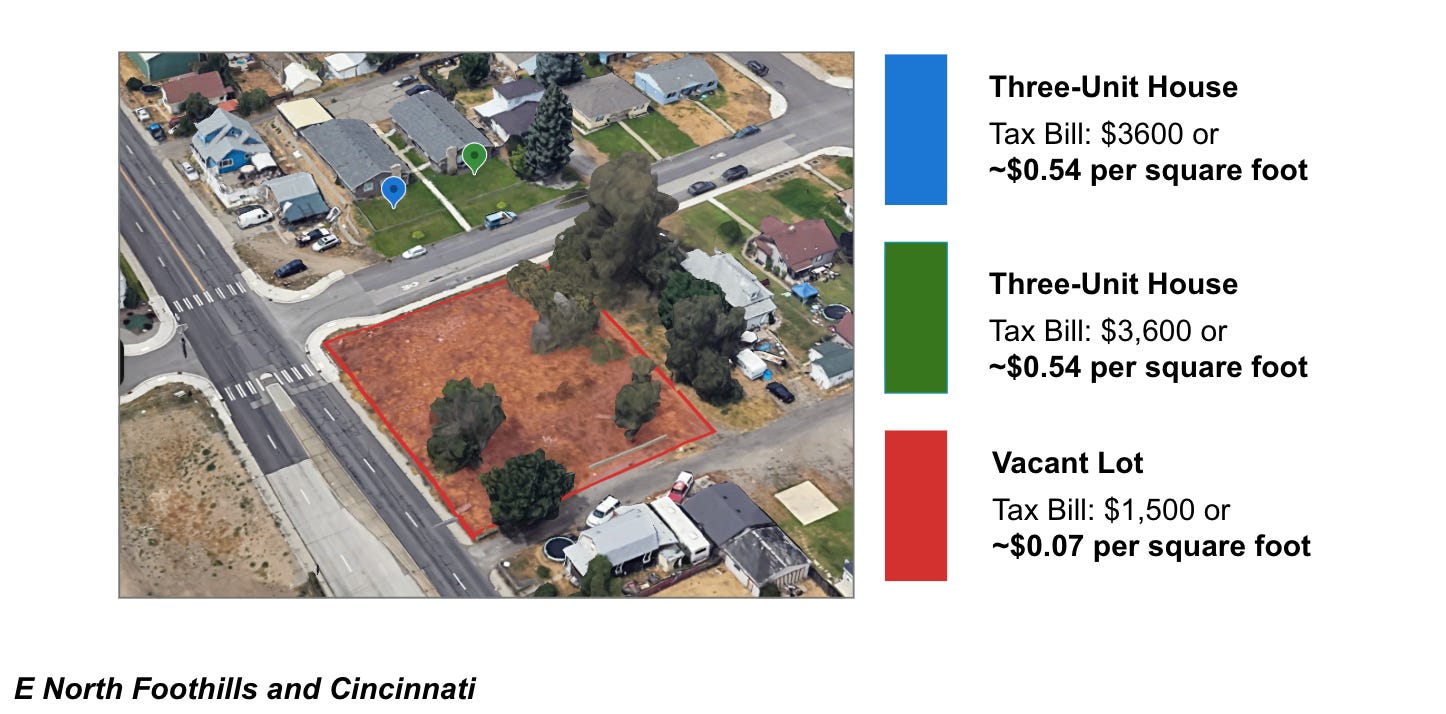
Three parcels next door to each other with the same zoning all have wildly different tax bills per square foot. Under a land value tax, the per-square-foot bill would be roughly equal across the three — because the location is roughly equal across the three. Under our actual property tax, the vacant lot pays one-eighth the rate of its neighbors per square foot, because nobody has built anything on it. The system rewards keeping land unproductive.
What does Erdmann get wrong?
He makes one main mistake: he reasons only about an individual parcel in isolation, with a structure that has already been built. He never asks the question that comes before that: would this structure have been built in the first place, at this size, at this quality, on this lot, under this tax regime?
In Erdmann’s setup, the property tax shows up after the $300,000 home already exists, and the only question is how the existing rent splits between structure cost, tax, and residual land. His “100% land value tax” claim is a statement about the incidence of the tax on an already-built parcel, but not on the production margin, and the production margin is not binary.
It is not simply a question of “build or don’t build.” It is a spectrum of how much structure gets built and at what quality: A four-story building or a six-story building? A three-unit house or a single-family detached? Brick or vinyl? An ADU expansion or solar rooftop?
Every one of those margins gets compressed when the building portion of the tax rises. Erdmann shows the property tax falling on the residual at one specific parcel. What he doesn’t show is the city full of parcels where the structure that would have been built under a land value tax is smaller, lower-quality, or absent under a property tax. The parcel graphics above are precisely that city-level evidence: when you tax structures, you get less structure. The vacant lot pays one-eighth the per-square-foot rate of its developed neighbor because the system bills you on what you build, not on what the land is worth, and the developer knows this at the time they decide to build, or not.
Erdmann does attempt to treat structures as non-fixed at one point, but even there he stays at the isolated parcel level and gets it wrong at that scope too:
“If a $100,000 addition was built on the $300,000 structure above, the total rental value, whether taxed or untaxed, would increase to $3,417. However, the additional property tax would lower the residual land value by $40,000, so the net property value would only increase by $60,000.”
Erdmann presents this as fine; land value gets compressed, and the addition still gets built.
But looking closer, the owner just spent $100,000 on the addition and was rewarded with $60,000 of net property value. That is a $40,000 hole on the construction margin. Under a 1% tax instead of 2%, the hole would be roughly half the size. Under a pure land value tax with zero building tax, there would be no hole at all.
And the hole isn’t only about whether the addition gets built. It’s about how much gets built. Assume I own a parcel and I am sizing up an investment: under a 1% regime, the numbers say “build the addition.” Under a 2% regime, the same investment might still pencil but only at three quarters of the size.
Multiply across every owner in the city making decisions like that, and you get a city that builds less and builds smaller.
The Building Tax is A Big Deal
The average property tax in the United States is ~1%. That does not sound like much, when we are used to marginal income tax rates of 20% and sales taxes of 8%. However, building taxes are actually some of the most significant taxes we have, because they are an annual tax applied over and over again to the same asset.
Think of it this way. If I had to pay a huge up front one-time fee every time I wanted to build something, I would obviously build a less valuable building than I would if I didn’t have to pay that fee. Any annual recurring tax can be converted and compared to such a fee through the magic of discount rates. Let’s do this for the building component of a property tax.
Over 30 years, a 1% annual building tax has a “net present value” cost of roughly 12% to 20% of the entire investment, depending on my discount rate. A 2% tax is more like 25% to 40%. At a 5% discount rate, a 2% building tax is about a 31% tax on the original investment in net present-value terms.
This is the wedge sitting between every “build it” decision and every “build it smaller” or “don’t build at all” decision. Erdmann’s model treats it as innocuous because it gets capitalized into a lower lot price in his economic model. However, a developer can clearly see in their pro-forma, that if they build a bigger building, they will pay a higher building tax, because the building will directly add to the total property value.