

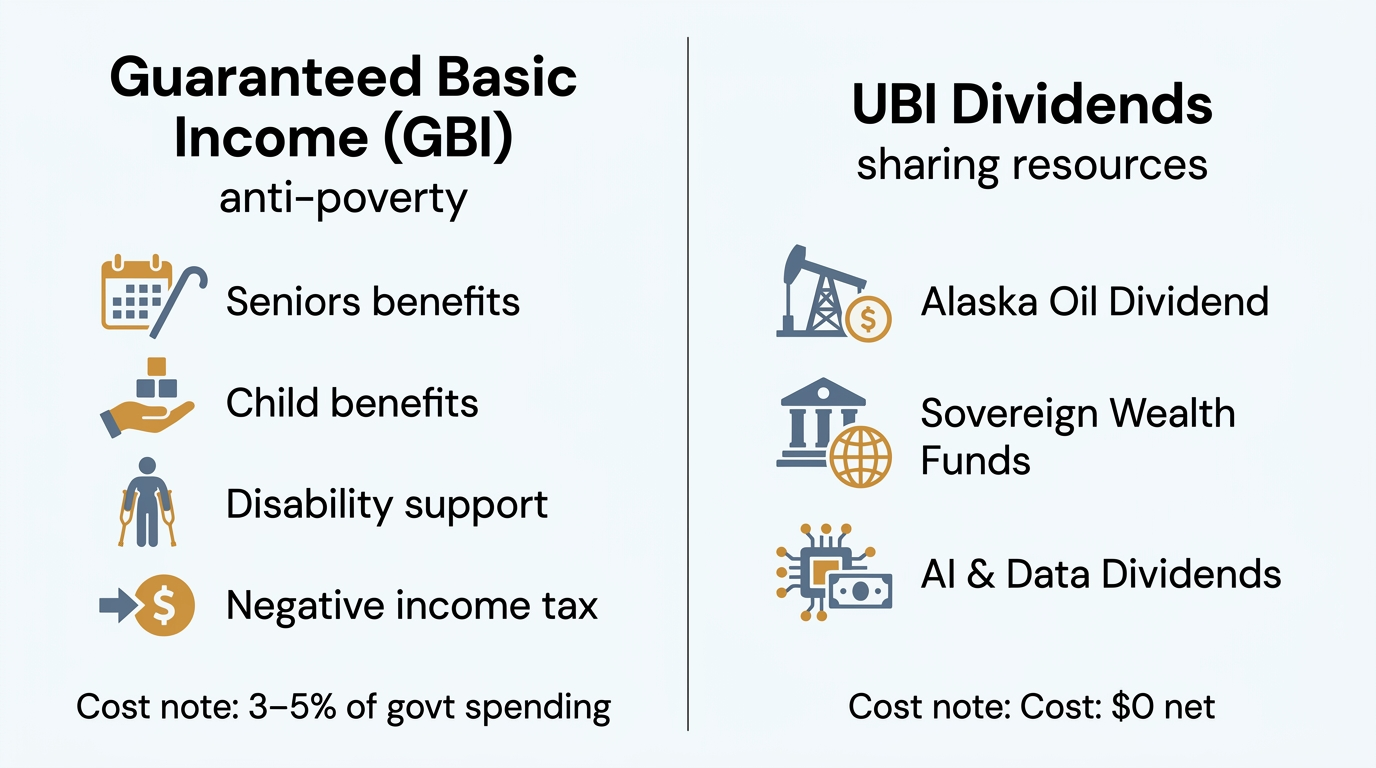
We already have basic income models that work around the world: guaranteed basic income to buy people time by keeping them out of poverty, and UBI dividends from common wealth. This piece explains the differences and how the two work together to provide economic security for all — drawing on evidence from every continent.
Summary
Guaranteed basic income (GBI) tackles poverty by targeting cash to those in need. It buys people time in a world of rapid technological transition. We already have working examples in seniors' pensions, child benefits, and conditional cash transfers across dozens of countries. A broad-based GBI program is typically an order of magnitude cheaper than universal payments and pays for itself in reduced poverty-related costs — healthcare, incarceration, lost productivity.
Universal basic income (UBI), when given to everyone regardless of income, is most politically viable as a dividend from a common fund or resource — like Alaska's oil dividend, Norway's sovereign wealth fund, or proposed AI dividends.
GBI and universal dividends are complementary. Together they can provide economic security for all and let everyone share in the value of nature and technological progress.
"It's impossible to truly have equality of opportunity without some version of guaranteed income." — Sam Altman, OpenAI CEO
Guaranteed Basic Income vs. Universal Basic Income
Two dominant models of basic income are being explored today, both with working real-world examples:
1. Guaranteed Basic Income (GBI) — directed to those in need, as an anti-poverty program. The benefit phases out as earned income rises. 2. Universal Basic Income (UBI) — distributed equally to everyone, ideally as a dividend from a common fund or resource.
While there is a strong principled case for universality over means-testing, the prevailing political focus for anti-poverty programs is targeted: directing money to those with the lowest incomes. A universal variant that goes to everyone regardless of income, but isn't structured as a common dividend, typically claws back the payment from higher earners through the tax system — so the net result is effectively an income-tested transfer.
Under this framework, it becomes evident that many people who advocate for "UBI" actually mean GBI. This includes governments, politicians, journalists, and non-profits worldwide. Critics, in turn, often argue against a different model than what's actually on the table politically. The result is a confused public debate. Advocates need to coordinate on clearer messaging and public education about viable basic-income schemes.
Guaranteed Basic Income to tackle poverty
The primary goal of a GBI is poverty reduction. Because the benefit declines as earned income rises, it is an order of magnitude cheaper than giving everyone equal payments. GBI can often be implemented by consolidating existing fragmented welfare programs, and saves money over time from the even higher costs of poverty in healthcare, crime, child welfare, and lost productivity.
Evidence from around the world
The model has been tested repeatedly, on every populated continent, and the evidence is remarkably consistent:
- Manitoba "Mincome", Canada (1974–79). In the Dauphin saturation site, hospitalization rates fell 8.5% and median wages rose by ~6.8% as workers gained bargaining power. Most recipients kept working; reductions were concentrated in new parents and students staying in school longer.
- Finland Basic Income Experiment (2017–18). 2,000 unemployed adults received €560/month unconditionally for two years. Employment effects were small but slightly positive; recipients reported significantly better mental health, life satisfaction, and trust in institutions.
- GiveDirectly, Kenya (2016–present). A 12-year randomized trial across hundreds of villages — the largest basic-income study ever run — has shown sustained gains in nutrition, education, business formation, and psychological wellbeing, with no measurable reduction in work effort.
- Madhya Pradesh, India (2011–13, SEWA). Villages receiving small unconditional grants showed improved nutrition, school attendance, and a rise in productive economic activity, debunking the "people will stop working" critique.
- Namibia Basic Income Grant pilot, Otjivero (2008–09). Child malnutrition fell from 42% to 10% in a year; school dropouts fell sharply; small businesses proliferated.
- Stockton SEED, California, USA (2019–21). $500/month for 125 low-income residents; full-time employment among recipients rose (from 28% to 40%) versus the control group, and income volatility dropped.
- Brazil — Bolsa Família and Auxílio Brasil. A conditional cash transfer covering ~14 million families. It has cut extreme poverty by roughly half since 2003 and is consistently identified as one of the most cost-effective anti-poverty programs ever designed (operating cost ~0.5% of GDP).
- Iran's nationwide cash transfer (2010–present). Replaced fuel subsidies with a near-universal monthly payment. A study by MIT's Djavad Salehi-Isfahani and Mohammad Mostafavi-Dehzooei found no adverse effect on labor supply; if anything, it modestly increased work hours.
Researchers and budget officers reviewing GBI proposals consistently find: minimal labor-supply impact (typically a fraction of a percent), minimal inflation risk when properly funded, and GDP-positive net effects when poverty reduction is priced in.
This idea travels under many names — negative income tax (NIT), guaranteed livable income (GLI), guaranteed annual income (GAI), guaranteed minimum income (GMI), basic income guarantee (BIG), unconditional cash transfer (UCT) — but the core idea is consistent: give cash directly to people in need, with minimal conditions.
We already have GBI — for kids and seniors
Most wealthy democracies already operate effective targeted basic-income programs. They're just not labelled as such:
- Child benefits. Universal or near-universal child allowances exist in the UK (Child Benefit), Germany (Kindergeld), France (Allocations familiales), Canada (Canada Child Benefit), and dozens of other countries. The UK Child Benefit and Canada Child Benefit have each been shown to reduce child poverty by 30–40% on their own.
- Seniors' guaranteed incomes. The dramatic post-war collapse in elderly poverty across the OECD — from 30%+ in the 1960s to single digits today in most rich countries — was driven by guaranteed-income-style programs: Old Age Pension (UK), AOW (Netherlands), Social Security + SSI (US), OAS/GIS (Canada), the universal pension in New Zealand, and similar schemes worldwide. Economists have called this collapse in elder poverty the major success story of 20th-century social policy.
- Disability income guarantees. Countries are increasingly extending the senior model to disabled adults — Spain's Ingreso Mínimo Vital, Canada's new Canada Disability Benefit, the UK's Personal Independence Payment, Germany's Bürgergeld. These are early steps toward a broader GBI.
A broader guaranteed basic income simply extends this proven model to everyone in financial need, rather than to children, the elderly, and the disabled alone.
Universal Basic Income to share common wealth
"All persons have a right to income from wealth we inherit or create together… paying dividends from wealth we own together is a practical, market-based way to assure the survival of a large middle class." — Peter Barnes, entrepreneur and pioneer of cap-and-dividend
UBI in its purest form is about sharing wealth from a common fund or resource. Where GBI targets poverty, UBI dividends give every citizen a stake in something we have a collective claim to — wealth generated by nature, public infrastructure, or technological progress.
Paying common dividends is a fair and efficient way to tackle extreme inequality, safeguard common resources from enclosure, and better distribute the returns to capital in an increasingly automated economy.
The funding source for UBI dividends is structurally baked in — it flows from the common asset rather than from taxing labor. Greek economist and former Finance Minister Yanis Varoufakis put it this way: "If a universal basic income — liberty's main prerequisite in an age of obsolete labor — is to be legitimate, it cannot be financed by taxing Jill to pay Jack."
Working and proposed dividend programs
The model is not theoretical. It is already running, and serious proposals exist worldwide:
- Alaska Permanent Fund Dividend (USA, 1982–present). Every resident — adult or child — receives an annual cash dividend from a sovereign wealth fund seeded by oil royalties. Payments have ranged from ~$800 to ~$3,300 per person depending on the fund's market performance. It has been the most politically durable cash-transfer program in modern American history; Alaskans of all parties defend it fiercely.
- Norway's Government Pension Fund Global. The world's largest sovereign wealth fund (~$1.7 trillion), built from offshore oil revenue. Norway chose to invest rather than distribute, but the principle is the same: convert finite resource wealth into a perpetual common asset on behalf of the citizenry.
- Gulf state citizen funds. Kuwait, UAE, Qatar, and Saudi Arabia all redistribute substantial portions of resource wealth to citizens via subsidies, lump-sum transfers, or universal services. These are de facto resource dividends, even if not labelled as cash UBI.
- Eastern Band of Cherokee Indians, North Carolina (1996–present). Per-capita casino-revenue distributions to all enrolled tribal members, often cited in research as a "natural UBI experiment." Studies by economist Randall Akee and colleagues show large, persistent gains in children's mental health, education attainment, and adult economic outcomes — with no measurable reduction in adult work effort.
- Mongolia's Human Development Fund (2010–12). Briefly paid every citizen a monthly dividend from mining royalties. Ended for fiscal reasons, but proved the operational feasibility of nationwide distribution.
- UK Citizens' Wealth Fund (proposed). UK think tank IPPR has proposed a sovereign wealth fund that would pay a one-time £10,000 dividend to every UK-born 25-year-old, giving young adults a meaningful stake to invest in education, housing, or business formation.
- US "Freedom Dividend" (proposed). US entrepreneur and presidential candidate Andrew Yang proposed a $1,000/month dividend to every American adult, funded by a value-added tax on the largest tech and AI firms — the "oil of the 21st century."
- OpenAI's Sam Altman has proposed an "American Equity Fund." A US sovereign wealth fund financed by a small equity stake in every public company and a tax on land value, paying every American adult an estimated $13,500/year in dividends as AI productivity rises.
- Peter Barnes' "Sky Trust" / cap-and-dividend. Estimates that the United States could pay every American (including children) ~$5,000/year by monetizing four common assets: the atmosphere (carbon dividends), the electromagnetic spectrum, financial infrastructure, and the intellectual-property protection system.
- Karl Widerquist's social wealth fund. A proposed fund that would give every 21-year-old a $30,000 lump sum, which they could either invest at compound interest (growing to ~$246,000 by retirement) or draw as yearly dividends.
Notably, support for UBI dividends crosses ideological lines. Conservative and libertarian think tanks — historically critical of redistributive welfare — have championed Alaska-style resource dividends, on the grounds that nature's bounty was never anyone's to enclose in the first place. Cap-and-dividend climate proposals have been endorsed by figures from across the political spectrum, including James Hansen, Greg Mankiw, and Citizens' Climate Lobby.
"Our societies must embrace the rise of machines, but ensure that they contribute to shared prosperity by granting every citizen property rights over them, yielding a Universal Basic Dividend." — Yanis Varoufakis, former Greek Finance Minister
Basic income in the age of AI
The case for both GBI and UBI is sharpening in an era of advanced AI and broad automation. The economic backdrop is unmistakable across the OECD and most emerging economies:
- Labour's share of national income is falling. Across nearly every major economy, a steadily rising share of GDP accrues to capital — land, real estate, equity, and intellectual property — rather than to wages. The ILO documents this trend continuously since the 1980s.
.avif)
.avif)
.avif)
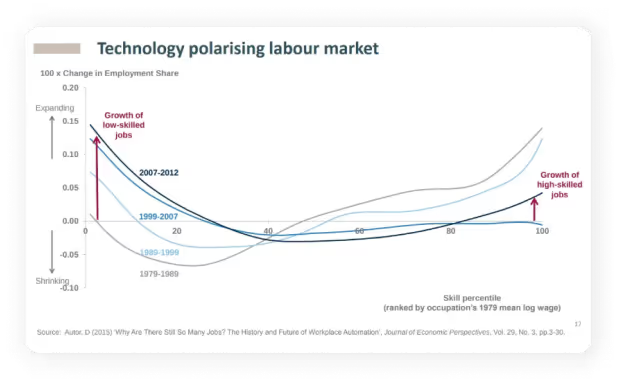
- The labour market is polarising. Automation has hollowed out middle-skill, middle-pay work. The growth has been at the high-skill / high-pay end (where AI and software complement workers) and the low-skill / low-pay end (where automation is harder than in manufacturing). The squeezed middle is real and global.
.avif)
- The "great decoupling" of wages from productivity that began in the US in the 1970s, and later in many other rich economies, has continued. Workers no longer automatically share in productivity gains the way they did during the post-war decades.
.avif)
.avif)
History offers an uncomfortable precedent. During the First Industrial Revolution, real wages stagnated for roughly 50 years before workers eventually shared in the productivity gains. The economist Karl Widerquist observes:
"Even if the total number of jobs increases with automation, innovation disrupts the labour market… Their children or grandchildren might eventually get better jobs, but this is cold comfort to people spending the rest of their lives at the bottom of the labour market."
The Fourth Industrial Revolution — advanced AI plus general-purpose robotics — may produce a similar transition, but compressed in time and global in scope.
"I think we need to make sure that the benefits [of AI] accrue to as many people as possible — to all of humanity, ideally." — Demis Hassabis, Google DeepMind Co-founder, Nobel Laureate in Chemistry
GBI and UBI are essential in an AI-driven future
GBI provides an economic floor no one can fall under. For workers displaced by automation, it buys time to retrain and to weather periods of precarity. It gives people the economic power to say no — to poverty wages, to exploitative conditions, to abusive situations. It gives people the freedom to take important risks: starting a business, going back to school, switching careers, leaving a bad relationship.
UBI gives everyone a financial stake in the value generated by nature and technological progress. It tackles extreme wealth inequality at its root, ensuring the value of common resources benefits everyone through a share of ownership. It ties every citizen's financial wellbeing directly to the success of the broader economy. As automation widens the gap between returns to capital and returns to labour, a UBI dividend gives everyone a source of capital income that doesn't depend on selling their labour.
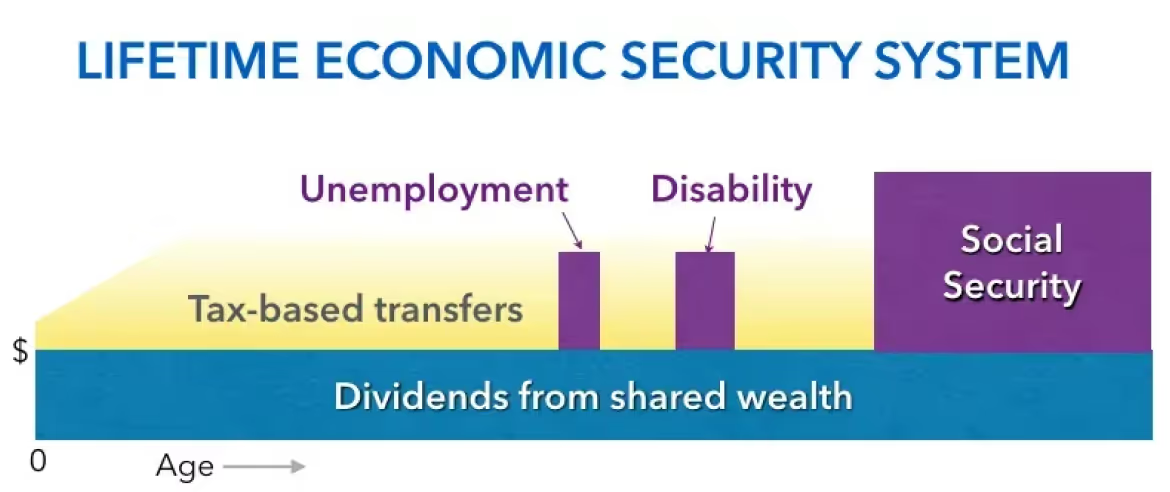
The two policies are not in competition. They are complementary tools in a broader economic-security architecture: targeted GBI to keep anyone from falling into destitution, and universal dividends to ensure everyone shares in the wealth we collectively create.
"We are the owners and shareholders of this society… We need to take the bounty of the 21st-century economy and return it to the people." — Andrew Yang, Founder of the Forward Party, former US Presidential Candidate
Critics often debate strawmen
Opponents of basic income frequently conjure up economically unfeasible UBI schemes with astronomical costs, then knock them down without engaging with what advocates actually propose. Some recurring patterns:
- "Imagine giving every adult $5,000 a month — it would bankrupt the country!" No serious advocate proposes this. Real dividend proposals are calibrated to the actual sustainable yield of the underlying common asset (Alaska's is around $1,500/year, not $5,000/month).
- "It would require doubling income taxes!" Only if you ignore (a) the existing welfare programs a GBI would consolidate, (b) the savings from reduced poverty-related public spending, and (c) the alternative of funding via natural-resource rents, land-value taxes, carbon dividends, or technology rents — none of which fall on labour income.
- "COVID-era emergency cash was UBI, and it didn't work." The US stimulus payments, Spain's emergency IMV rollout, and Canada's CERB were not UBI. They were temporary emergency benefits with poor work-incentive design (in some cases punitive clawbacks that disappeared the moment someone took a job). No serious basic-income design would include those features. Conflating emergency pandemic transfers with a permanent, well-designed basic income is a category error.
These imaginations of UBI bear little resemblance to what serious advocates or policymakers are actually proposing. They reflect a broader phenomenon: people debating a fictional strawman rather than engaging with the real ideas on the table.
Let's debate real ideas
Because critiques often fail to distinguish between guaranteed basic income and universal dividends, they are at best misinformed and at worst disingenuous strawman arguments. No mainstream advocate seriously proposes raising taxes on working families to fund identical monthly cheques for billionaires. That fictional scheme fulfils neither the purpose of a GBI nor a UBI dividend.
The real debate is far more interesting and far more grounded in evidence:
- GBI tackles poverty, saves lives, and saves money. We already have working models of it — child benefits, seniors' pensions, disability incomes, conditional cash transfers — in dozens of countries. The question is whether to extend the model to everyone in need.
- UBI dividends share wealth we all have a claim to. We already have working models — Alaska, Norway's fund, the Cherokee per-capita distributions, GCC citizen funds. The question is which common assets to monetize next: data, AI compute, atmospheric carbon, land rents, intellectual property.
Both are practical. Both are tested. Both are increasingly necessary in an automating economy. The choice isn't between them — it's whether to build both, before the disruption of advanced AI arrives at full scale.
This article is an internationally-oriented adaptation of “Basic Income Explained: Guaranteed Basic Income (GBI) vs. Universal Basic Income (UBI)” by Ken Yang, and Floyd Marinescu originally published at ubiworks.ca/gbi-vs-ubi. Canadian-specific evidence has been replaced with global examples; the underlying argument, structure, and key quotations are preserved.