The Impact of Local Residential Land Use Restrictions on Land Values Across and Within Single Family Housing Markets
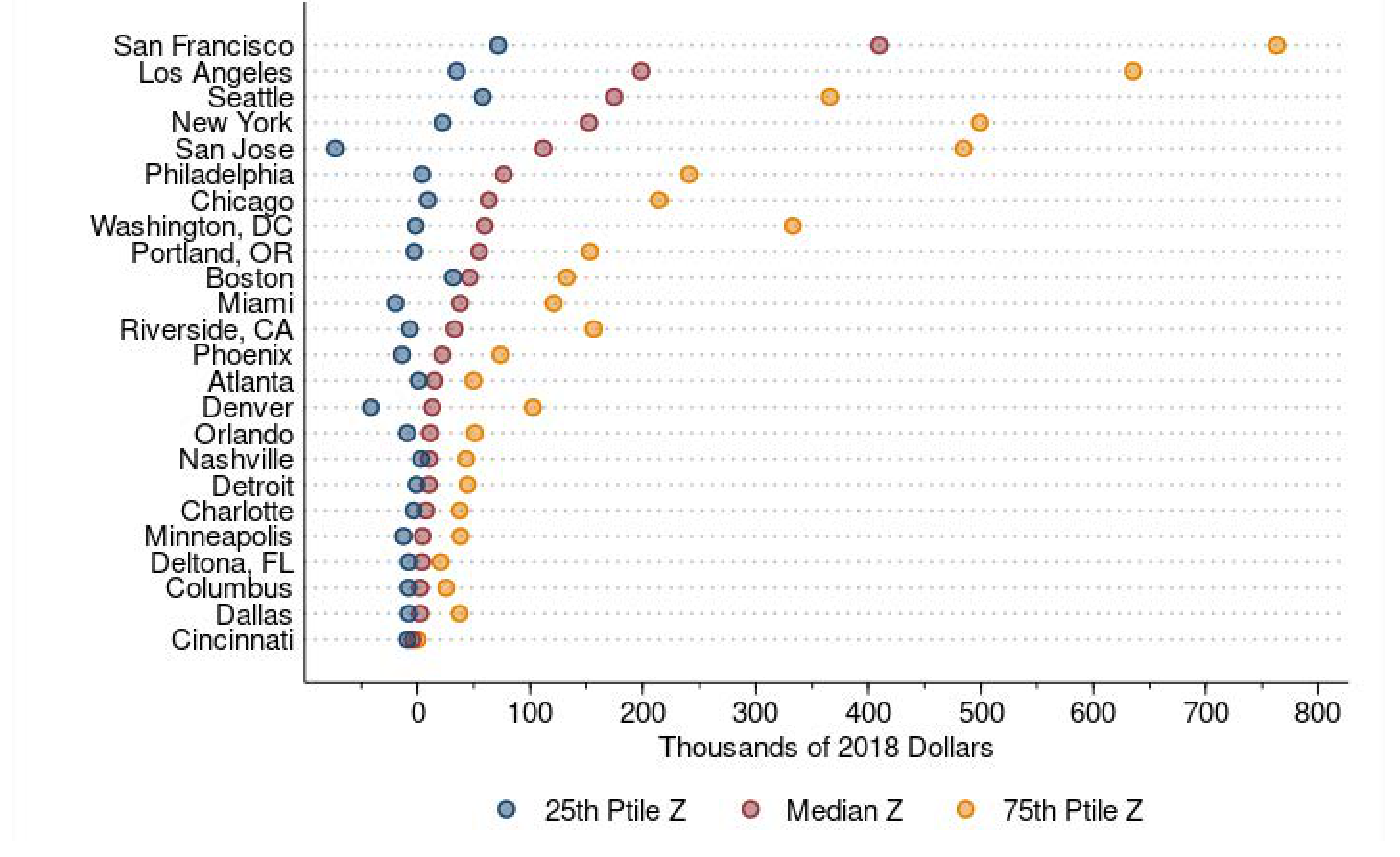
Gyourko and Krimmel estimate 'zoning taxes' from vacant-lot sales: regulation bids up land prices by ~$400k per quarter-acre in San Francisco and $150-200k in LA, NYC and Seattle — direct evidence that valuable urban land is held below its market-implied intensity of use.
Summary
Circulated as NBER Working Paper 28993 (July 2021) and published in the Journal of Urban Economics 126 (2021), 103374, this paper by Joseph Gyourko (Wharton) and Jacob Krimmel (Federal Reserve Board) puts dollar figures on how much land-use regulation inflates land prices in America's high-demand metros. From the abstract: "Using micro data on vacant land purchased to develop single family housing, we implement a new empirical strategy for estimating so-called 'zoning taxes' – the amount by which land prices are bid up due to supply side regulations."
Method and Findings
The "zoning tax" is the gap between what land sells for on the extensive margin (a whole additional lot) and its intensive-margin value (what an extra square foot adds to an existing lot). Absent binding density limits, the two should converge; the gap measures how much regulation stops land from being used as intensively as buyers would pay for. Across 24 major metros:
- "The typical gap between extensive and intensive margin land values of a quarter acre plot of land is about $400,000 in the San Francisco metro, ranges between $150,000-$200,000 in three other large coastal markets (Los Angeles, New York City and Seattle)," and exceeds $100,000 in San Jose.
- In San Francisco, Los Angeles and Seattle the land-price premium applies essentially everywhere in the metro, at magnitudes of at least a typical household's annual income.
- Zoning-tax estimates correlate strongly (and non-mechanically) with the Wharton Residential Land Use Regulatory Index of 2018.
- Much of interior America shows no economically meaningful zoning tax — the phenomenon is concentrated precisely in high-demand coastal cities.
What It Supports — and What It Reframes
For the outcome page land underuse and speculative vacancy persist in high-demand cities, this is peer-reviewed confirmation of the underuse half of the claim: in exactly the cities where land is most valuable, sites are demonstrably held below the intensity of use the market would pay for, at six-figure per-lot magnitudes.
But the paper attributes that underuse to regulation, not speculation: the binding constraint it identifies is legal density limits, and its policy implication is zoning reform. It is therefore also the strongest statement of the main counter-frame to speculative-withholding accounts — echoing Glaeser & Gyourko (2018) — and a caution against attributing all urban underuse to owners waiting for capital gains. The two mechanisms are not exclusive: a site can be both under-zoned and land-banked, and holding-cost evidence (Segú 2020, Cunningham 2006) shows owner behaviour responds to carrying costs within whatever the zoning envelope allows.
Limits
- Estimates come from vacant-lot transactions for single-family development; thin samples in some metros (69 observations in San Francisco) make point estimates sensitive — dropping one large parcel moves the SF median by 10%.
- The zoning tax measures regulation's price wedge, not speculative behaviour, tax policy, or vacancy; it says nothing about land value taxation either way.
See Also
- Land underuse and speculative vacancy persist in high-demand cities — the outcome page this supports
- Glaeser & Gyourko, The Economic Implications of Housing Supply
- Hsieh & Moretti, spatial misallocation
- Speculative Vacancy · High land rents suppress productivity
Sources
- Joseph Gyourko & Jacob Krimmel (2021), "The impact of local residential land use restrictions on land values across and within single family housing markets," NBER Working Paper 28993; published in Journal of Urban Economics 126 (2021), 103374. NBER PDF · published DOI — used for all quotes and figures on this page (B-claims; quotes verified against the NBER working-paper text, accessed 2026-07-10).