Understanding Weak Capital Investment: The Role of Market Concentration and Intangibles
Steelmans the efficiency reading of rising concentration: intangible capital (software, IP, brand) drove weak physical investment and rising concentration, but productivity gains — not markups — dominate in some sectors, market power in others.
Summary
"Understanding Weak Capital Investment: the Role of Market Concentration and Intangibles" is a paper by Nicolas Crouzet and Janice Eberly, both of Northwestern University (Eberly is also a Research Associate at the NBER), prepared for the Federal Reserve Bank of Kansas City's Jackson Hole Economic Policy Symposium, held August 23–25, 2018, under the symposium theme "Changing Market Structures and Implications for Monetary Policy." The version cited here is dated May 14, 2019, and was circulated as NBER Working Paper 25869. Jackson Hole is one of the most closely watched venues in central banking and macroeconomics — its symposium volume is read directly by policymakers — so a paper presented there carries substantial institutional weight independent of its later citation count. The paper was formally discussed at the symposium by Thomas Philippon, a leading market-power/concentration researcher in his own right, whose published commentary (symposium proceedings, pp. 151–169) accepts the paper's sector-by-sector split but pushes back toward a stronger market-power reading of the economy-wide evidence — see the discussant-pushback bullet in Nuances and Limits below.[7]
The paper matters for this wiki because it is the most direct, mainstream steelman of the efficiency interpretation of rising U.S. industry concentration: rather than treating concentration as evidence of rent extraction, Crouzet and Eberly show that a substantial share of it is statistically associated with genuine productivity gains from intangible investment, not just market power — while being careful to show that the two mechanisms operate differently across sectors rather than claiming efficiency explains everything.
The Core Argument and Findings
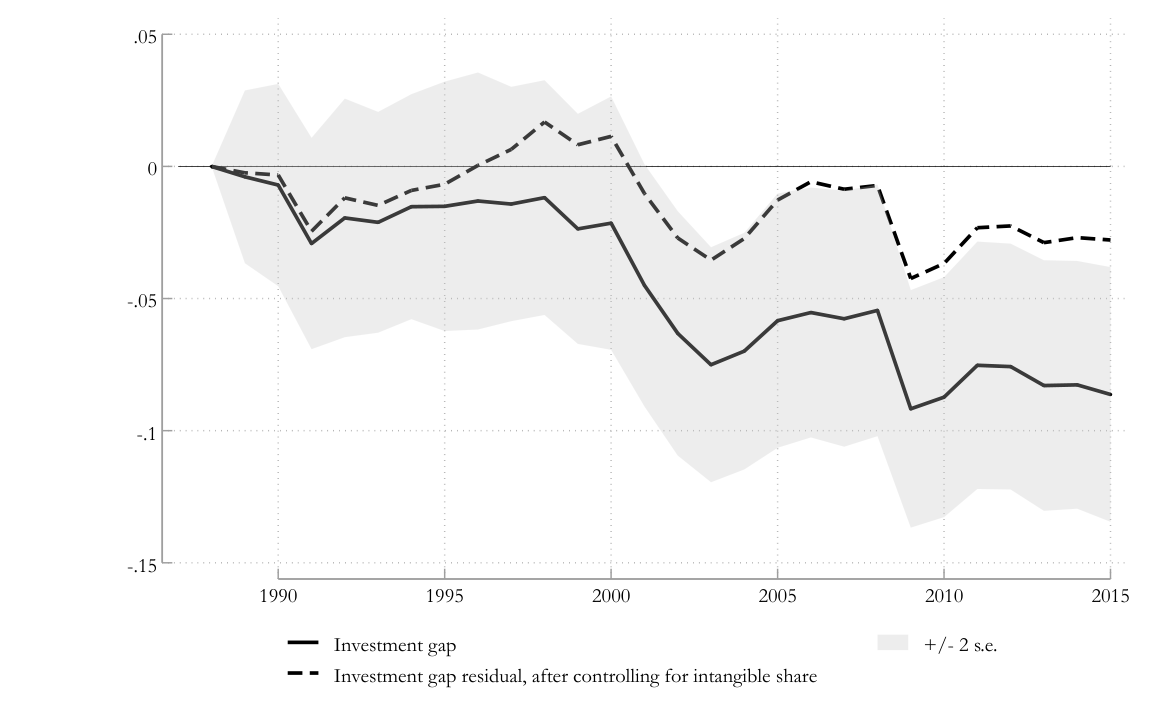
The puzzle. Physical (PP&E) investment in the U.S. corporate sector was unusually weak relative to firm valuations and profitability starting around 2000 — predating the 2008 financial crisis — even as corporate profitability and Tobin's Q rose. Prior work the authors build on (Gutiérrez & Philippon 2017; Alexander & Eberly 2018) documented this "investment gap" but could not fully explain it through standard determinants (weak expected growth, financing constraints, interest rates).
The proposed resolution: intangible capital as an omitted factor. Crouzet and Eberly argue that firms have shifted a growing share of their capital stock toward intangible capital — software, intellectual property (including R&D), brand, and innovative business processes, following the taxonomy of Corrado, Hulten & Sichel (2005). Because standard investment measures count only physical property, plant, and equipment (PP&E), and firm balance sheets generally do not capitalize most self-developed intangible investment, a rising share of true investment is effectively invisible to conventional PP&E-based measures. Using industry-level data from the BEA's fixed-asset tables and firm-level Compustat data (with balance-sheet intangibles cross-checked against an instrumented proxy for internally developed intangibles from Peters & Taylor 2017), the authors show that measured "investment gaps" between expected and observed PP&E investment are strongly correlated with a firm's or industry's share of intangible capital. Adjusting for intangible capital closes roughly one quarter of the investment gap in firm-level data and roughly three quarters of the gap in industry-level data — i.e., most of the industry-level weak-investment puzzle, and a smaller but still substantial share of the firm-level puzzle, is explained once intangible investment is counted as investment.
Intangibles and rising concentration. The paper's second and more consequential finding for the Georgist rent debate is that the rise in intangible capital is not evenly distributed: it is concentrated among industry leaders, and firms' market share is positively related to their "intangible intensity" (the ratio of intangible to total capital), both across firms and within firms over time. This directly implicates intangible investment in the well-documented rise of U.S. industry concentration (citing Autor et al.'s "superstar firms" work as the concentration finding they are explaining).
Disentangling productivity from market power. The paper's central methodological move is to note that rising concentration driven by intangibles could reflect two distinct, observationally different mechanisms: (1) productivity gains — the most productive firms scale up using intangible-enabled efficiencies (the "superstar firm" story), which would be efficient; or (2) market power — intangibles (patents, trademarks, brand) create legal exclusivity and pricing power that raises markups without raising productivity, which would be a rent story. Crucially, the authors argue these are empirically separable: productivity-driven concentration should show rising productivity among leaders without rising markups, while market-power-driven concentration should show rising markups without rising productivity. They test this sector by sector (Consumer, Healthcare, High-tech, Manufacturing) rather than assuming a single economy-wide mechanism, and their headline result is genuinely mixed:
- Consumer sector (including large retailers): concentration is driven primarily by productivity gains, closely tied to intangible investment in process innovation (inventory management, distribution, online platforms) — largely non-patentable but potentially scale-deterring.
- Healthcare sector: concentration is driven primarily by rising markups, not productivity, tied to intangible investment in patentable product innovation (pharmaceuticals, devices) — the sector where the market-power reading is strongest.
- High-tech sector: both mechanisms operate together — markups and productivity both rise and both correlate with intangible investment, so the sector does not cleanly support either a pure-efficiency or pure-rent story.
- Manufacturing sector: concentration rose only mildly, with stable markups and productivity and slower intangible growth; the authors suggest ordinary consolidation as a more likely explanation, while noting their evidence does not directly test this.
Policy implications. Because intangible capital depreciates much faster than physical capital (the authors cite BEA depreciation-rate estimates ranging from roughly 20% for some innovative property to nearly 70% for some economic competencies such as advertising, and cite Li & Hall's 2016 estimate of a 30% depreciation rate for R&D capital), its user cost is far less sensitive to interest rates than physical capital's, and intangible assets are also harder to use as loan collateral. The authors argue this weakens the traditional monetary-policy transmission mechanism as intangible capital's share of the economy grows, and that policy responses to concentration should focus more on competition and intellectual-property regulation than on interest-rate or investment-tax-credit tools, since the latter are far less effective at moving intangible investment.
Relation to the Georgist Case
Georgist analysis treats a growing share of concentrated corporate profit and market power as evidence of rent — income captured by scarce, non-produced advantage rather than earned through productive contribution — paralleling the classical land-rent argument. Crouzet and Eberly's paper is significant precisely because it resists collapsing into that reading: it is a careful, mainstream empirical steelman of the efficiency interpretation, showing that at least part of the concentration commonly cited as evidence of rising market power (e.g., by De Loecker, Eeckhout & Unger) is instead statistically tied to genuine, intangible-capital-driven productivity gains — most strongly in the Consumer sector, and partially in High-tech.
At the same time, the paper does not claim concentration is generally benign. It finds that in Healthcare, and to a lesser extent High-tech, the intangible-driven rise in concentration is tied to rising markups without rising productivity — a pattern much closer to the classical rent story, mediated through patents and legal exclusivity rather than land scarcity, but structurally analogous: a legally protected, non-produced form of scarcity (patent-conferred market position) generating a return in excess of what competition would allow. The authors' own framing — "rising concentration may result from changes in technology in an otherwise competitive environment, and thus be largely efficient. Or it may arise from market power, leading to bigger wedges between price and marginal cost, and potentially inefficient allocations" — treats this as a genuinely open, sector-dependent empirical question rather than a settled answer in either direction, and their own data support both answers in different parts of the economy.
This paper therefore functions on this wiki as the primary challenged_by-side source for Corporate profits increasingly reflect economic rents, which lists it in its challenged_by field: it is the strongest available mainstream case that a material share of what looks like rising rent-like concentration is, at least in some sectors, a byproduct of real productivity gains from intangible investment rather than pure extraction. This page's supports_outcomes is intentionally empty because the paper cuts against, rather than supports, that claim.
Nuances and Limits
- The paper does not adjudicate the debate economy-wide — it splits it by sector. Its strongest and most honest contribution is showing that "is concentration efficient or rent?" does not have a single answer across the U.S. economy: the Consumer sector supports the efficiency reading, Healthcare supports the rent/market-power reading, and High-tech shows both simultaneously. A reader should not cite this paper as blanket evidence that concentration is efficient; the authors explicitly warn against a "one size fits all" interpretation of concentration.
- Measurement of firm-level intangible capital is imperfect. The authors' primary firm-level proxy is balance-sheet intangibles, which mostly reflects intangibles acquired through mergers and acquisitions and can be mismeasured if firms over- or under-value acquired intangibles. The authors address this by instrumenting with the Peters & Taylor (2017) capitalized-expenditure proxy for internally developed intangibles and report consistent results, but the underlying measurement problem — self-developed intangible investment is generally not capitalized in standard accounting — is a genuine, unresolved data limitation for this literature as a whole, not unique to this paper.
- Correlation, not a fully identified causal test. The productivity/markup decomposition by sector is based on correlational patterns (regressions of productivity and markups on intangible intensity, across and within firms), not a randomized or fully causally identified design. The authors themselves note that "more work is needed to understand why intangible capital may confer market power in certain circumstances... but not in others," and that "modeling of industry equilibrium will provide more structure for the analysis."
- Scope. The firm-level analysis is restricted to publicly traded U.S. firms in Compustat and a small number of broad sector groups (Consumer, Healthcare, High-tech, Manufacturing); it does not cover privately held firms or extend the sector-level decomposition to the full breadth of the U.S. economy.
- Even the "efficiency" sectors do not rule out land- or location-linked advantage. The paper is silent on whether any of the productivity or market-power gains it documents are themselves connected to real-estate or location advantages (e.g., logistics/distribution networks, retail footprints) — it treats "intangible capital" and physical capital/location as separate categories and does not test for interaction between them.
- Philippon's discussant pushback (Jackson Hole commentary). Thomas Philippon's published commentary on the paper organizes the debate into three hypotheses — efficient scale ("H-EFS"), consolidation ("H-CONS"), and decreasing domestic competition ("H-DDC") — and, while endorsing Crouzet and Eberly's key insight ("A key point from Crouzet and Eberly (2018b) is that intangible assets can create efficiency gains and barriers to entry at the same time"), concludes that "The evidence is inconsistent with optimistic EFS hypothesis": under efficient scale, leaders should increase investment in concentrating industries, but "at the firm level, however, we observe the opposite. Industry Leaders account for the increased profit margins and for the investment gap in tangible and intangible investments." He summarizes the paper's own results as "the optimistic H-EFS seems warranted for the retail sector (at least so far, since what was true for Walmart might not be true for Amazon), and ... the pessimistic H-DDC seems warranted for health," with "the High-tech sector [as] a mixed bag of rents and efficiency" — but adds that on his and Gutiérrez's evidence "H-DDC also seems to apply to many sectors outside manufacturing," that concentration and industry TFP growth were positively related only in 1997–2002 and turned negative by 2007–2012, and that the U.S.–Europe comparison (concentration, profits, and Q rising only in the U.S., while European antitrust enforcement grew relatively more aggressive) is decisive against efficiency as a general story: "H-EFS therefore cannot explain these facts." He also cautions that some of the paper's firm-level results (on market shares and productivity) "are sensitive to excluding goodwill or using the PT measure for intangible[s]." Philippon thus reads the same evidence as tilting further toward the market-power side than the authors' agnostic sector split — a named critique from the paper's own discussant, which a reader should weigh against the efficiency reading this page steelmans.[7]
- The paper predates and does not address subsequent critiques of the underlying markup measures it cites (e.g., the Traina and Basu critiques of the De Loecker-Eeckhout markup methodology, discussed on that paper's wiki page); to the extent those measurement critiques are correct, the Healthcare and High-tech "market power" findings here — which rely on similar markup-estimation logic — could be more fragile than the headline results suggest.
Bears On
- Corporate profits increasingly reflect economic rents — this paper supplies the leading sector-differentiated efficiency-side evidence in that page's
challenged_byfield; it directly complicates any economy-wide claim that rising concentration is simply rising rent, while conceding the Healthcare-sector pattern looks more like rent than efficiency. - Superstar Firms — this paper supplies a specific economic mechanism (intangible capital's scalability and legal protections) for why superstar firms can emerge and scale, complementing Autor et al.'s reduced-form concentration evidence with a more granular productivity-versus-markup decomposition.
- De Loecker, Eeckhout & Unger — market power — this paper takes the same broad concentration/markup pattern and asks what is driving it, finding a genuinely mixed answer (productivity in some sectors, market power in others) rather than treating rising markups as evidence of rent-seeking across the board.
- Rent-Seeking and Economic Rent — the Healthcare-sector finding (rising markups tied to patent-protected intangible investment, without matching productivity gains) is a modern, non-land instance of rent generated through legal exclusivity rather than physical scarcity; the Consumer-sector finding is the paper's sharpest counter-example, where the same broad phenomenon (concentration) is not rent at all.
See Also
- Superstar Firms
- Autor, Dorn, Katz, Patterson & Van Reenen — The Fall of the Labor Share and the Rise of Superstar Firms
- De Loecker, Eeckhout & Unger — The Rise of Market Power and the Macroeconomic Implications
- Barkai — Declining Labor and Capital Shares
- Economic Rent
- Rent-Seeking
Sources
- Nicolas Crouzet & Janice Eberly (2019), "Understanding Weak Capital Investment: the Role of Market Concentration and Intangibles," prepared for the Federal Reserve Bank of Kansas City's Jackson Hole Economic Policy Symposium, August 23–25, 2018 (this version dated May 14, 2019); also circulated as NBER Working Paper 25869. Full text: Kansas City Fed symposium PDF · NBER working paper PDF — used for the abstract, the investment-gap/intangibles methodology, the sector-by-sector productivity/markup decomposition, all quoted passages, and the policy-implications section; both PDF versions read in full (2026-07-10).
- Federal Reserve Bank of Kansas City, "Changing Market Structures and Implications for Monetary Policy," Jackson Hole Economic Policy Symposium program, August 23–25, 2018. Symposium page — used for the symposium theme, dates, and venue context.
- Nicolas Crouzet faculty page, Kellogg School of Management, Northwestern University. Kellogg research summary — used to corroborate the paper's summary and page range (87–149) in the printed symposium volume.
- SSRN listing. Crouzet & Eberly, SSRN abstract 3395631 — used for cross-verification of authorship, title, and year.
- Wiki: De Loecker, Eeckhout & Unger — market power — internal navigation only; records the market-power-centered reading of concentration that this paper partially complicates.
- Wiki: Autor, Dorn, Katz, Patterson & Van Reenen — superstar firms — internal navigation only; records the concentration finding this paper investigates the mechanism behind.
- Thomas Philippon (2018), "Commentary: Understanding Weak Capital Investment: The Role of Market Concentration and Intangibles," in Changing Market Structures and Implications for Monetary Policy, Jackson Hole Economic Policy Symposium proceedings, Federal Reserve Bank of Kansas City, pp. 151–169. Kansas City Fed PDF · Internet Archive copy — the full commentary was read (2026-07-10) in the Internet Archive copy; used for the discussant-pushback bullet in Nuances and Limits, the three-hypothesis framing, and all verbatim quotations from the commentary.