One Hundred Years of Land Values in Chicago
Homer Hoyt's 1933 University of Chicago dissertation traces Chicago land values from 1830 to 1933, documenting a recurring boom-bust rhythm in land prices — the founding empirical study behind the Georgist 18-year land cycle.
Summary
One Hundred Years of Land Values in Chicago: The Relationship of the Growth of Chicago to the Rise in Its Land Values, 1830–1933 is the doctoral dissertation of Homer Hoyt (1895–1984), submitted for his Ph.D. in economics at the University of Chicago and published by the University of Chicago Press in 1933 (xxxii + 519 pp., with 103 maps and 103 data tables).[1][2] It is a purely empirical, historical-statistical study: Hoyt reconstructs a century of Chicago land values, from a frontier settlement of a few log huts in 1830 to a city of 211 square miles and roughly 3.5 million people in 1933, and tracks land values rising from a few thousand dollars in aggregate to more than $5 billion.[3] The book carries weight less because of any theoretical apparatus — it advances none — and more because it was, at the time, the first comprehensive, long-run, data-driven study of land values in a major American city, and it is the founding empirical source behind the Georgist "18-year land cycle" thesis popularised decades later by the practitioner-author Fred Harrison and others.[4] Hoyt himself was not a Georgist and does not argue for land value taxation anywhere in the book; he went on to a career as principal housing economist for the Federal Housing Administration (1934–1940) and later originated the "sector model" of urban land use.[5] The wiki's 18-Year Land Cycle concept page and the Progress and the 18.6-Year Cycle research page already draw on this study; this page is the dedicated source-record for the underlying primary text.
The Core Argument and Findings
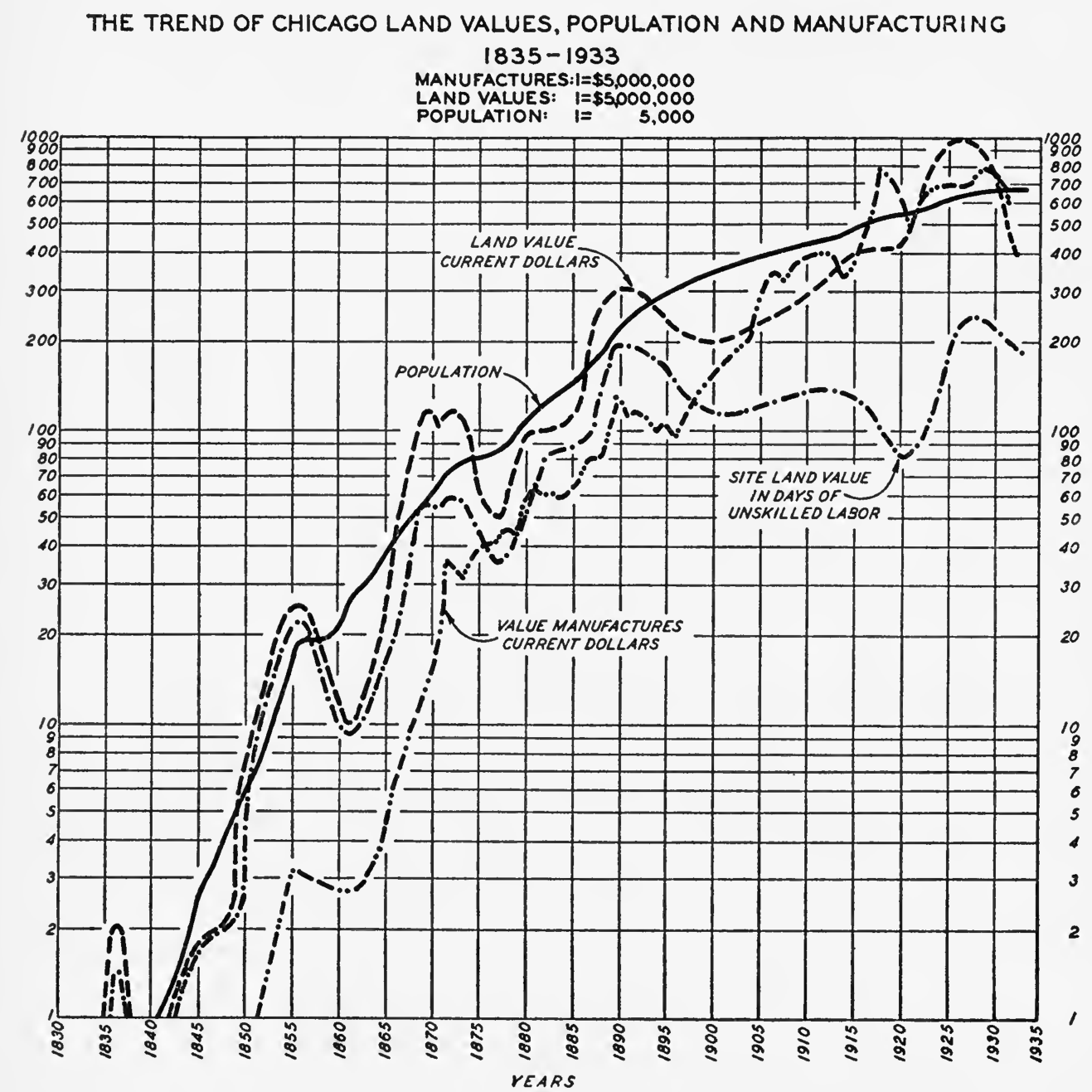
Hoyt's central empirical finding is that Chicago's land-value history divides into a sequence of distinct boom-and-bust episodes rather than smooth growth. Part I of the book is organized into exactly five chapters, one per major boom cycle; Hoyt states plainly that "each of the five chapters in the first part of this work deals" with a distinct cyclical episode (p. 5, in §A, "Introduction: Objectives of the Study" — the phrase "five major real estate cycles" itself appears in the body text at pp. 374 and 391, not as a section heading). His own chapter titles and dates are: I. The Canal Land Boom, 1830–42; II. The Land Boom of the Railroad Era, 1843–62; III. The Land Boom That Followed a Panic, a Civil War, and a Fire [1863–77]; IV. The Land Boom of the First Skyscrapers and the First World's Fair [1878–98]; and V. The Land Boom of a New Era That Followed a World War, 1898–1933.[1] This confirms the five-episode structure secondary sources describe, with Hoyt's own boundary dates.[6][7]
Hoyt's own framing of the underlying mechanism, verified verbatim against the primary text (p. 371, opening the section "Definition of the Chicago Real Estate Cycle"), describes the Chicago real estate cycle as "the composite effect of the cyclical movements of a series of forces that are to a certain degree independent and yet which communicate impulses to each other in a time sequence, so that when the initial or primary factor appears it tends to set the others in motion in a definite order."[1] He then traces an explicitly numbered sequence of twenty steps (pp. 373–403), running from step 1 ("The initial impulse — a sudden spurt in population growth") through rising gross and net rents (steps 1–2), rising prices of existing buildings (step 3), new construction and easy credit (steps 4–6), the land boom as new buildings absorb vacant land (step 8), speculative subdivision (steps 9–10), the peak (step 12), the lull and rising foreclosures (steps 13–14), the stock-market debacle and depression (step 15), banks reversing loan policy (step 17), stagnation and foreclosures (step 18), the wreckage being cleared (step 19), and finally step 20, tellingly titled "Ready for another boom which does not come automatically."[1] This is a Type B (empirical) / Type A (historical) claim: Hoyt is describing an observed sequence in one city's data, not proving a general law of land markets. Hoyt's own text confirms the widely cited peak-year list: on p. 391 he writes that the subdivision boom "has occurred at the most hectic phase of all the five major real estate cycles in Chicago... In 1836, in 1856, in 1872, in 1890, and in 1925 the same story was repeated with some variations."[1] (Hoyt uses these exact years for the subdivision/land-boom peaks; for some individual series he dates peaks to adjacent years — e.g. 1873 rather than 1872, and 1892–1893 for the World's Fair boom — so the canonical "1836, 1856, 1872, 1890, 1925" is Hoyt's own but is a rounded summary of series that peak within a year or two of those dates.)[8]
The book's methodological contribution — separate from the periodicity finding — was its scale and rigor for the time: Hoyt assembled comparative data on population density, ethnic settlement patterns, transportation networks, construction activity, employment, mortgage rates, and property sales across comparable American cities. The "103 maps and 103 tables" figure is confirmed against the primary text: the highest-numbered figure/map in the book is Fig. 103 and the highest-numbered table is Table CIII (103), so the book contains 103 figures (maps and charts) and 103 tables.[1] A 1934 scholarly review of the book is recorded in bibliographic listings (sources 2 and 9), reflecting its early professional reception; the review's full text has not been consulted here, so no characterization of its verdict is asserted, and the venue attribution in those listings remains unconfirmed.
From the Text (verbatim, Chapter VII: The Chicago Real Estate Cycle)
The full 1933 first edition is now mirrored in this repository at sources/publicdomain/hoyt-100-years-chicago-land-values.md (public domain; raw Internet Archive OCR, mechanically cleaned — see that file's provenance). The passages below are the primary-source basis of the wiki's land-cycle account, pinned to the page numbers shown in the scan's running heads and checked verbatim against the page images during ingest (2026-07-11). Chapter VII is the "long-cycle" summary chapter the 18-year-cycle literature draws on; it distils the five booms narrated separately in Part I (chapters I–V).
1. Definition of the cycle (Ch. VII §B, p. 371). Hoyt's own definition of the mechanism — a chain of semi-independent forces firing in sequence:
The Chicago real estate cycle is a term used here to describe the composite effect of the cyclical movements of a series of forces that are to a certain degree independent and yet which communicate impulses to each other in a time sequence, so that when the initial or primary factor appears it tends to set the others in motion in a definite order.
2. The five great cycles as "tidal waves" (Ch. VII §B, p. 372). Hoyt's summary of what the five booms had in common — the single most-quoted description of the recurring pattern:
[T]he five major cycles of Chicago real estate, which were like tidal waves in magnitude, have registered their effect in striking fashion. All five movements, Figure 90 shows, were characterized on their upswing by rapid increases in population, feverish building operations, and a hectic land boom in which land values increased from twofold to tenfold in a few years and on their downswing by widespread declines in rents and foreclosures on a large scale which reduced land values 50 per cent or more from the peak levels and which brought building operations almost to a standstill.
3. The peak years of the subdivision boom (Ch. VII §D, step 10, p. 391). The canonical peak-year list, in Hoyt's own words:
Such is the nature of the subdivision boom which has occurred at the most hectic phase of all the five major real estate cycles in Chicago, as Figure 94 on page 389 indicates. In 1836, in 1856, in 1872, in 1890, and in 1925 the same story was repeated with some variations in the mode of transportation to the subdivision and of communication with the prospect but with little change in the nature of the sales arguments.
4. The last of the twenty steps: no automatic recurrence (Ch. VII §D, step 20, p. 403). The sequence of events (steps 1–20) runs from p. 373 to p. 403, and Hoyt closes it by explicitly denying that the cycle is self-perpetuating:
20. Ready for another boom which does not come automatically.—From this account it might be inferred that the real estate cycle automatically repeats itself. Such is by no means the case.... the recurrence of land booms in Chicago in the future will depend on the expansion of industrial opportunities which attract a sudden accession of population.
5. No fixed period between booms (Ch. VII §G.2, p. 417). The passage that most directly undercuts any reading of Hoyt as claiming a fixed ~18-year cycle:
The exceptional speculative movements in land, commodities, and stocks are separated by long intervals of time, and there is no definite period of years between one boom and the next. Chicago land booms have occurred less frequently since 1873 than before, until thirty-five years elapsed from the hectic land market of 1890 to that of 1925.
(Immediately above this, on the same page, Hoyt notes there had been "only five land booms in Chicago" between 1830 and 1933. The earlier hint of periodicity the cycle literature seized on is at p. 219, not p. 217 (see the correction below): "Although seventeen years had passed since the peak of 1890, there was no general boom in 1907, as there has been at seventeen-year intervals prior to 1890." Hoyt raises the ~17-year interval only to record that it broke.)
Bonus — Hoyt's own forecast that the cycle would fade (Ch. VII §H, "Real Estate Cycles May Be a Passing Phase," p. 423). The 1933 book anticipates its own obsolescence, the seed of Hoyt's later (1968) disavowal:
[I]f rapid rises or declines in land values become of rare occurrence in older or more stable societies, the sequence of events just described may in the future be of interest only to historians delving in the habits and customs of "early machine age culture in the United States," and the knowledge of the mode of behavior of forces in the real estate cycle will have no value in forecasting the trend of future events.... one must live long and be gifted with extraordinary patience to wait for an opportunity that knocks on the door not oftener than once every twenty or thirty years.
What the Primary Text Confirms
The substantive claims on this page have been checked against the 1933 first edition, page image by page image. Confirmed: the cycle definition (p. 371); the peak-year list 1836/1856/1872/1890/1925 in Hoyt's words (p. 391); "no definite period of years between one boom and the next" (p. 417); "only five land booms in Chicago" 1830–1933 (p. 417); the five-chapter Part I structure and boundary dates (TOC/pp. 3–232); the 103-figure/103-table scale (highest is Fig. 103 and Table CIII); the headline figures of 211 square miles and land value rising to "five billion dollars" (p. 3); the "each of the five chapters in the first part of this work deals with a complete cycle" statement (p. 5); the twenty-step sequence (present in full, pp. 373–403); Table LXVII giving average phase intervals within a cycle, not a fixed period between booms (p. 409/410); and the racial/nationality ranking (pp. 314–316).
Five page-level details are worth recording for readers checking the citations above against the scan:
- The twenty-step sequence runs pp. 373–403, with step 20 ("Ready for another boom which does not come automatically") on p. 403. Page 391 carries the subdivision peak-year passage (quote 3 above), not step 20.
- The "seventeen-year intervals prior to 1890" / "no general boom in 1907" remark is on p. 219 (running head "A NEW ERA THAT FOLLOWED A WORLD WAR 219").
- No section headed "The Five Major Real Estate Cycles of Chicago" exists. The p. 5 statement about the five cycles sits inside §A, "Introduction: Objectives of the Study," and the phrase "five major real estate cycles" appears only in body text (pp. 374, 391).
- "behavior," not "behaviour." Hoyt's passing-phase line uses the American spelling (p. 423).
- The 1930 population figure. The Internet Archive scan's machine transcription renders it as "3,376,436" (p. 3, fn. 1); the correct 1930 census count, and the figure used on this page and elsewhere, is 3,376,438.
Relation to the Georgist Case
Hoyt's book is a historical-empirical source for the premise that land markets exhibit a recurring speculative boom-bust cycle — the phenomenon the Georgist land-cycle tradition, from the economist Fred Foldvary to practitioner cycle writers such as Fred Harrison, Phillip Anderson and Akhil Patel, built on, and that the wiki's 18-Year Land Cycle concept describes.[4] It documents that land values in one major American city rose and fell in a repeating rhythm over a century, consistent with Henry George's claim in Progress and Poverty that speculative land-value expectations, not smooth economic growth, drive the timing of depressions.
It is important to be precise about what this book does not do. Hoyt's dissertation contains no discussion of land value taxation, no policy analysis, and no comparison of speculation under taxed versus untaxed land regimes. It is not itself evidence that a land value tax would dampen the cycle it documents — that is a separate theoretical claim (argued on this wiki's LVT dampens land speculation outcome page) that later writers, not Hoyt, layered onto his data. The book's real evidentiary contribution to the Georgist case is establishing that the speculative land cycle is a real, long-run, empirically documented historical pattern — the premise the LVT "dampens speculation" argument needs in order to have a cycle to dampen — rather than direct evidence of LVT's effect on that cycle. Readers and editors should treat this distinction carefully: Hoyt is best read as supporting the 18-Year Land Cycle concept and the land-speculation-drives-cycles mechanism, with only an indirect, premise-level bearing on the LVT-dampens-speculation outcome claim.
Nuances and Limits
- Single-city, pre-modern-econometrics study. Hoyt's data and methods reflect 1930s social-science practice: descriptive statistics, maps, and narrative synthesis rather than the regression-based causal-inference methods used in modern urban and public economics. The findings are a rich historical case study of one city, not a cross-city or cross-country panel that could isolate land speculation from other drivers of Chicago's growth (railroads, immigration, the Fire, two world fairs, national business cycles).
- No LVT variation to test. Chicago in this period did not have a land value tax regime distinct from ordinary property taxation, so the book cannot and does not speak to how a taxed-land counterfactual would have altered the cycle's amplitude or timing — a limitation that travels with any citation of Hoyt for the LVT-dampens-speculation claim.
- Hoyt explicitly denies a fixed period — the "18-year" cycle is a later reading, not his claim (verified against the primary text). This is the single most important correction from a direct read of the book. Hoyt documents five recurring but irregular booms and is explicit that they are not evenly spaced. On p. 417 he writes: "The exceptional speculative movements in land, commodities, and stocks are separated by long intervals of time, and there is no definite period of years between one boom and the next. Chicago land booms have occurred less frequently since 1873 than before, until thirty-five years elapsed from the hectic land market of 1890 to that of 1925."[1] Earlier (p. 219) he notes booms had recurred "at seventeen-year intervals prior to 1890," but stresses that this pattern then broke: "Although seventeen years had passed since the peak of 1890, there was no general boom in 1907."[1] The final step of his twenty-step cycle sequence is titled "Ready for another boom which does not come automatically" (p. 403).[1] Hoyt's Table LXVII gives average time intervals only for the phases within a cycle (rise-to-peak, peak-to-bottom), not a fixed period between successive booms.[1] The crisp ~18 (or 18.6)-year figure was extracted and popularised chiefly by later writers (Roy Wenzlick, Harrison, Foldvary, Anderson, Patel); the wiki's own Progress and the 18.6-Year Cycle page notes this periodicity claim has not been confirmed by peer-reviewed econometric testing and remains contested. Hoyt's own text does not support a fixed ~18-year period and should not be cited as if it did.
- Hoyt later disavowed the cycle's continued operation entirely — and the cycle literature is built against that disavowal. The 1933 book itself anticipates its own obsolescence: Hoyt writes the events described "may in the future be of interest only to historians… and the knowledge of the mode of behavior of forces in the real estate cycle will have no value in forecasting the trend of future events."[1] Thirty-five years later he concluded "his prescience was warranted": "The fluctuations in the real estate cycle which characterised our economy in the 150 years prior to 1933, have ceased" (Hoyt, ULI Technical Bulletin No. 60, 1968, p. 11, as quoted by Harrison). He reaffirmed the disavowal in correspondence with Fred Harrison in 1976 and in a 1978 interview at his Washington home, aged 83.[10] Harrison's chapter "The Hoyt Heist" (The Power in the Land, 1983) is precisely a rebuttal of Hoyt's disavowal — Harrison collates appraiser interviews and post-war data to argue the cycle continued despite its discoverer's denial.[10] So the honest sequence is: Hoyt documented recurring but irregular booms (1933), denied a fixed period (1933, p. 417), predicted and later affirmed the pattern's demise (1968–78); the persistence of an ~18-year rhythm is the claim of Harrison, Anderson, and successors, maintained contra late Hoyt.
- Hoyt was not a Georgist and later work is in tension with land-value-capture-friendly planning. As FHA principal housing economist from 1934, Hoyt's sector model of urban land use is documented by later urban historians as having contributed to racially discriminatory mortgage underwriting practices (redlining) in FHA appraisal guidance — a biographical fact that has no bearing on the accuracy of his 1933 Chicago land-value data, but is worth noting for readers assessing the source's overall context and should not be elided. Notably, this dissertation itself contains an explicit ranking of "races and nationalities with respect to their beneficial effect upon land values" (pp. 314–316), placing "English, Germans, Scotch, Irish, Scandinavians" first and "Negroes" and "Mexicans" last — the same land-value-succession thinking Hoyt later carried into FHA appraisal doctrine.[1] The wiki's dedicated Homer Hoyt page documents this in full.
- Notable citation history. Fred Harrison's essay "The Hoyt Heist" discusses Hoyt's data and its use (and, per the title, alleged mis-appropriation or under-credited use) within the real-estate-cycle literature; this wiki's narrative on land-speculation cycles already cites this essay for context on how Hoyt's findings have been used by later writers.[10]
Bears On
- Outcome: LVT dampens land speculation — indirectly: Hoyt documents the speculative land-value cycle this outcome claims LVT would dampen, but the book itself contains no test of LVT's effect and should not be cited as if it directly measured that effect.
- Concept: 18-Year Land Cycle — Hoyt's study is the founding empirical source for this concept's Chicago data and its ~18-year framing.
- Research: Progress and the 18.6-Year Cycle — a later popular restatement of the same lineage that cites Hoyt's peak-year list directly; this page is the primary-source record behind that citation.
- Narrative: Land Speculation Causes Boom and Bust — uses Hoyt's data as the founding historical example in its "Historical Examples" section.
- Person: Fred Harrison — built his popularisation of the 18-year cycle explicitly on Hoyt's Chicago data.
See Also
- Lewis (1965): Building Cycles and Britain's Growth — the British counterpart to Hoyt's Chicago study, cited by Harrison for a 17.4-year average cycle duration
- Chicago
- Gaffney's Georgist City-Growth Case Studies — a companion 1890s Chicago political-history workpaper (Altgeld, the 1894 Bureau of Labor Statistics land-concentration study) this page does not otherwise document
- 18-Year Land Cycle
- Progress and the 18.6-Year Cycle
- Narrative: Land Speculation Causes Boom and Bust
- Fred Harrison
- LVT dampens land speculation
- Progress and Poverty
Sources
- Homer Hoyt, One Hundred Years of Land Values in Chicago: The Relationship of the Growth of Chicago to the Rise in Its Land Values, 1830–1933, University of Chicago Press, 1933. Full text (Internet Archive) — the primary source for this page; used throughout. A mechanically-cleaned full-text mirror of the 1933 first edition is now held in this repository at
sources/publicdomain/hoyt-100-years-chicago-land-values.md(public domain — 1933 copyright not renewed; see EDITORIAL §3b and the "From the Text" section above for pinned verbatim passages). - "One Hundred Years of Land Values in Chicago...," review notice, Journal of American History 21(1), 1934, p. 108. Oxford Academic abstract — used for publication details (pagination, price) and confirmation the book was reviewed as a serious scholarly work on release.
- Internet Archive item metadata for
onehundredyearso00hoytrich— used for author dates, page count, and bibliography location. - Fred Harrison, Boom Bust: House Prices, Banking and the Depression of 2010, Shepheard-Walwyn, 2005 — Publisher — used for Harrison's use of Hoyt's Chicago data to build the modern 18-year cycle forecasting tradition, per the wiki's existing 18-Year Land Cycle page.
- American Planning Association, Economic Development Division, "Dr. Homer Hoyt: Planning's Unsung Hero," 2009. Blog post; see also Homer Hoyt biographical summaries via Wikipedia and SAGE's Encyclopedia of American Urban History — used for Hoyt's career at the FHA and his later sector-model work.
- Beard Books, excerpt/description page for One Hundred Years of Land Values in Chicago. Beard Books — used for the book's period-by-period growth narrative and headline growth statistics (log-hut settlement to 211 square miles / 3.5 million population / $5 billion land value).
- Beard Books excerpt (same as above) — used as a secondary pointer to Hoyt's description of real-estate cycles. The "composite effect of the cyclical movements of a series of forces..." quotation has now been verified verbatim against the primary text (Internet Archive full text, p. 371) and is quoted directly from Hoyt in Source 1.
- Progress.org, "The 18-Year Pattern Predicting 2027's Market Crash" — cited via this wiki's Progress and the 18.6-Year Cycle page — as the popular restatement of the Chicago peak-year list (1836, 1856, 1872, 1890, 1925). That list has now been confirmed against Hoyt's own primary text (p. 391; see Source 1), so it is no longer flagged as unverified here; note, however, that Hoyt presents these as irregular booms, not a fixed-period cycle (p. 417).
- The book's scope and methodology (103 maps/figures, 103 tables; comparative city data on population, transportation, construction, and mortgages) — now confirmed directly against the Internet Archive full text (highest figure = Fig. 103; highest table = Table CIII); see Source 1.
- Fred Harrison, "The Hoyt Heist," ch. of The Power in the Land (1983), reprint. cooperative-individualism.org — read in full (2026-07-09); used for Hoyt's later disavowal of the cycle, verified verbatim: "The fluctuations in the real estate cycle which characterised our economy in the 150 years prior to 1933, have ceased" (Hoyt, ULI Technical Bulletin No. 60, 1968, p. 11, per Harrison's footnote 2), reaffirmed "in correspondence with the present author in 1976, and also when interviewed at his home in Washington at the age of 83 in 1978"; and for Harrison's rebuttal programme ("Three sorts of evidence have been collated to show that Hoyt is wrong"). Also cited on the land-speculation-causes-cycles narrative page.
Copyright / public-domain note (2026-07-11): A US copyright-renewal check confirms this 1933 book is in the public domain*. No renewal registration for Homer Hoyt or for the title "One Hundred Years of Land Values in Chicago" appears in the Catalog of Copyright Entries book-renewal records for 1959–1962 — the full valid renewal window for a 1933 work (searched the machine-readable CCE renewal transcriptions, Project Gutenberg ebooks
11819–#11826). Under the 1909 Act a work whose 28-year term lapsed without a renewal filed
in its 28th year fell into the public domain; for a 1933 publication that occurred in 1961. This is corroborated by the Internet Archive, which hosts the full scan onehundredyearso00hoytrich openly — a direct full-text download, not controlled-digital-lending — in its americana/prelinger_library collections, with item metadata flagging possible-copyright-status: NOT_IN_COPYRIGHT. (Stanford's Copyright Renewal Database and HathiTrust's catalogue were not accessible at last review, so the verdict rests on the primary CCE renewal records plus IA's open hosting, which is the stronger evidence in any case.) The book being PD, it would be eligible for full mirroring to sources/publicdomain/; it is deferred only for its length (xxxii + 519 pp.), not for any rights reason.*
Verification note (2026-07): The key empirical claims on this page have been checked directly against the Internet Archive full text (DJVU OCR) of Hoyt's 1933 book. Confirmed against the primary source: the "composite effect... communicate impulses to each other in a time sequence" quotation (p. 371); the twenty-step numbered cycle sequence (pp. 373–403); the peak-year list 1836, 1856, 1872, 1890, 1925 in Hoyt's own words (p. 391); the five-chapter period structure and boundary dates (Part I, pp. 3–232); the 103-figure/103-table scale (Fig. 103, Table CIII); and the headline figures of 211 square miles, a 1930 population of 3,376,438 (~3.5 million), and land value rising to roughly five billion dollars (pp. 3–5, 483). Most importantly, Hoyt explicitly denies a fixed period between booms — "there is no definite period of years between one boom and the next" (p. 417) — so this page and the 18-Year Land Cycle framing must treat the "~18-year" periodicity as a later interpretive gloss, not Hoyt's own claim.