Garden Cities of To-morrow
Howard's 1902 manifesto proposing Garden Cities—new towns combining town and country advantages on communally-owned land, financed by land-value capture. A foundational text in urban planning and the Garden City movement. PUBLIC DOMAIN (pre-1929).
Summary
Garden Cities of To-morrow is a book by Ebenezer Howard (1850–1928), first published in 1898 as To-morrow: A Peaceful Path to Real Reform and reissued under this title in 1902 by Swan Sonnenschein & Co., London. The book is the foundational text of the Garden City movement and a landmark in urban planning history. It is in the public domain (pre-1929).
Howard's central thesis is that the migration of people from countryside to overcrowded cities is driven by the relative "magnetic" attraction of town life (higher wages, social opportunity) versus country life (nature, health), and that a new "Town-Country" combination could capture the advantages of both while eliminating the drawbacks of each. He proposes the construction of planned Garden Cities on communally-owned land, where the increase in land value generated by the community would be captured for public revenue rather than private speculation (Howard 1902, Introduction, Ch. I–II).
Core Findings
The Three Magnets (Introduction, Ch. I)
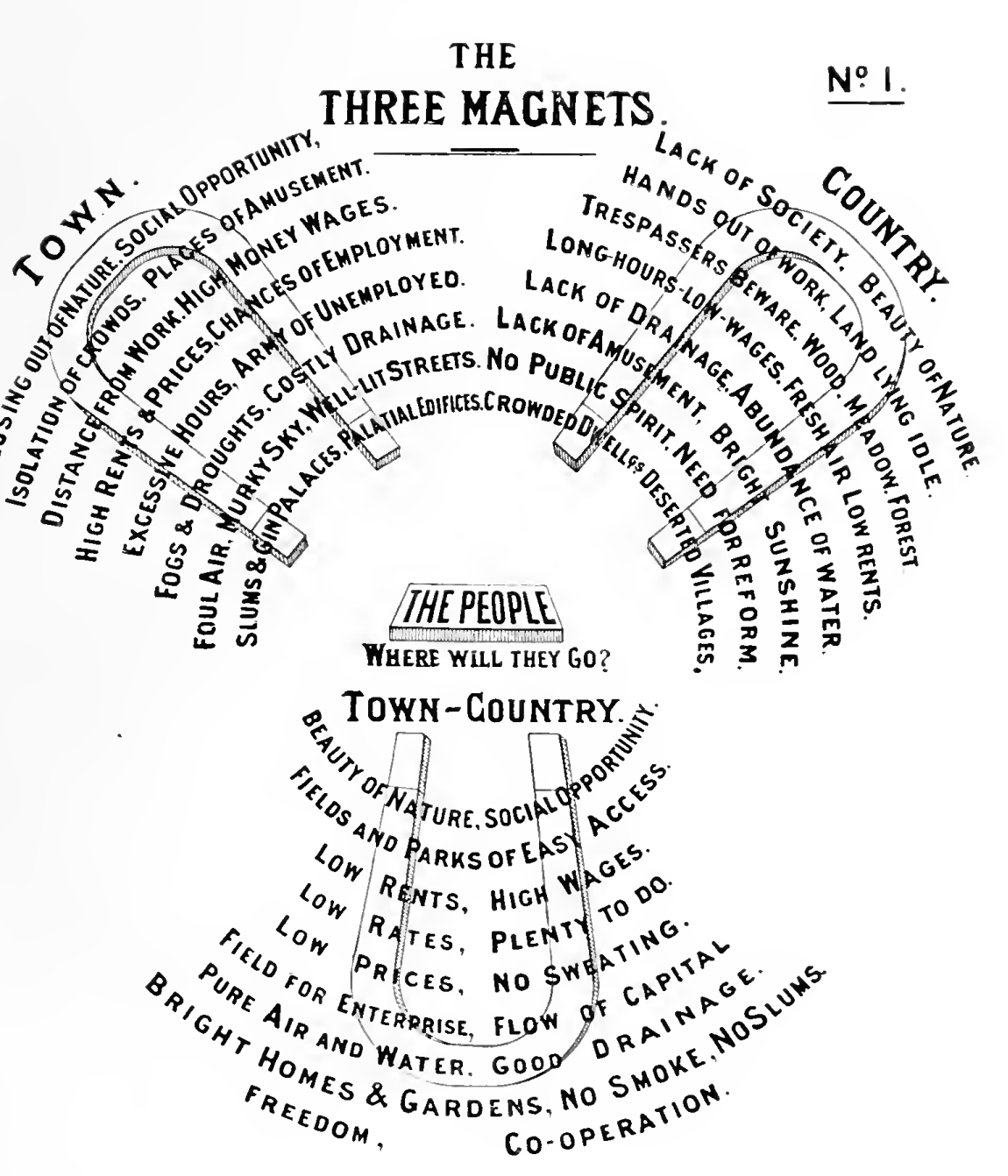
Howard frames the urban-rural problem using a "Three Magnets" diagram: the Town magnet (high wages, social opportunity, but slums, high rents, poor air), the Country magnet (nature, health, low rents, but low wages, isolation, lack of amusements), and the proposed Town-Country magnet (combining the advantages of both). He argues that the migration to cities is not inevitable but results from the absence of a third alternative offering both economic opportunity and natural beauty (Howard 1902, Introduction, pp. 9–19).
Communal Land Ownership and Revenue (Ch. II–IV)
Howard proposes that Garden City be built on land purchased by a company at agricultural value, with the community retaining ownership. As the town develops and land values rise, the "unearned increment" — the increase in land value created by the community rather than individual effort — would be captured for public revenue. Howard estimates that on a 6,000-acre estate with 30,000 residents, the rate-rent (land rent) could yield approximately £50,000 per annum at the outset, rising as the town prospered (Howard 1902, Ch. I–III, pp. 20–43 — the estate purchase is set out in Ch. I, the rate-rent/unearned-increment mechanism in Ch. II, and the £50,000 revenue table specifically in Ch. III).
Municipal Enterprise and Semi-Municipal Enterprise (Ch. V–VI)
Howard argues that municipal activities — gas, water, tramways, etc. — should be operated by the municipality, and that the surplus from these enterprises, along with the rate-rent, should fund public goods including pensions for the aged, healthcare, and education. He distinguishes between "municipal" (directly operated) and "semi-municipal" (leased to cooperative societies) enterprise (Howard 1902, Ch. V–VI, pp. 38–57).
Social Reform and Temperance (Ch. VII–VIII)
Howard argues that Garden City's model of land ownership and municipal revenue would address root causes of intemperance and poverty. With land values captured for public use, wages could be higher and rents lower, reducing the economic pressures driving social dysfunction (Howard 1902, Ch. VII, pp. 68–76).
A Unique Combination of Proposals (Ch. XI)
Howard emphasizes that no single element of his proposal is novel — communal land ownership, planned towns, municipal enterprise all had precedents — but their combination into a single coherent scheme was unique. He cites the precedent of the London County Council's housing efforts and model villages like Bournville and Port Sunlight (Howard 1902, Ch. XI).
The Path Followed Up / Social Cities (Ch. XII–XIII)
Howard envisions Garden Cities proliferating in a network, with each city of ~30,000 surrounded by an agricultural belt, and groups of cities connected by rapid transit. He proposes a "central city" of ~58,000 with surrounding Garden Cities totalling ~250,000, forming a "Social City" (Howard 1902, Ch. XII–XIII, pp. 126–153).
Policy Recommendations
- Construct new Garden Cities on communally-owned land, ~6,000 acres, ~30,000 population (Ch. II)
- Capture the "rate-rent" (land value) for municipal revenue rather than allowing private speculation (Ch. II–IV)
- Municipalise utilities and services; use surplus revenue for social welfare (Ch. V–VI)
- Use increased licence duties and land-value taxation as revenue sources (Ch. VII)
- Build a network of Garden Cities connected by rapid transit, each surrounded by agricultural belts (Ch. XII–XIII)
Nuances and Limits
- Howard's financial estimates for land-value capture are approximate and based on early 1900s land values; they have not been empirically tested at the scale he envisioned.
- The first Garden City, Letchworth (founded 1903), implemented Howard's principles partially but not fully; Letchworth's land was held by First Garden City Ltd., and the rate-rent mechanism was never fully operationalised as Howard described it. The empirical record is mixed: the utopian social-economic programme eroded within decades, but the community's freehold ownership of the estate did persist and still captures ground rent for the town today — the estate is now held by the Letchworth Garden City Heritage Foundation (constituted by the Letchworth Garden City Heritage Foundation Act 1995), which in 2024 reported roughly £14.4m income "largely derived from commercial and residential rental income" and reinvested about 34p of every £1 of investment income into community services and a £600,000 grants programme.[3] See the Garden City Movement page for the fuller empirical account and the academic assessment.
- Howard does not advocate full land nationalisation; his model preserves private ownership of buildings and improvements while communalising land ownership — a distinction important to Georgist theory but often overlooked in popular accounts.
- The book's optimism about the ease of financing and governing Garden Cities has been questioned by subsequent urban planners.
- Howard's model assumes a relatively homogeneous community; issues of scale, diversity, and political governance at the metropolitan level are underdeveloped.
Key Quotes
"This enormous difference of rental value is, of course, almost entirely due to the presence in the one case and the absence in the other of a large population; and, as it cannot be attributed to the action of any particular individuals, it is frequently spoken of as the 'unearned increment,' i.e., unearned by the landlord, though a more correct term would be 'collectively-earned increment.'" — Ebenezer Howard, Ch. II, The Revenue of Garden City
"The entire increment of value gradually created becomes the property of the municipality, with the effect that though rents may rise, and even rise considerably, such rise in rent will not become the property of private individuals, but will be applied in relief of rates." — Ebenezer Howard, Ch. II, The Revenue of Garden City
"One essential feature of the plan is that all ground rents, which are to be based upon the annual value of the land, shall be paid to the trustees, who, after providing for interest and sinking fund, will hand the balance to the Central Council of the new municipality, to be employed by such Council in the creation and maintenance of all necessary public works—roads, schools, parks, etc." — Ebenezer Howard, Ch. I, The Town-Country Magnet
"The key to the problem how to restore the people to the land—that beautiful land of ours, with its canopy of sky, the air that blows upon it, the sun that warms it, the rain and dew that moisten it—the very embodiment of Divine love for man is indeed a Master-Key." — Ebenezer Howard, Introduction
"It is this arrangement which will be seen to give Garden City much of its magnetic power. The site of Garden City we have taken to be worth at the time of its purchase £40 an acre, or £240,000." — Ebenezer Howard, Ch. II, The Revenue of Garden City
"The term 'rent' has, in Garden City, acquired a new meaning. That part of the rent which represents interest on debentures will be hereafter called 'landlord's rent'; that part which represents repayment of purchase-money 'sinking fund'; that part which is devoted to public purposes 'rates'; while the total sum will be termed 'rate-rent.'" — Ebenezer Howard, Ch. II, The Revenue of Garden City
"Under this system, while it would be impossible for the tenant to secure to himself any undue share of that natural increment of land-value which would be brought about by the general growth in well-being of the town, he would yet have, as all tenants in possession probably should have, a preference over any new-comer." — Ebenezer Howard, Ch. II, The Agricultural Estate
"The increased rents which follow from this form of competition are common or municipal property, and by far the larger part of them are expended in permanent improvements." — Ebenezer Howard, Ch. I, The Town-Country Magnet
Bears On
- Land Value Tax — Howard's rate-rent proposal is a form of LVT applied at the municipal level
- Land Speculation — Howard's model explicitly seeks to prevent land speculation through communal ownership
- Citizen's Dividend — the surplus revenue from rate-rent funding social welfare echoes the citizen's dividend concept
- Georgism — Howard was influenced by Henry George; the land-value capture mechanism is Georgist in inspiration
- Ebenezer Howard — author page
See Also
Sources
- Ebenezer Howard, Garden Cities of To-morrow (London: Swan Sonnenschein & Co., 1902). — used for all claims on this page (primary source); verified against primary text 2026-07-07 (Scan Depth: Moderate). PUBLIC DOMAIN (pre-1929). Complete text held in this repository:
sources/publicdomain/garden-cities-of-to-morrow.md(transcribed from Project Gutenberg #46134, fetched 2026-07-11; Gutenberg boilerplate stripped top and bottom, no modernization — see EDITORIAL §3b). - Robert Fishman, Urban Utopias in the Twentieth Century: Ebenezer Howard, Frank Lloyd Wright, and Le Corbusier (New York: Basic Books, 1977) — used for contextual analysis of Howard's Garden City model (B-claim; secondary).
- Letchworth Garden City Heritage Foundation, Report & Accounts to 31 December 2024 letchworth.com (PDF) and "About Us" letchworth.com; with the North Hertfordshire District Council Local Plan examination statement (Matter 8) north-herts.gov.uk (PDF) — used for empirical data on the first implementation: the Foundation owns the freehold of the Letchworth estate as successor to First Garden City Ltd and the Letchworth Garden City Corporation under the Letchworth Garden City Heritage Foundation Act 1995, is a Community Benefit Society reinvesting surplus from its property portfolio into the community, and in 2024 reported £14.4m income (largely commercial and residential rent), ~£4m of charitable spend, a £600,000 grants programme, and community reinvestment of "up to 34p" per £1 of investment income (verified against the report; figures quoted on the Garden City Movement page). For scholarly assessment of the model's partial erosion, see Katie O'Sullivan, "Letchworth: The First Garden City's Economic Function Transcribed From Theory to Practice," Berkeley Planning Journal 28 (2017). DOI