Is There a Bubble in the Housing Market?
Case and Shiller's 2003 Brookings paper surveys homebuyers in four US cities and finds ten-year price-appreciation expectations of 12–16% a year — direct survey evidence that speculative expectations, not just fundamentals, were driving the housing boom that crashed in 2007–2008.
Summary
"Is There a Bubble in the Housing Market?" is a paper by Karl E. Case (Wellesley College) and Robert J. Shiller (Yale University), published in Brookings Papers on Economic Activity, vol. 2003, no. 2, pp. 299–362, with comments and discussion by Christopher Mayer and other panelists.[1] Brookings Papers on Economic Activity is a leading, peer-refereed venue for policy-relevant macroeconomics, and Case and Shiller are the co-creators of the Case-Shiller Home Price Indices, the standard repeat-sales measure of US house prices — giving the paper's empirical methodology unusual authority in this literature. The paper carries additional retrospective weight because it was written well before the 2007–2008 housing crash, and its central finding — that homebuyers in "glamour" markets held ten-year price-appreciation expectations far in excess of anything justified by income or rental fundamentals — is now widely read as an early, data-based documentation of the bubble psychology that preceded that crash, though the authors themselves stopped short of forecasting a national collapse.[2]
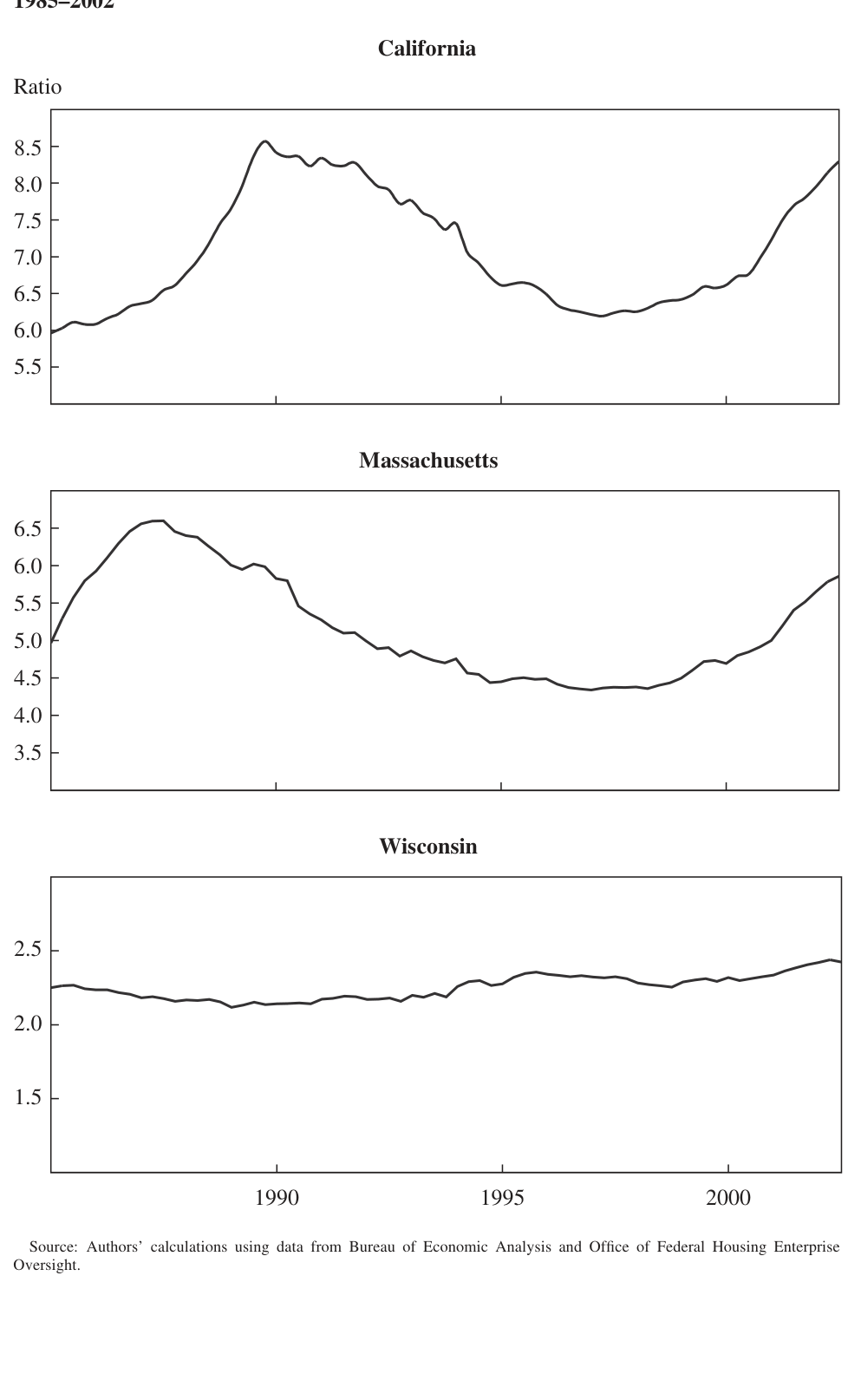
The paper combines two distinct pieces of evidence: a state-level statistical analysis of house prices against economic "fundamentals" (income, employment, interest rates, construction costs) for 1985–2002, and a questionnaire survey of homebuyers conducted in 2003 in four US metropolitan areas, replicating a similar survey the authors had conducted in 1988 during an earlier housing boom that subsequently went bust in several of those cities.[1] For this wiki, the survey evidence is the paper's most directly relevant contribution: it is a rare instance of economists asking buyers, at the moment of a real transaction, what they expected land and housing prices to do — providing direct evidence on the speculative-expectations mechanism that Georgist land-cycle theory identifies as the driver of land-price booms and busts.
The Core Argument and Findings
Case and Shiller define a housing bubble as a situation "in which excessive public expectations of future price increases cause prices to be temporarily elevated," in which buyers accept prices they would otherwise consider too high because they expect future appreciation to compensate them, and in which the anticipation of large, low-risk gains — not current fundamentals — sustains demand.[1] This is a Type D (interpretive) definitional framing that the authors then operationalize empirically — they do not merely assert a bubble exists; they test for its behavioral signature directly.
The fundamentals analysis. Using state-level data spanning 71 quarters (1985–2002), Case and Shiller found that income growth alone explains most of the pattern of home-price increases across most US states, and that falling interest rates explain much of the national run-up and part of the cross-state variation (via differing supply elasticities). Only in a small number of large, high-profile states did prices diverge sharply from what income and interest-rate fundamentals would predict.[1] This is an important qualifier: the paper does not claim the entire national housing market was a bubble — it explicitly attributes most of the price increase nationally to genuine fundamentals, and confines the strongest bubble evidence to a subset of "glamour" markets.
The survey evidence. The authors surveyed recent homebuyers (people who had purchased homes in 2002) in Los Angeles, San Francisco, Boston, and Milwaukee in 2003, replicating a 1988 survey of buyers in the same four cities. Milwaukee served as a comparison city not reputed to have experienced a speculative bubble.[1] Key findings, reported with precise figures:
- Near-universal expectation of further price increases. In both 1988 and 2003, roughly 90% or more of respondents in each city expected home prices to increase over "the next several years" (e.g., 89.7% in Los Angeles and 90.5% in San Francisco in 2003).[1]
- Extraordinarily high ten-year expectations. Asked what average annual rate of price increase they expected over the next ten years, 2003 respondents answered: Los Angeles, 13.1%; San Francisco, 15.7%; Boston, 14.6%; Milwaukee, 11.7% — figures the authors note imply, at the low end, a tripling of a home's value in ten years.[1] These ten-year expectations were, in three of the four cities, higher in 2003 than they had been during the acknowledged 1988 bubble, even though one-year expectations were somewhat lower.
- Median vs. mean gap. Median ten-year expectations were substantially lower than the means (8% in Los Angeles, 7% in San Francisco, 5% in Boston, 5% in Milwaukee in 2003), indicating the very high expectations were concentrated among a subset of respondents rather than uniform across the sample.[1]
- Fear of being priced out. Substantial shares of respondents — 48.8% in Los Angeles, 59.7% in San Francisco — agreed with the statement "Housing prices are booming. Unless I buy now, I won't be able to afford a home later," a direct measure of the anxiety-driven urgency the authors identify as a bubble symptom.[1]
- Endorsement of "simplistic theories." Large majorities in the glamour cities (up to roughly 90%) agreed that prices were booming "because lots of people want to live here," and 60–73% agreed that when homes attract multiple offers "there is panic buying and price becomes irrelevant" — responses the authors read as evidence that buyers were, at least partly, confusing high price levels (which can reflect genuine scarcity or desirability) with high price growth rates (which cannot be sustained indefinitely), though a discussant (Martin Baily) later contested this reading as not necessarily indicating confusion, since inelastic local supply can rationally justify both a high level and a fast growth rate together.[3]
- Word-of-mouth and excitement. Close to half of Los Angeles respondents admitted to being influenced by "excitement" about home prices, and 30–50% reported discussing housing market conditions "frequently" with friends — evidence the authors treat as a hallmark of speculative contagion.[1]
- Low perceived risk. Despite intense 2003 media coverage of "bubble" fears (which the authors document via a Lexis-Nexis count of the term's near-zero use before 2002 and its sharp spike that year), most respondents perceived little to no risk that prices could fall — the authors conclude "one may say that homebuyers did not perceive themselves to be in a bubble," even in cities the authors judged were most bubble-prone.[1]
Relation to the Georgist Case
This paper is directly relevant, primary survey evidence for the speculative-expectations mechanism at the heart of the Georgist land-speculation-and-cycles thesis. Henry George argued in Progress and Poverty that anticipation of future land-value increases — not current use value — drives land speculation and periodically produces economic depressions.[4] Case and Shiller's survey is one of the few empirical studies that asks buyers directly about exactly this anticipatory psychology, and finds it present and quantifiable: buyers were not simply responding to current rental or income fundamentals but were purchasing partly on the strength of extrapolated future appreciation, in some cities at rates several multiples of plausible income growth. This supports the LVT dampens land speculation outcome page's underlying mechanism — that speculative anticipation of price gains, not current-use value, is what an annual land-value carrying cost would need to blunt — by documenting that mechanism operating in real buyer behavior shortly before the actual 2007–2008 crash validated the broader concern.
It is important to state precisely what the paper does not show. Case and Shiller do not test, mention, or model land value taxation anywhere in this paper. It contains no comparison of speculative intensity or price volatility between taxed and untaxed land regimes, no discussion of holding costs as a deterrent to speculation, and no policy recommendation resembling a Georgist land tax. The paper's contribution to the Georgist case is evidentiary, not argumentative: it documents that the anticipatory-expectations mechanism the Georgist theory relies on is real and measurable, not that a land value tax would suppress it. That inferential step — from "speculative expectations exist and move prices" to "an annual land-value carrying cost would dampen this" — is supplied by Georgist economic theory and by other sources on this wiki (e.g., the 18-Year Land Cycle concept and Tomson's Estonia study), not by Case and Shiller themselves.
Nuances and Limits
- The paper is agnostic, not alarmist, about a national crash. The authors explicitly weigh fundamentals-based explanations (income growth, falling interest rates, demographic demand, land-use restrictions) alongside the survey's bubble indicators, and conclude only that "it is reasonable to suppose that... price increases will stall and that prices will even decline in some cities" — a hedged, city-by-city prediction, not a forecast of the scale of collapse that in fact followed in 2007–2008.[1] Reading the paper as a confident prediction of the subsequent crisis overstates its own stated conclusions.
- Discussants challenged the "confusion" interpretation. Discussant Martin Baily argued that agreement with statements like "there is just not enough land available" need not reflect a fallacy conflating price levels with growth rates: in cities with inelastic housing/land supply, rational expectations of continued demand growth can justify both a high price level and a high expected growth rate simultaneously. Alan Blinder and Jeffrey Frankel raised related points about supply elasticity and price-to-rent ratios that the published analysis did not fully incorporate.[3] This is a genuine methodological limitation worth stating plainly: the survey evidence for expectations is solid, but the authors' inference that some of it reflects buyer error is more contested.
- Small, four-city, homebuyer-only sample. The survey covers only recent buyers (not renters, not sellers, not the general population) in four metropolitan areas, chosen partly because three (Los Angeles, San Francisco, Boston) were widely believed to be "glamour" bubble markets and one (Milwaukee) was a comparison case. This is a deliberate design choice for studying bubble psychology where it was thought most likely to appear, not a nationally representative sample — a limitation the authors themselves flag when noting most of the national price increase is explained by fundamentals.
- The paper does not isolate land value from structure value. Like most housing-price research, the survey and the fundamentals regressions treat "home price" as a single bundled quantity; the authors discuss elastic/inelastic land supply and zoning as drivers of cross-city price divergence, but the survey itself asked about "the value of your home," not land value specifically. This paper should not be read as directly measuring land-price expectations in isolation from structure and location value.
- Superseded and extended by later work. Case, Shiller, and Anne Thompson published a follow-on paper, "What Have They Been Thinking? Home Buyer Behavior in Hot and Cold Markets" (NBER Working Paper 18400, 2012), extending the same four-city survey annually from 2003 through the 2008 crash and its aftermath, which allows a fuller before/after test of these expectations against the crash that this 2003 paper alone cannot provide.[5] The 2012 follow-up does not currently have a dedicated page on this wiki.
Bears On
- Outcome: LVT dampens land speculation — supplies direct survey evidence that speculative price-appreciation expectations (the mechanism an LVT carrying cost is theorized to blunt) were real, large, and measurable among actual homebuyers, strengthening the empirical premise behind the outcome's theoretical mechanism, though the paper itself does not test LVT.
- Narrative: Land Speculation Causes Boom and Bust — a natural inbound link: this paper is a rigorous, mainstream (non-Georgist) empirical documentation of the buyer psychology the narrative describes, independent of the contested 18-year periodicity claim.
- Concept: 18-Year Land Cycle — the paper's replication of its 1988 survey in 2003, spanning two booms roughly 15 years apart in the same four cities, is suggestive circumstantial support for a recurring speculative rhythm, though Case and Shiller make no periodicity claim themselves and none should be attributed to them.
- Concept: Speculative Vacancy — the survey's "fear of being priced out" and "panic buying" findings document the buyer-side urgency that complements this concept's holding-side documentation of speculative behavior.
- Research: Progress and Poverty — this paper is modern survey evidence bearing on George's original claim that anticipated future land values, not present income, drive speculative purchasing.
See Also
- Land value taxation dampens land speculation
- Narrative: Land Speculation Causes Boom and Bust
- 18-Year Land Cycle
- Progress and Poverty
- Sustainable Urban Development and Land Value Taxation: The Case of Estonia
- Speculative Vacancy
Sources
- Karl E. Case & Robert J. Shiller, "Is There a Bubble in the Housing Market?," Brookings Papers on Economic Activity, 2003, no. 2, pp. 299–342 (plus comments and discussion, pp. 343–362). Full text (Brookings); also available via Robert Shiller's Yale page — used throughout for the paper's definition of a bubble, the fundamentals analysis, and all survey figures and quotations (verified by direct extraction of the primary-text PDF in this research pass).
- Robert J. Shiller, Irrational Exuberance, 2nd ed., Princeton University Press, 2005 (housing-bubble chapter added), and Royal Swedish Academy of Sciences, "Understanding Asset Prices" (Scientific Background on the 2013 Sveriges Riksbank Prize in Economic Sciences), 14 October 2013, pp. 32, 44. PDF (nobelprize.org) — used for the paper's retrospective reputation: the Nobel committee's survey of Shiller's prize-winning work cites this paper by name among the investor-survey studies through which Shiller "has continued to argue for the importance of social psychology" and "extended his analysis of fads and bubbles to housing markets (Case and Shiller, 1987, 1989, 2003)." As a rough quantitative measure of its standing, the paper records over 1,400 citations in the Semantic Scholar database (retrieved July 2026).
- Christopher Mayer, comment, and general discussion (Martin Baily, Alan Blinder, Jeffrey Frankel, William Brainard, Alan Auerbach, Benjamin Friedman, Christopher Sims), in Case & Shiller (2003), pp. 343–362 (same source as [1]) — used for the discussants' methodological critique of the "confusion" interpretation of survey responses and of the fundamentals regressions.
- Henry George, Progress and Poverty, 1879, Book V. Full text (Project Gutenberg) — used for the original Georgist theory of speculative land-value expectations driving depressions, which this paper's survey evidence bears on.
- Karl E. Case, Robert J. Shiller & Anne Thompson, "What Have They Been Thinking? Home Buyer Behavior in Hot and Cold Markets," NBER Working Paper 18400, 2012. NBER — used to note the existence of a follow-on survey extending this paper's methodology annually through the 2008 crash; not otherwise drawn on for findings in this page.